


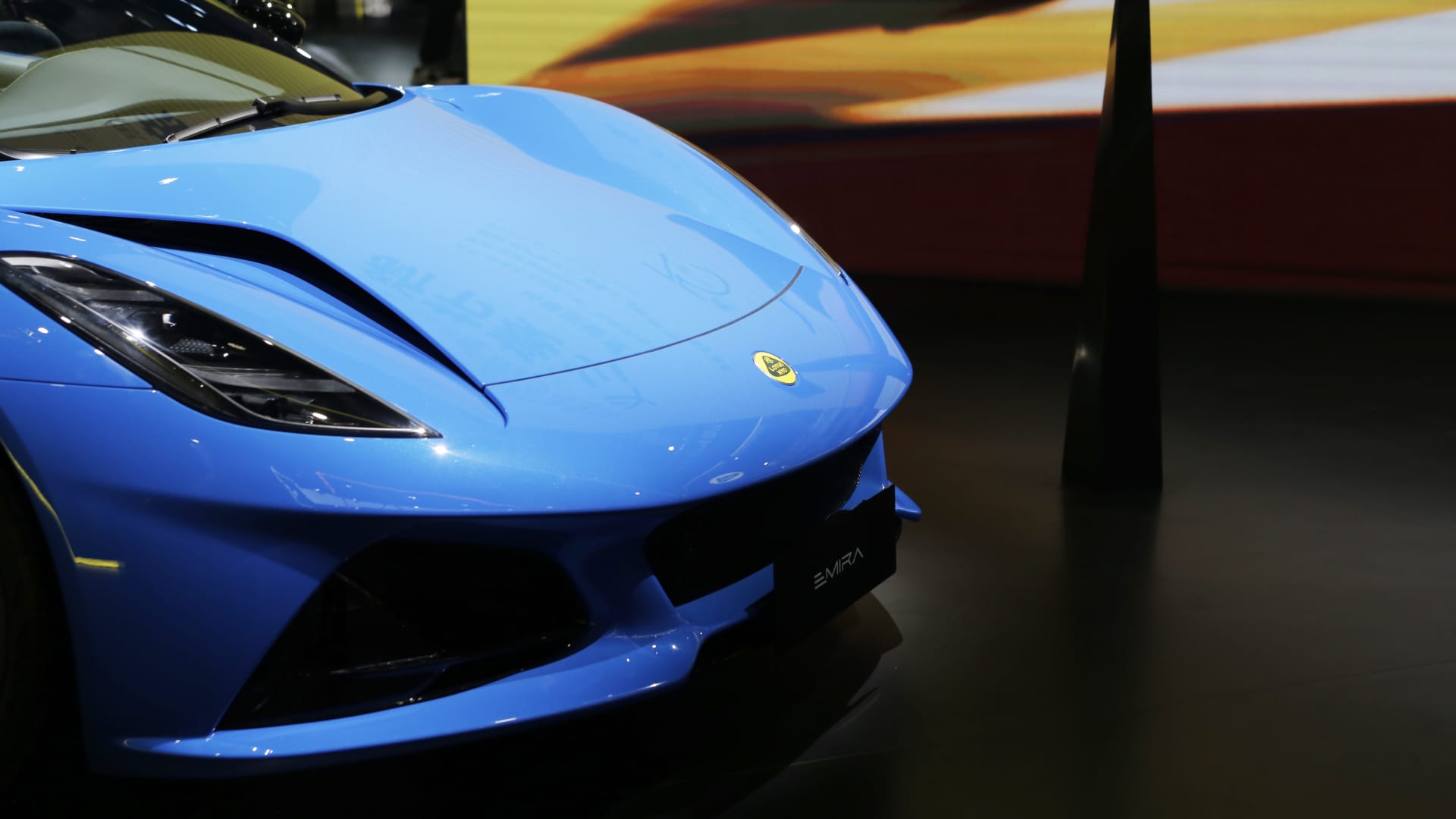
Lotus Emira, a sports car, is on display during the 20th Shanghai International Automobile Industry Exhibition at the National Exhibition and Convention Center (Shanghai) on April 21, 2023 in Shanghai, China.
Vcg | Visual China Group | Getty Images
LONDON — The chief executive of British sports carmaker Lotus poured cold water on the idea that the commercialization of solid-state batteries for electric vehicles is just around the corner.
Solid-state batteries are said to offer significantly higher energy density than conventional lithium-ion batteries, fueling expectations that they could enable the next-generation of EVs.
Sometimes billed as the “holy grail” of sustainable driving, the technology has long been stuck between theory and the promise of commercialization in the next five to 10 years.
Auto giants and cell producers have touted the prospect of rolling out the mass production of solid-state batteries before the end of the decade, although analysts and industry experts maintain a high-degree of skepticism about this promise.
Speaking on the sidelines of the FT’s Future of the Car summit, Lotus CEO Qingfeng Feng told CNBC that there are still a lot of unanswered questions in the race to transform the science of EVs.
“It is not just Lotus who are working on and making efforts on this trend, it is actually Geely that is taking the lead in the development of solid batteries,” Feng said, speaking via a translator.
“Geely has recently established [an] R&D center focusing on solid battery-related technologies [and] has been closely following the trend — and actively developing related technologies,” said Feng, who previously worked as chief technology officer at Geely.
“However, in my personal view, I do believe there is still a long time to go before we could achieve the mass production of such technologies. My take is, say three to five years — or even a decade.”
Headquartered in Norfolk in eastern England, Lotus is controlled by Chinese automotive giant Geely, which also has large investments in Polestar and Volvo Cars, as well as smaller stakes in luxury carmakers Mercedes-Benz and Aston Martin.
‘A problem that hasn’t been fixed yet’
As the name suggests, solid-state batteries contain a solid electrolyte, made from materials such as ceramics. That makes them different from lithium-ion batteries, which contain liquid electrolyte.
Proponents say solid-state batteries offer safer, cheaper and more powerful batteries for EVs, as well as faster charging times.
Critics, meanwhile, have flagged relatively high production costs and the swelling of the battery during charging, as well as the degradation of the cell after extensive charging.
Two solid-state lithium metal cells of different capacity batteries held side by side.
Solid Power
Some carmakers have favored the development of semi-solid-state batteries over solid-state. These cells use a hybrid design of solid electrolyte and liquid electrolyte.
“I still don’t think that the technology has matured to the level to feed for mass productions to provide the consistent, sustainable performances that would be needed in the industry,” Feng said.
“Safety issues have already been resolved. However, the problem here is that when the discharge rate goes up, the battery life goes down and also when the battery life goes up, the discharge rate goes down. This is just a problem that hasn’t been fixed yet.”
