Close Menu

    Subscribe to Updates

    Get the latest creative news from FooBar about art, design and business.

    What's Hot

    SpaceX to acquire the AI coding startup Cursor for $60 billion

    June 16, 2026

    Watch: Defence spending plans fall well short, says Healey

    June 16, 2026

    Yum Brands sells Pizza Hut to LongRange Capital and Yum China

    June 16, 2026
    Facebook X (Twitter) Instagram
    Addison Markets
    • Home
    • USA
    • Europe
    • Business
    • Investing
    • Tech
    • Politics
    • Contact Us
    Addison Markets
    Home»Tech»Iran demands Big Tech pay fees for undersea Internet cables in Strait of Hormuz
    Tech

    Iran demands Big Tech pay fees for undersea Internet cables in Strait of Hormuz

    franperez66q@protonmail.comBy franperez66q@protonmail.comMay 19, 2026No Comments3 Mins Read
    Facebook Twitter Pinterest Telegram LinkedIn Tumblr WhatsApp Email
    Share
    Facebook Twitter LinkedIn Pinterest Telegram Email


    “Operators face a choice: pay protection fees and accept Iranian licensing over Middle East Gulf seabed activity, or accept that future faults may go unrepaired indefinitely,” said Windward, a maritime intelligence company, in a blog post. “A single transoceanic cable system costs between $300 million and $1 billion to deploy. The expected value of an Iranian protection fee, from Tehran’s perspective, is structured to sit well below that.”

    The Strait of Hormuz has already been a no-go region for repair ships since the conflict began early this year—and new cable projects have also been halted. In March, the French state-owned company Alcatel Submarine Networks notified customers that it could not fulfill ongoing contracts due to one of its main cable-laying ships being stranded near Saudi Arabia, according to Bloomberg. That led to the suspension of a Meta-backed undersea cable project aimed at expanding Internet service across Africa.


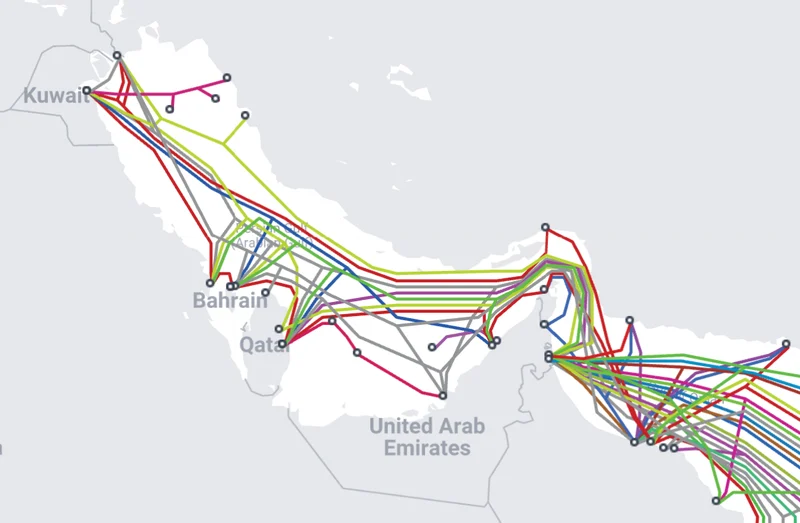
    Multicolored lines show undersea Internet cable routes running through the Strait of Hormuz.

    Multicolored lines show undersea Internet cable routes running through the Strait of Hormuz.


    Credit:

    TeleGeography


    Going by land

    All this has spurred efforts by US tech companies and Gulf countries to develop overland routes for Internet cables that bypass the Strait of Hormuz, according to Rest of World. But the independent projects originated by Saudi Arabia, Qatar, and the United Arab Emirates represent competing efforts rather than regional coordination—and overland cable projects can face their own geopolitical complications with planned routes through countries such as Syria, Iraq, Sudan, and Ethiopia.

    Most major US tech companies involved in the AI data center buildout have bought into a scheme to channel data through fiber-optic cables that run along protected oil and gas pipeline routes, from the southern end of Iraq to the Turkish border and beyond to Europe, the Rest of World reported. Once completed, the overland project by IQ Networks, an Iraqi telecom company, would provide a direct overland fiber link between the Gulf and Europe.

    The need to seek alternative Internet fiber routes comes on top of Big Tech’s other headaches from the war and Strait of Hormuz crisis. As the US and Israel launched airstrikes on Iran in the early weeks of the war, Iran retaliated by attacking shipping near the strait along with targeting a wide range of infrastructure across the Gulf region. Iranian drone attacks on data centers disrupted Amazon Web Services in the region and stuck Amazon with months of repairs while forcing another data center developer to pause Middle East projects.


    Source link

    Share. Facebook Twitter Pinterest LinkedIn Tumblr Email
    franperez66q@protonmail.com
    • Website

    Related Posts

    SpaceX to acquire the AI coding startup Cursor for $60 billion

    June 16, 2026

    Critical Copilot vulnerability allowed hackers to seal 2FA code from users

    June 16, 2026

    Commodore’s newest gadget is a flip phone that blocks social media and browsers

    June 16, 2026

    Who is Gwynne Shotwell, Elon Musk’s second-in-command at SpaceX?

    June 16, 2026

    SpaceX gains 9% in premarket trading as momentum builds

    June 16, 2026

    Qualcomm working on 40 new AI device designs

    June 16, 2026
    Leave A Reply Cancel Reply

    Top Reviews
    Editors Picks

    SpaceX to acquire the AI coding startup Cursor for $60 billion

    June 16, 2026

    Watch: Defence spending plans fall well short, says Healey

    June 16, 2026

    Yum Brands sells Pizza Hut to LongRange Capital and Yum China

    June 16, 2026

    Yum Brands to sell Pizza Hut for $2.7 billion

    June 16, 2026
    © 2026 All right reserved
    • Privacy Policy
    • Terms & Conditions

    Type above and press Enter to search. Press Esc to cancel.