Close Menu

    Subscribe to Updates

    Get the latest creative news from FooBar about art, design and business.

    What's Hot

    Strategists weigh in on Treasury 2-year yield spike post-Fed

    June 18, 2026

    European stocks ease as markets digest hawkish Fed

    June 18, 2026

    Towers once planned for California shuttle launches leveled for SpaceX rockets

    June 18, 2026
    Facebook X (Twitter) Instagram
    Addison Markets
    • Home
    • USA
    • Europe
    • Business
    • Investing
    • Tech
    • Politics
    • Contact Us
    Addison Markets
    Home»Tech»3D-printable humanoid legs let robotics experiments run wild
    Tech

    3D-printable humanoid legs let robotics experiments run wild

    franperez66q@protonmail.comBy franperez66q@protonmail.comMay 27, 2026No Comments2 Mins Read
    Facebook Twitter Pinterest Telegram LinkedIn Tumblr WhatsApp Email
    Share
    Facebook Twitter LinkedIn Pinterest Telegram Email


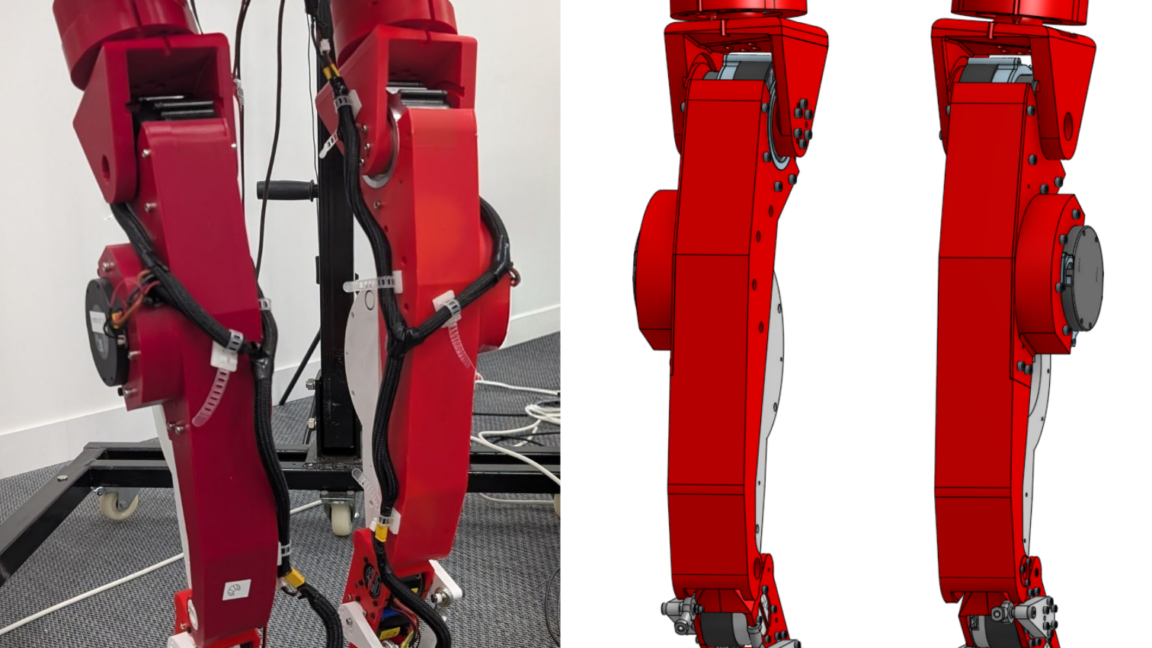
    A $2,500 pair of humanoid robot legs built from 3D-printed parts and off-the-shelf components is not going to win marathons just yet. But such relatively inexpensive hardware could enable researchers to more easily test and train AI-powered robotics software in a physical body during real-world experiments.

    The newly available LeRobot Humanoid project comes from the machine-learning and AI development platform Hugging Face. The full-stack release gives robot builders and researchers access to a bill of materials, files for 3D-printable parts, wiring documentation, and physical assembly instructions—but it also includes software tools for calibrating and controlling the robot in both the physical body and in simulation.

    “If you are looking for the most advanced humanoid robot, this is not it,” wrote Virgile Batto, a robotics engineer at Hugging Face, in a blog post coauthored with other colleagues. “If you are looking for a humanoid you can build, understand, repair, instrument, simulate, and use for learning experiments, this is the robot we are trying to make.”

    The Hugging Face team aimed for a “practical balance between affordability, mechanical performance, and ease of assembly.” The design, built around printable parts, off-the-shelf hardware, and affordable actuators and electronics, means the bipedal robotic platform can be easily fixed and modified to enable rapid experimentation and development, rather than being a “one-off prototype useful for a demo.”

    Such a design also aims to enable a more reproducible “full-robot design loop” in which robots designed in simulation can be tested and validated in physical body experiments, according to Batto and colleagues. In turn, data from the real-world trials can help inform and improve the simulations used for training robot behaviors.


    Source link

    Share. Facebook Twitter Pinterest LinkedIn Tumblr Email
    franperez66q@protonmail.com
    • Website

    Related Posts

    Towers once planned for California shuttle launches leveled for SpaceX rockets

    June 18, 2026

    “Dangerous” AI models are coming no matter what

    June 18, 2026

    The Slate Truck’s price may have leaked, starts at $24,950

    June 18, 2026

    Tesco moving 40,000 server workloads off VMware amid Broadcom’s “abusive conduct”

    June 18, 2026

    Massive breach spills credentials for thousands of sensitive networks

    June 18, 2026

    California says AT&T lied to FCC in attempt to shut off old phone network

    June 18, 2026
    Leave A Reply Cancel Reply

    Top Reviews
    Editors Picks

    Strategists weigh in on Treasury 2-year yield spike post-Fed

    June 18, 2026

    European stocks ease as markets digest hawkish Fed

    June 18, 2026

    Towers once planned for California shuttle launches leveled for SpaceX rockets

    June 18, 2026

    People starting new jobs at lowest level in five years

    June 18, 2026
    © 2026 All right reserved
    • Privacy Policy
    • Terms & Conditions

    Type above and press Enter to search. Press Esc to cancel.