Close Menu

    Subscribe to Updates

    Get the latest creative news from FooBar about art, design and business.

    What's Hot

    Commonwealth Fusion makes the physics case for its 400 MW reactor

    June 10, 2026

    BP leadership exits reignite questions over board structure, oversight

    June 10, 2026

    SoftBank sinks as Asia tech stocks tumble, tracking Wall Street tech losses

    June 10, 2026
    Facebook X (Twitter) Instagram
    Addison Markets
    • Home
    • USA
    • Europe
    • Business
    • Investing
    • Tech
    • Politics
    • Contact Us
    Addison Markets
    Home»Tech»Bumblebees can spontaneously solve problems, study finds
    Tech

    Bumblebees can spontaneously solve problems, study finds

    franperez66q@protonmail.comBy franperez66q@protonmail.comJune 5, 2026No Comments2 Mins Read
    Facebook Twitter Pinterest Telegram LinkedIn Tumblr WhatsApp Email
    Share
    Facebook Twitter LinkedIn Pinterest Telegram Email


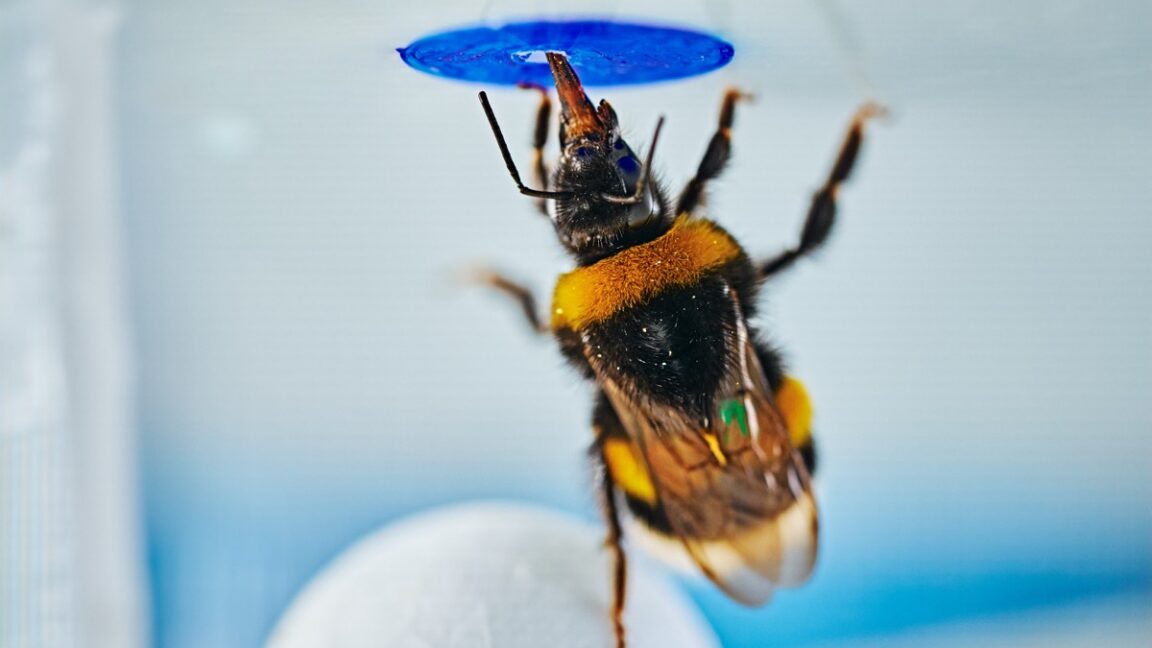
    “This design assessed whether bees could solve the task without continuous perceptual feedback,” the authors wrote. All told, 16 of 22 bees succeed in this task. Granted, the bees could still potentially catch a glimpse of the flower once the ball was near the opening, so the team repeated the experiment with three openings in the barrier to further limit visual feedback. This time, there were no significant differences in performance between trained and untrained (control group) bees.

    In one last experiment, Loukola et al. sought to isolate the bees’ goal-directed performance from accidental success and from visual feedback cues. This time, the testing apparatus featured a rectangular arena with two compartments, both invisible to the bees. During pretraining, 30 bees were shown the flower positioned above one of those compartments. For the actual test, the flower was not visible from the ball’s starting location, and the bees had to move the ball into the correct compartment. The results: 23 of the 30 bees succeeded at the task, and 16 of the successful 23 bees did so without first moving the ball to the incorrect compartment.

    The team acknowledged that the experimental setups had no way to track the bees’ gaze, posture, or other behavioral cues that might have let them pinpoint the precise “Eureka!” moment when the bees “understood” the problem. Further experiments should test how well bees grasp causal relationships. “Nonetheless, the present design provides the clearest evidence to date that bumblebees are capable of generating novel, goal-directed solutions, establishing a foundation for future studies to further investigate the cognitive processes underlying insight in insects,” the authors concluded.

    Science, 2026. DOI: 10.1126/science.ady1618 (About DOIs).


    Source link

    Share. Facebook Twitter Pinterest LinkedIn Tumblr Email
    franperez66q@protonmail.com
    • Website

    Related Posts

    Commonwealth Fusion makes the physics case for its 400 MW reactor

    June 10, 2026

    Beyond ‘Silicon Roundabout’: The next challenge for UK tech

    June 10, 2026

    Three key vital signs make up the “urban pulse” of a city

    June 10, 2026

    Stocks recover from sell-off, but even bulls warn of more volatility

    June 10, 2026

    Locked in heated rivalry with researcher, Microsoft fixes 0-day they disclosed

    June 10, 2026

    How Jim Cramer views Apple on Day 2 of its post-WWDC keynote pullback

    June 10, 2026
    Leave A Reply Cancel Reply

    Top Reviews
    Editors Picks

    Commonwealth Fusion makes the physics case for its 400 MW reactor

    June 10, 2026

    BP leadership exits reignite questions over board structure, oversight

    June 10, 2026

    SoftBank sinks as Asia tech stocks tumble, tracking Wall Street tech losses

    June 10, 2026

    Taiwan stocks lower at close of trade; Taiwan Weighted down 3.48%

    June 10, 2026
    © 2026 All right reserved
    • Privacy Policy
    • Terms & Conditions

    Type above and press Enter to search. Press Esc to cancel.