Close Menu

    Subscribe to Updates

    Get the latest creative news from FooBar about art, design and business.

    What's Hot

    Scottish Labour leader hopefuls warn against party divisions

    August 13, 2026

    In pictures: Total solar eclipse crosses Europe

    August 13, 2026

    US boosts drone surveillance as flesh-eating screwworms spread in Texas

    August 13, 2026
    Facebook X (Twitter) Instagram
    Addison Markets
    • Home
    • USA
    • Europe
    • Business
    • Investing
    • Tech
    • Politics
    • Contact Us
    Addison Markets
    Home»Tech»Your empty cuppa could capture carbon
    Tech

    Your empty cuppa could capture carbon

    franperez66q@protonmail.comBy franperez66q@protonmail.comJune 9, 2026No Comments3 Mins Read
    Facebook Twitter Pinterest Telegram LinkedIn Tumblr WhatsApp Email
    Share
    Facebook Twitter LinkedIn Pinterest Telegram Email


    Some of the amine groups hang out solo, while others link with each other to help create the porosity within the solid.

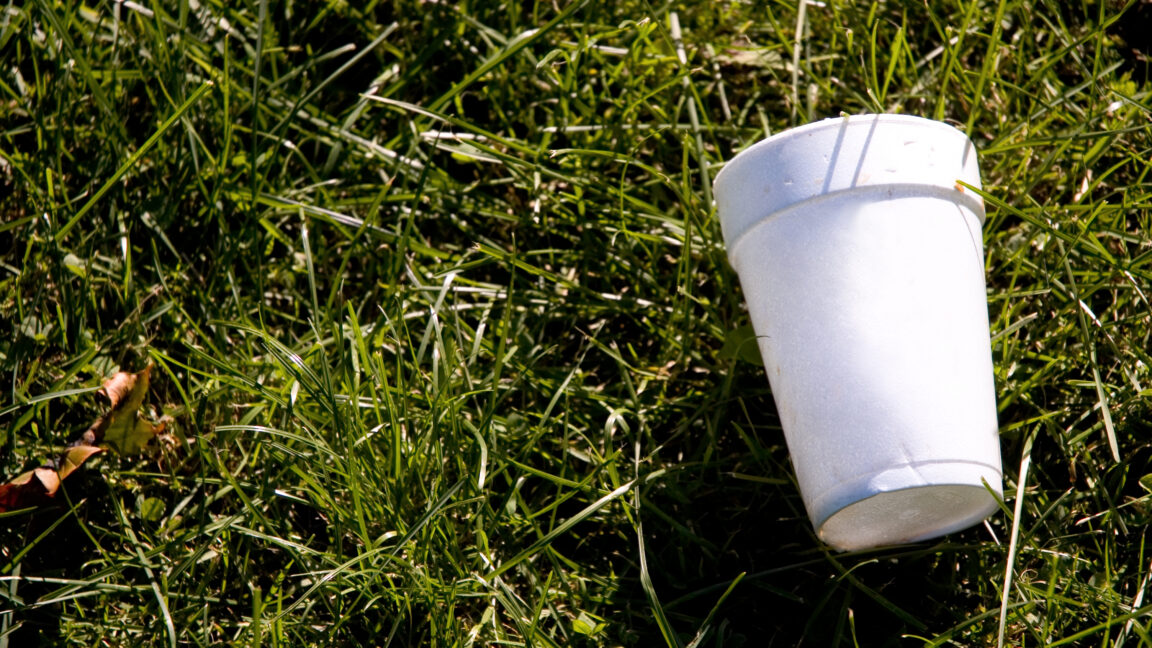
    The researchers tested this process with a few plastic objects, including Styrofoam, food packaging, a fork, a CD case, and a Lego base plate (which has another chemical component). They found that the material they produced performed well in the carbon-capture cycle, both at the extremely high CO2 concentration of a smokestack and the lower concentration of ambient air.


    Chemical structure of polystyrene with and without attached amines (NH2 and NH), and an illustration of capturing and releasing carbon by controlling temperature.

    Chemical structure of polystyrene with and without attached amines (NH2 and NH), and an illustration of capturing and releasing carbon by controlling temperature.


    Credit:

    Ebenbauer, et al./Chem Circularity


    Fine tuning

    The researchers also found that they could control the material’s properties along the way. They could tune the amine content up or down, as well as adjusting the proportion that made porosity-building linkages instead of CO2-grabbers.

    Since the amine-containing starting material they used was ultimately fossil-fuel derived, they also tested turning a couple other kinds of synthetic materials into amines instead. Past research has shown a few pathways to do this, but those give you slightly more complicated forms of amines that may not be as reactive.

    In this case, they used these amines in an upcycling reaction on urethane foam mattress material and decorative building trim. This worked, producing carbon-capture material made completely from waste, but the chunkier amine groups made from waste didn’t perform as well. Its capacity for CO2 was lower, and it failed to sponge up CO2 from ambient air.

    But the polystyrene still held up its end of the bargain, and there’s a flexible blueprint here. With the right source and process for amines, carbon-capture material could be entirely produced from the flood of plastics going into landfills. And even if it’s only half produced from plastics, that would still be improvement. This could both provide a market to redirect some of the plastic waste and technically reduce the carbon footprint of carbon capture (although the vast majority of its footprint is the energy required to run the process.)

    Carbon capture isn’t a license to keep using fossil fuels. It’s an additional action we can take to rein in atmospheric CO2 more quickly. And the more sustainably you can run that process, the better it is.

    Chem Circularity, 2026. DOI: 10.1016/j.checir.2026.100027 (About DOIs).


    Source link

    Share. Facebook Twitter Pinterest LinkedIn Tumblr Email
    franperez66q@protonmail.com
    • Website

    Related Posts

    US boosts drone surveillance as flesh-eating screwworms spread in Texas

    August 13, 2026

    Trump sued over “brazen” scheme to sell Truth Social API access for $100K a month

    August 13, 2026

    Twitch content has trained Amazon AI for years, but users can opt out now

    August 13, 2026

    South Korea Kospi bull market: SK Hynix, Samsung surge

    August 13, 2026

    Have physicists finally discovered glueballs? New evidence points to yes.

    August 13, 2026

    Cerebras (CBRS) Q2 earnings report 2026

    August 13, 2026
    Leave A Reply Cancel Reply

    Top Reviews
    Editors Picks

    Scottish Labour leader hopefuls warn against party divisions

    August 13, 2026

    In pictures: Total solar eclipse crosses Europe

    August 13, 2026

    US boosts drone surveillance as flesh-eating screwworms spread in Texas

    August 13, 2026

    Peterborough residents urged to avoid fireworks in heat spell

    August 13, 2026
    © 2026 All right reserved
    • Privacy Policy
    • Terms & Conditions

    Type above and press Enter to search. Press Esc to cancel.