
Unlock the Editor’s Digest for free
Roula Khalaf, Editor of the FT, selects her favourite stories in this weekly newsletter.
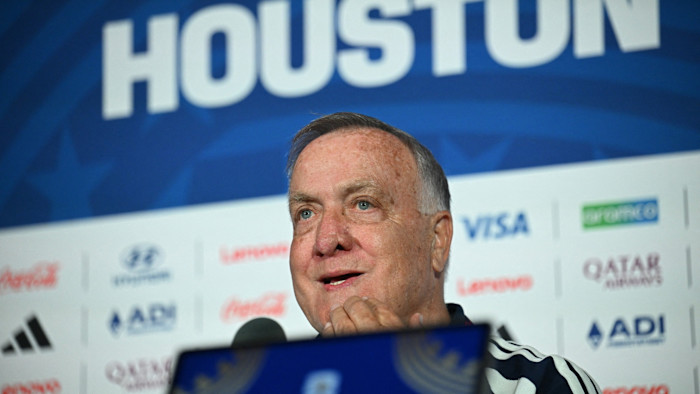
When Curaçao’s team are on their Caribbean island, they travel around in an ancient American bus with music booming out of the gaps where a door and windows should be. Among them sits a little 78-year-old Dutchman, Dick Advocaat, oldest coach in the World Cup’s history, leading the smallest country ever to qualify, looking like a grandpa on a family holiday.
It’s not his music, but he accepts it, along with the players’ hugs every day at breakfast — for which in Curaçao he let them join the all-you-can-eat buffet with tourists at their hotel. Now, very unusually for a squad at a World Cup, the players’ families are staying with them in the team camp in Boca Raton, Florida.
This isn’t how a workaholic disciplinarian would choose to prepare an island of 158,000 people to face four-time world champions Germany in Houston on Sunday. But only when training sessions or matches start do Advocaat and his players turn fanatical. Otherwise, he has mellowed because he knows this might be his last job. He told Dutch newspaper NRC he fears death, always asking himself, “How long is left?” For now, though, Advocaat and Curaçao are proving a potent cocktail.
Born in 1947 into a poor Hague family with five children, he followed his brother Jaap into professional football, becoming a midfield battler who played with short sleeves and socks around his ankles even in midwinter. His speciality was stepping on Achilles heels. He was so fanatical that — freakishly for a 1970s footballer — he didn’t drink.
He later taught PE and built ceilings before becoming a coach by accident. Jaap, offered a job running an amateur club, nominated Dick instead. Advocaat became obsessed. “In summer I watched how the grass on the practice pitch grew.”
In 1984, he got a call from the Dutch team’s legendary manager, Rinus ‘The General’ Michels. Advocaat thought it was a spoofer pretending to be Michels and hung up, but Michels wanted an assistant, and Advocaat found his role model. A sentimental man who cries easily, he learned from Michels to hide weakness, to address players in short clear sentences, and never to debate with them. He became known as “The Little General”. Asked to describe himself as a coach, he says: “Clarity”.
He worked nonstop, taking his notebook to the toilet to sketch out formations, and once admitted: “I have no sense of humour.” His generation of Dutch baby boomer coaches — Johan Cruyff, Guus Hiddink and Louis van Gaal — bestrode global football, preaching the traditional attacking Dutch game, but only Advocaat favoured defence. He coached the Netherlands, South Korea, Glasgow Rangers (earning enough to buy his mum a house and a TV), Zenit Petersburg and Russia’s national team. There he got to know Vladimir Putin, “an enormous fan of Zenit”. When Putin asked him, “What is leadership?”, Advocaat replied, “If you or I walk into the room, it falls silent.” Putin liked that. “We clicked,” Advocaat once recalled. “Both of us equally big or small, maybe that played a role in the bond I felt.”
After saying for years that each new job would be his last, in 2024 he took on Curaçao. With the team needing just a draw from their final World Cup qualifier against Jamaica, he rushed back to the Netherlands where his daughter was ill. He didn’t tell his players, because he knew he would cry, and couldn’t bear them feeling sorry for him, he told the NRC. When they held Jamaica 0-0, he called it “the most special thing that has happened to me as coach”.
Quitting the job to be with his daughter, he suggested the Dutchman Fred Rutten as his successor. But when his daughter’s condition improved, the players and team sponsor Corendon called for Advocaat’s return. In May, Rutten resigned under pressure.
At the World Cup Advocaat is working 14-hour days. He still sometimes shouts, but permits joking and dancing in the changing room, and joins in the team’s daily ecumenical prayer.
All their opponents in the group — Germany, Ivory Coast and Ecuador — are stronger in every position. Curaçao’s starting goalkeeper, Eloy Room, was clubless when they qualified, though later signed for tiny FC Miami. Their third-choice keeper, a reserve at little Dutch club Telstar, has never yet played a professional football match. Curaçao hope to become the first Caribbean team since Cuba in 1938 to reach the World Cup’s knockout rounds (which would test Advocaat’s ability not to cry), but fear a 6-0 thrashing by Germany. “We won’t be the most attacking team at the World Cup,” says Advocaat. In short, they will play Advocaat-football.
And afterwards? He has said: “You can write down that I’ll stop coaching, but with me you never know.”
