


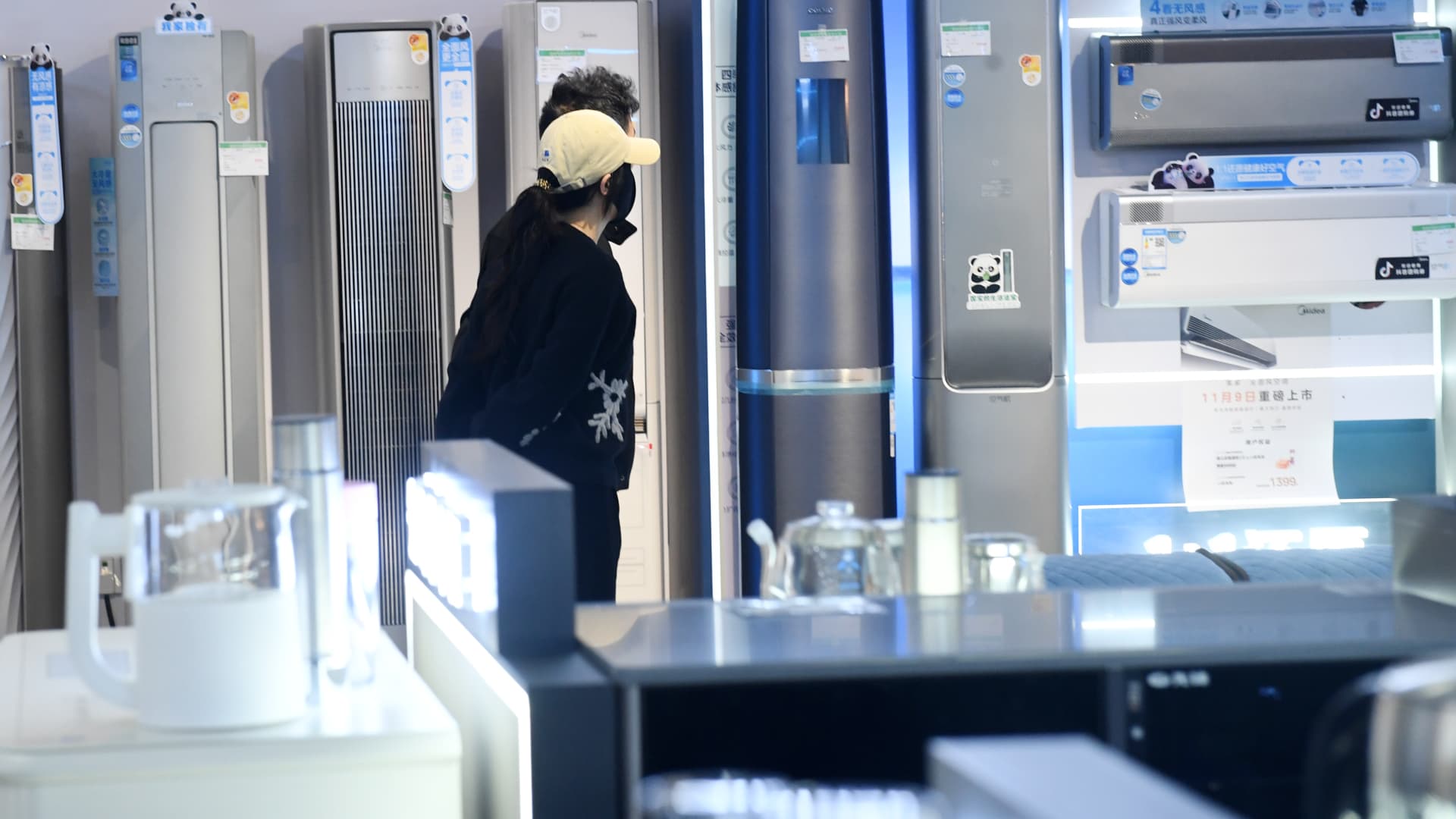
Hong Kong-listed home appliance company Midea has two options, J.P. Morgan analysts said last week. Either become an industrial giant like Siemens — and double in market cap by 2030 — or plod along “the Panasonic path” with gains of just 25%, the analysts said. Midea shares are already up more than 7% so far this year, bucking a more than 3% decline in Hong Kong’s Hang Seng Index. The home appliance maker is one of the 20 largest stocks in the index by market capitalization, ahead of chip company SMIC and consumer electronics maker Xiaomi . “The market is still paying for the old Midea — a high-quality appliance champion — but we think the new Midea is becoming a more interesting hybrid of [business-to-consumer] cash flow and [business-to-business] industrial tech,” the JPMorgan analysts said. The Wall Street bank initiated research coverage on Midea’s Shenzhen-traded shares with an overweight rating and a price target of 105 yuan ($15.50). That implies upside of more than 20% from Friday’s close. Powerhouse For Midea to become an industrial powerhouse, the JPMorgan analysts said the appliance company must do three things simultaneously: Become a global leader in commercial heating, ventilation and air conditioning systems. Turn its German industrial robot subsidiary Kuka into an earnings driver by growing share in China’s factory automation market to at least 25% from just under 10% today. Build out a new business-oriented unit that achieves at least 20 billion yuan in revenue by 2030. Potential candidates include Midea’s data center liquid cooling, energy storage or medical imaging units. Revenue from commercial and industrial solutions climbed by 17.5% in 2025 to account for more than one-fourth of Midea’s total revenue , although “smart home solutions” still comprises the majority of the business. More than 40% of Midea’s revenue comes from outside China. Leveraging advantages “The question is not whether Midea is a good business. The question is whether it becomes a different kind of business — one that the market values on a structurally different framework,” the JPMorgan analysts said, noting it’s critical for the company to leverage its advantages due to increased competition in the appliance market. Midea’s work in factory automation and sustainability has earned the company the World Economic Forum’s “lighthouse” designation in recent years. The home appliance company last week also launched a tech solutions business to help Chinese companies expand their factory network overseas , and highlighted a virtual reality-based training system that helps new workers get up to speed more quickly. “The old framework — subsidy, replacement cycle and margin — still matters, but it misses the more important transition: China B2C is becoming the funding base, overseas [original brand manufacturing] is becoming the growth engine, and B2B industrial tech could become the multiple-expansion driver,” the JPMorgan report said. That has implications for global industry. “Many overseas players are financially constrained by the rising inefficiency in their supply chains,” the JPMorgan analysts said, forcing them to raise prices faster than their Chinese rivals to maintain profitability. JPMorgan also assumed coverage of two other Chinese home appliance players, giving each an overweight rating: Haier’s Hong Kong-listed shares and Zhejiang Supor’s Shenzhen-listed shares. — CNBC’s Michael Bloom contributed to this report.
