


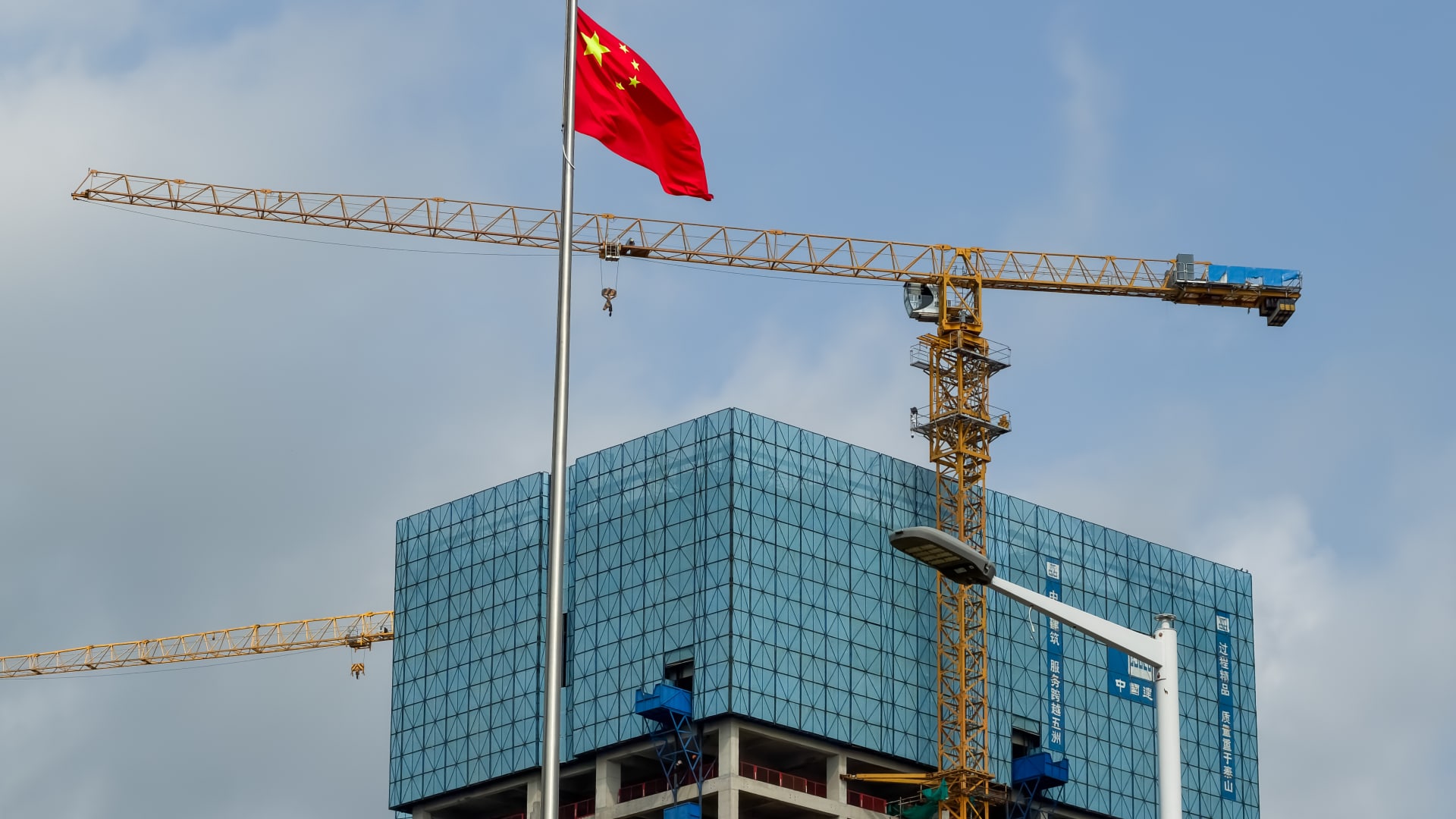
SHENZHEN, CHINA – MAY 3: The national flag of China flies on a flagpole near a construction site with tower cranes and a high-rise building under development on May 3, 2026, in Shenzhen, Guangdong Province, China.
Cheng Xin | Getty Images News | Getty Images
China’s retail sales fell for the first time in more than three years in May while urban investment contracted more than expected, signaling a deepening economic slump, according to data released Tuesday by the National Bureau of Statistics.
Retail sales, a gauge of consumption, declined in May for the first time since December 2022, dropping 0.6% from a year earlier, as the Labor Day holiday at the start of May failed to offset the country’s sluggish consumer spending. That figure came in lower than the forecast for no change among economists polled by Reuters.
China’s urban fixed-asset investment, including real estate and infrastructure, contracted 4.1% this year as of end-May from a year earlier, compared with the estimated 2% decline and steepening from the 1.6% drop in the first four months this year.
Real estate dragged on investment, with inflows falling 16.2% in the January-to-May period, while manufacturing fixed-asset investment contracted for the first time since December 2020, Wind data showed. Investment in infrastructure grew 0.6% from a year earlier.
Industrial output was the lone bright spot, rising 4.5% in May to top estimates of 4.3% growth and rebounding from April’s near three-year low of 4.1%.
The national unemployment rate fell to 5.1% in May, compared with 5.2% in April.
“The domestic imbalance between strong supply and weak demand is acute,” the statistics bureau said, calling for the development of new technology and greater employment support to achieve “an appropriate increase in economic output.”
The economy has shown signs of faltering following a strong first quarter. Growth slowed across the board in April, with industrial output and retail sales recording their weakest gains in years. In May, the official gauge on manufacturing activity slowed to 50, the threshold separating expansion from contraction.
During the extended holiday in early May, while boosting travel and dining activity, per capita spending lagged behind the same period in 2025, as consumers have grown more price-conscious.
China’s economy has developed into what economists have termed a “K-shaped” growth model, with robust manufacturing and export sectors countering persistent weakness in property and consumer spending.
The country’s exports remained a standout area with double-digit growth in April and May, as surging renewables and AI-related demand largely offset the drag from the Middle East conflict.
However, the Iran war’s disruption to energy flows has also pushed up commodity costs, helping ease deflationary pressures that have plagued the Chinese economy for years.
China’s producer inflation rose at the fastest pace in nearly four years in May, yet the gains have barely filtered through to consumer inflation, which grew a modest 1.2%, as upstream suppliers absorb higher costs amid weak demand.
