Close Menu

    Subscribe to Updates

    Get the latest creative news from FooBar about art, design and business.

    What's Hot

    China built robots that can do backflips – but can they make money?

    August 14, 2026

    Ukrainian drones wipe out entire US tank brigade in live war game

    August 14, 2026

    Uber partners with China’s Pony.ai for 2,000 robotaxis in Europe

    August 14, 2026
    Facebook X (Twitter) Instagram
    Addison Markets
    • Home
    • USA
    • Europe
    • Business
    • Investing
    • Tech
    • Politics
    • Contact Us
    Addison Markets
    Home»Tech»Good news—we have extra time before the Sun ends life on Earth
    Tech

    Good news—we have extra time before the Sun ends life on Earth

    franperez66q@protonmail.comBy franperez66q@protonmail.comJune 16, 2026No Comments2 Mins Read
    Facebook Twitter Pinterest Telegram LinkedIn Tumblr WhatsApp Email
    Share
    Facebook Twitter LinkedIn Pinterest Telegram Email


    It’s a bit worrying when a scientific paper begins, “How long will life on Earth survive?” But in this case—a study by Jacob Haqq‐Misra of Blue Marble Space and Eric Wolf at the University of Colorado Boulder—the billion-plus-year timeline under consideration shouldn’t cause you too much existential panic.

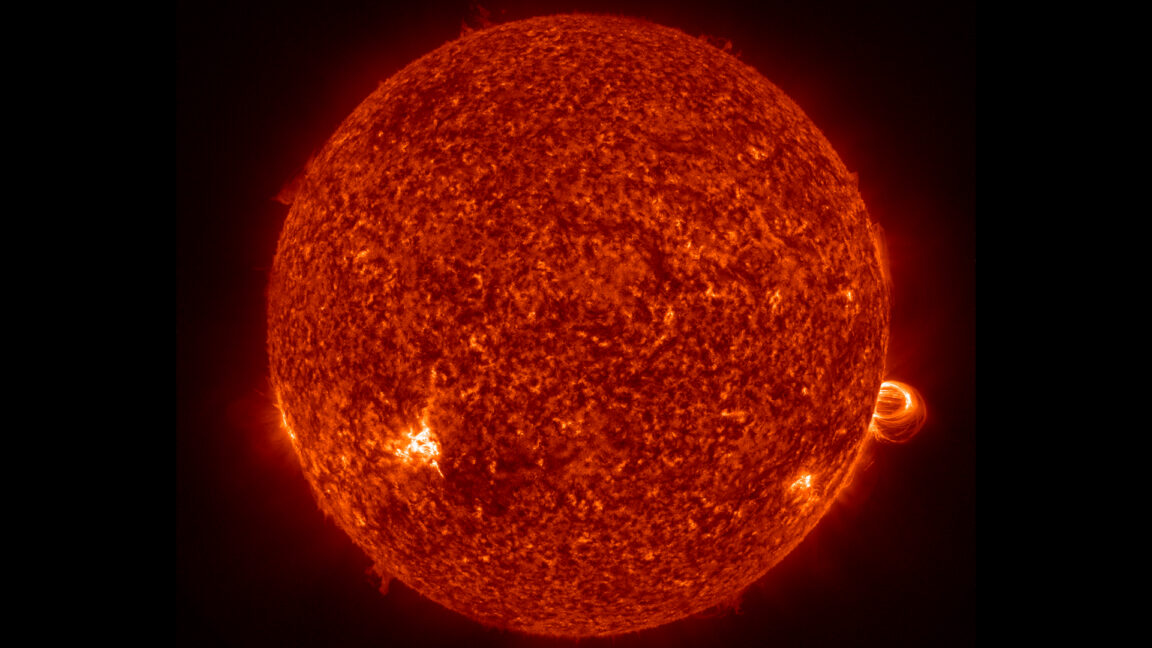
    The context for this question is that we understand the Sun will brighten as it eventually matures into a red giant that swallows the Earth in a solar furnace. So, where along that 5 billion-year path will life on Earth, in fact, be cooked?

    Weathering and the weather

    This isn’t just a question of incoming radiation. Among the thermostat-like stabilizing feedback loops in Earth’s climate, the cycling of CO2 through the solid Earth is a major factor over timescales this long. The weathering of silicate rocks at the surface converts atmospheric CO2 into carbonate that ends up on the seafloor, where it can be subducted into the mantle with tectonic plates. (And eventually, it can cycle back out to the atmosphere through volcanoes.)

    The weathering of bedrock depends, in part, on temperature. Warmer temperatures and a more active hydrologic cycle mean an increased rate of weathering, which pulls more CO2 out of the atmosphere. That slows rising temperatures. But in this scenario, it could also lead CO2 to fall to extremely low levels—and photosynthesis requires CO2.

    This far-future puzzle has been the focus of many model simulations over the past few decades. With a steadily brightening Sun, when does the Earth either get too hot or too CO2-starved for the base of the food chain to survive?

    Some of those models have been relatively simple equations. Others have been more complex one-dimensional layer models, representing an ocean and an atmosphere separately in the math, for example. This new study brings a 3D model to the party and uses a pair of scenarios that mark opposite ends of a spectrum.


    Source link

    Share. Facebook Twitter Pinterest LinkedIn Tumblr Email
    franperez66q@protonmail.com
    • Website

    Related Posts

    China built robots that can do backflips – but can they make money?

    August 14, 2026

    Ukrainian drones wipe out entire US tank brigade in live war game

    August 14, 2026

    Uber partners with China’s Pony.ai for 2,000 robotaxis in Europe

    August 14, 2026

    US wait times for cancer surgeries are getting longer and longer

    August 14, 2026

    From Apple to Ford: How Chinese tech is becoming harder for global companies to ignore

    August 14, 2026

    Virgin Galactic wants your help naming its new Delta class spaceship

    August 13, 2026
    Leave A Reply Cancel Reply

    Top Reviews
    Editors Picks

    China built robots that can do backflips – but can they make money?

    August 14, 2026

    Ukrainian drones wipe out entire US tank brigade in live war game

    August 14, 2026

    Uber partners with China’s Pony.ai for 2,000 robotaxis in Europe

    August 14, 2026

    US wait times for cancer surgeries are getting longer and longer

    August 14, 2026
    © 2026 All right reserved
    • Privacy Policy
    • Terms & Conditions

    Type above and press Enter to search. Press Esc to cancel.