
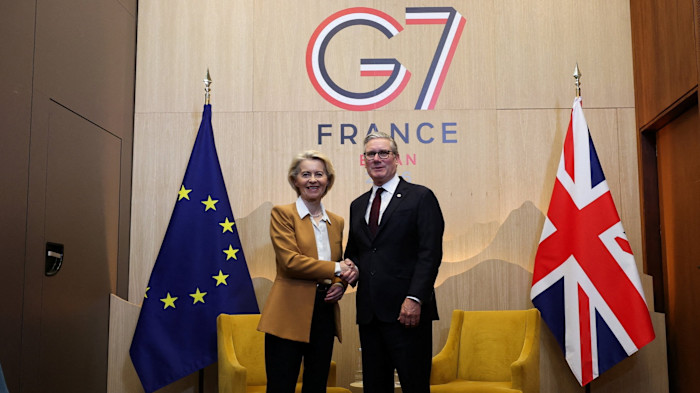
Sir Keir Starmer has announced a date for a UK-EU summit in Brussels next month, as he looks to flesh out his plan to put Britain “at the heart of Europe” in what could be the dying days of his premiership.
“Today I’ve agreed with @eucopresident that we will hold the second UK-EU summit on July 22,” Starmer said on X on Tuesday, after talks with European Council president António Costa at the G7 summit in France.
“My Labour government is delivering on our promise to reset our relationship and put Britain at the heart of Europe,” he said. “Together we will tackle the cost of living, boost jobs and create opportunities for young people.”
The European Commission, the bloc’s executive arm, had initially pencilled in July 13 for the date of the summit, but some member states were unsure about committing to a meeting with Starmer given questions over his future.
“Do we want to be negotiating with an outgoing prime minister?” asked one EU member state diplomat.
Others tried to assess whether Andy Burnham, the pro-European Greater Manchester mayor, would be able to cut a more ambitious deal if he wins a by-election on Thursday and ousts Starmer from Downing Street.
However, in Brussels the key question for the summit was “whether we can make concrete progress”, according to one EU diplomat. To that end, talks continued with Starmer’s team and the two sides were getting closer, a senior EU official said.
A second EU official said that “once you set a date, it’s a firm deadline for deliverables”. But another official warned that the summit could be a flop given the distance between the two sides.
A key demand by EU member states is that Britain should offer EU students discounted rates to study at British universities, a concession that some UK officials say is on the table.
Ten years on from the Brexit vote, the two sides are looking to finalise details of a youth mobility scheme and the removal of trade barriers in the areas of food and drink, and energy. Work on those projects began after the first EU-UK summit last May.
Costa posted on social media after a meeting with Starmer: “Close EU–UK co-operation is essential for our shared European security, resilience and prosperity. We are working closely together to make our upcoming second summit in Brussels on July 22 a success.”
Last month Starmer said he wanted to be ambitious at the summit and that “in terms of the policy challenges that our country faces, incremental change won’t cut it”.
He said: “This Labour government will be defined by rebuilding our relationship with Europe and by putting Britain at the heart of Europe.”
Mujtaba Rahman, Europe director at the Eurasia Group consultancy, said: “There was a good case for the EU to wait and see how UK politics evolved, since a Starmer successor might pursue a more ambitious reset. But Starmer pushed hard for the summit, so critics will suspect he conceded to EU demands to secure the July 22 date.”
The FT reported this month that UK ministers were pushing to ensure British companies were not left out of “Made in Europe” supply chains in future as the EU seeks to bolster its trade defences against China and the US.
Peter Kyle, UK business secretary, hinted at possible concessions on university fees this month on a visit to Brussels this month. “We do understand the importance [of tuition fees] to the EU and that’s why we are engaging with it in such an enthusiastic way,” he said.
Burnham, who is hoping to re-enter parliament this week after a by-election in Makerfield in northern England, has said he hopes Britain will rejoin the bloc “in my lifetime”, although he has dialled down his pro-EU rhetoric as he seeks votes in the heavily Leave-voting constituency.
