
The London Silver Vaults is one of the City’s more unexpected locations. Buried beneath the pavements of Chancery Lane, to descend its stairs is like taking a journey back in time. There is an austere, civic air to its interior which has surely not changed in 50 years and at the bottom of the steps is a long arcade, which would also be dreary were it not lined with silver sellers. If you want an art deco cocktail shaker, a Victorian stag or a pair of peerless Georgian candlesticks, this is the place to come.
Bomb proof and theft proof, it is also the location of safes containing all manner of valuables. And in one, until it travels to the Treasure House fair which opens in Chelsea on June 24, is a tiny but exquisite gold heart, around 3x3cm, with an intricately wrought laurel wreath frame and all enamelled in black-and-white. Its tassel is a lock of fine blond hair. This is the Aston Jewel, a memento mori ornament made to mourn a child who died at just six years old in 1634, and its dealer Martyn Downer has temporarily taken it out of its protective enclosure.
We are in a windowless room, the sort you might associate with police questioning. There is even a stray grey acrylic sweater scrunched on a chair. It is a strange place to see — and handle — an object that is now 400 years old and sends shivers up the spine, both in its perfect workmanship and its still-resonant message of mortality. Downer doesn’t wear white gloves and neither must I. “It’s better not to drop things. I just try and keep my hands clean,” he says, with dealer-like pragmatism towards precious objects, as he turns it in his fingers. (The jewel has been valued at £650,000.)


“Death is one of the great themes of all time,” says David Grob, another dealer who is taking part in the fair, which offers a potpourri of art and objects from the deeply historic to the present day. His works are rather more recent than Downer’s. In a callback to his involvement with the Young British Artists of the late 1980s, Grob will show a piece called “Hatchet Job”, made by Mat Collishaw in 2005, where an axe is embedded in a plastic medical skull. This piece was made for a charity auction, clearly with a hefty dose of humour, but Collishaw has often dwelt on death in his work, including a photographic record of last meals taken on death row (on view until September 6 at The Sherborne gallery). He has said that this focus on violence and death emphasises the very urgency and desperation of living, while his compositions — like the death row series — are modern manifestations of vanitas art, the genre developed by northern European painters in the 16th century to remind the living of the inevitability of death. Where the historic versions show worldly objects (globes, books, instruments) alongside symbols of mortality (skulls, hourglasses), in Collishaw’s fries and burgers take their place.

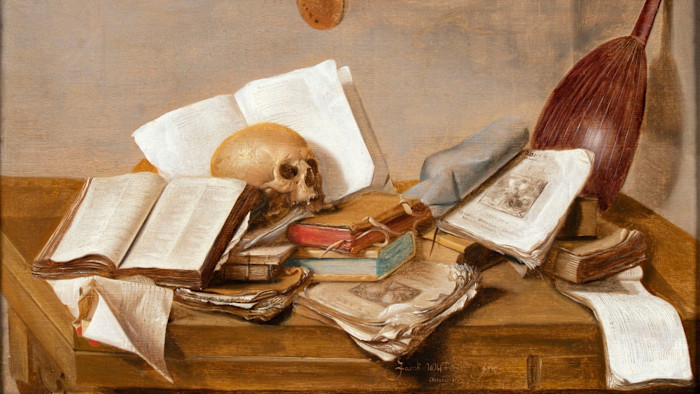
Douwes Fine Art from Amsterdam is bringing a fine example of the real thing: a 1629 vanitas by Jacob Westerbaen who was based in Leiden where the vanitas form first emerged. Douwes is said to be the oldest family-owned art gallery in the world, established in 1770 and now run by the eighth and ninth generation of the family; its business ranges over five centuries but its heart is in the older masters. “This is a very nice, intimate piece,” says Evert Douwes (generation eight), “possibly painted for his courtly cousin, Sir Jacob.” A skull sits amid volumes with furling pages (to own a library demonstrated wealth as well as intellect) and a lute is to one side. Documents detailing the business of the Vereenigde Oostindische Compagnie are scattered across the table.
The VOC, or the Dutch East India Company, established in 1602, was the first multinational, prefiguring the modern world of international mega corporations. Perhaps the painting might appeal to a tech bro? “Well, around that time, [the VOC] would have been worth twice what Nvidia’s worth now,” says Douwes. “But writers and musicians are attracted by these cerebral works. And of course, surgeons. They deal with life and death all the time.”

While some collectors are intrigued by the subjects of mourning and death, others are drawn to stories of royalty. Stephen Reynolds, a jewellery dealer based in the UK, is showing a gold, enamel, hair and diamond ring commemorating the death of Edward IV (“They dug him up in the 18th century and used his hair”) and a slightly less ghoulish one for William III that he discovered just weeks ago. “It turned up in a provincial auction in Holland, but any museum in the western world would want it,” says Reynolds, who is a renowned “divvie” in the business (in other words, someone with an almost uncanny ability to spot extraordinary treasures). “There is a brooch in the V&A by the same hand. But this is a ring, with a poem inscribed on top talking up his valour, and covered with a faceted rock crystal, and rings are more sought after than brooches.”
There is also a correlation between illustrious figures and quality pieces — royals, aristocrats and the famous often leaving hefty bursaries for pieces to be made after their death. “I’m very familiar with mourning rings for Pitt [the Younger] and Lord Byron,” says Downer, who was the jewellery expert at Sotheby’s in London for a number of years. “They carry a premium.” In the case of the latter, his very death — fevered, in Greece and aged 36 — is mythic and any reminder still carries the charge.


“I’ve been around a lot of lovely objects,” continues Downer, “but it’s their biography that appeals to me.” And he goes on to describe a painting which shows Sir Thomas Aston wearing the very jewel we are looking at in the bowels of the Silver Vaults. A huge work (6ft by 5ft) and a highlight of the collection at Manchester Art Gallery, to whom it was gifted around 100 years ago, it is known as “Sir Thomas Aston at the Deathbed of his Wife” (1635) and shows its protagonist solemn in grief beside his dead wife Magdalene, dressed in angelic white clothes. Beside her is the draped black cot of a stillborn child. “It’s so staged, it’s like a performance,” says Downer of the work by John Souch, a provincial Cheshire artist, but one who could get there in time to record the event.
In the painting, the memento mori is pinned to Aston’s silken sash. Here in the real world, that same object seems to transcend its own materiality. In its tiny form, and its delicacy, the jewel emblazoned with a skull is still about the aching death of a child. And its place is next to his father’s heart.
June 24-30, treasurehousefair.com
Find out about our latest stories first — follow FT Weekend on Instagram, Bluesky and X, and sign up to receive the FT Weekend newsletter every Saturday morning
