
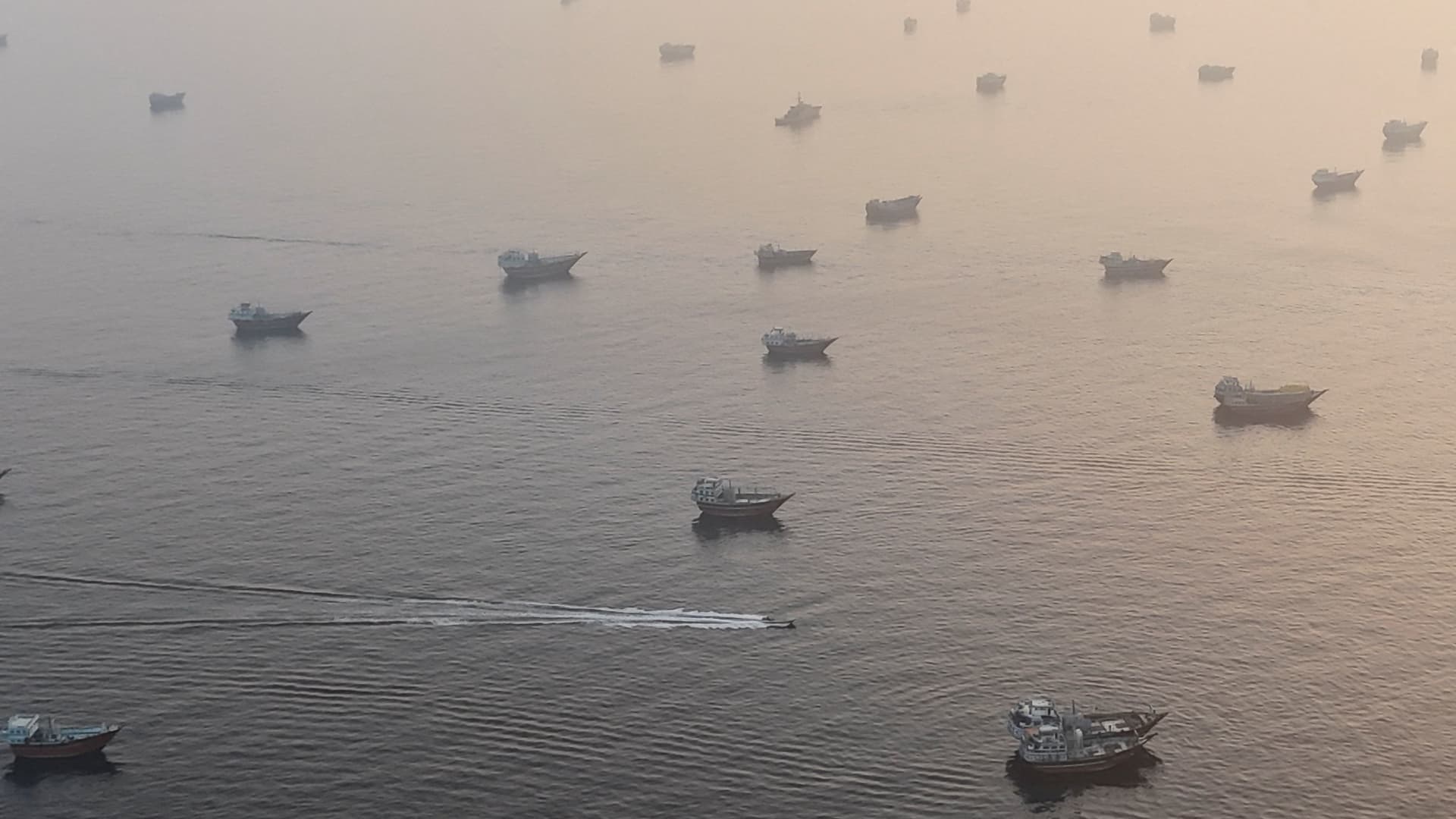
Iran and Oman will define how the Strait of Hormuz is administered in discussion with other Persian Gulf states under the agreement to end the war in the Middle East, senior U.S. officials told reporters Wednesday.
Tehran and Washington are expected to formally sign a memorandum of understanding to end the war on Friday in Geneva. The U.S. officials, speaking on condition of anonymity to discuss the terms that hadn’t been made public, read the contents of the MOU to reporters on a conference call.
Under the MOU, Tehran will allow the safe passage of commercial ships without tolls for 60 days only. Iran will then “conduct dialog” with Oman “to define the future administration and maritime services” in Hormuz in discussion with the other Gulf states, according to the agreement.
President Donald Trump has repeatedly insisted that the strait be un-tolled after the war ends. There were no tolls imposed by Iran or any other entity before Trump began the war.
The discussions on to how administer Hormuz should be “in line with the applicable international law and the sovereign rights of coastal states of the Strait of Hormuz,” according to the MOU.
A senior U.S. official acknowledged that the Iranians will likely “assert their rights as aggressively as they can” in the regional discussions on how to administer Hormuz. But the official said the other Gulf states “will never agree to an arrangement that doesn’t permit toll-free access.”
The U.S., meanwhile, will begin to lift its naval blockade of Iranian ports immediately after signing the MOU and will completely end the blockade within 30 days, an official said.
Ships transited Hormuz freely without any fees or conditions before the U.S. and Israel attacked Iran on Feb. 28. But Tehran has sought to impose its control over strait since the war began.
Traffic through Hormuz has changed little since the U.S. and Iran announced they reached a deal on Sunday. Six tankers were among 13 commercial ships that transited Hormuz on Tuesday, according to data shared by Kpler. More than 100 vessels sailed through the strait daily before the war.
The Joint Maritime Information Center on Tuesday downgraded the threat level to ships crossing Hormuz to “substantial” from “severe” previously. It warned shippers still face a strong possibility of attack, but the behavior of Iran’s Revolutionary Guard has “has become less volatile.”
The center is a maritime security organization led by the U.S. and headquartered in Bahrain that coordinates among allied navies and merchant ships in the Middle East.
Here is the full memorandum of understanding as read by a U.S. official:
- The United States of America and the Islamic Republic of Iran and their allies in the current war, by signing the MOU, declare the immediate and permanent termination of military operations on all fronts, including in Lebanon, and undertake from now on not to initiate any war or any military operation against each other and to refrain from the threat or use of force against each other, and ensuring the territorial integrity and sovereignty of Lebanon. The final deal will confirm the permanent termination of the war on all fronts, including in Lebanon, and other provisions of this paragraph.
- The United States of America and the Islamic Republic of Iran undertake to respect each other’s sovereignty and territorial integrity and to refrain from interfering in each other’s internal affairs.
- The United States of America and the Islamic Republic of Iran commit to negotiating and achieving the final deal in maximum 60 days extendable with mutual consent.
- Immediately upon the signing of this MOU, the United States of America will begin the removal of its naval blockade and any disturbances or impediments against the Islamic Republic of Iran, and will fully end the naval blockade within 30 days. During this period, the traffic of vessels will be in proportion to the numbers of pre-war traffic being restored by the Islamic Republic of Iran. The United States of America further undertakes to remove its forces from the proximity of the Islamic Republic of Iran within 30 days after the final deal.
- Upon the signing of this MOU, Islamic Republic of Iran will make arrangements using its best efforts for the safe passage of commercial vessels, with no charge for 60 days only, from the Persian Gulf to the Sea of Oman and vice versa. The traffic of commercial vessels will immediately start, and considering the need for removing the technical and military obstacles and demining by the Islamic Republic of Iran will be instated within 30 days. The Islamic Republic of Iran will conduct dialogue with the Sultanate of Oman to define the future administration and maritime services in the Strait of Hormuz in discussion with other Persian Gulf littoral states in line with the applicable international law and the sovereign rights of coastal states of the Strait of Hormuz.
- The United States of America undertakes with regional partners to develop a definitive, mutually agreed plan with at least USD $300 billion for the reconstruction and economic development of the Islamic Republic of Iran. The mechanism for the implementation of this plan will be finalized as part of a final deal within 60 days. All required licenses, waivers, and permissions needed for the relevant financial transactions will be granted by the United States of America.
- The United States of America undertakes to terminate all types of sanctions against the Islamic Republic of Iran, including the United Nations Security Council resolutions, IAEA Board of Governors resolutions, and all unilateral US sanctions, primary and secondary, in an agreed upon schedule as part of the final deal. The Islamic Republic of Iran and the United States of America acknowledge the critical importance of the sanctions termination issue above mentioned and expressed their intentions to immediately address these issues in the negotiations in order to achieve mutual agreement on them.
- The Islamic Republic of Iran reaffirms that it shall not procure or develop nuclear weapons. The United States of America and Islamic Republic of Iran have agreed to resolve the disposition of stockpile enriched material pursuant to a mechanism that will be mutually agreed upon in accordance with the schedule mentioned in paragraph seven with the minimum methodology to be down blending on site under the supervision of the IAEA. The two parties also agreed to discuss the issue of enrichment and other mutually agreed matters related to the Islamic Republic of Iran’s nuclear needs, based on a satisfactory framework being agreed upon in the final deal. The final deal will confirm the provisions of this paragraph. The United States of America and the Islamic Republic of Iran acknowledge the critical importance of the nuclear issues above mentioned and express their intention to immediately address these issues in the negotiations in order to achieve mutual agreement on them.
- Pending the final deal, the United States of America and the Islamic Republic of Iran agree to maintain the status quo. The Islamic Republic of Iran will maintain the current status quo of its nuclear program, and the United States of America will not impose any new sanctions and will not deploy additional forces in the region.
- The United States of America undertakes that immediately upon the signing of this MOU that until the termination of sanctions, the U.S. Department of Treasury will issue waivers for the export of Iranian crude oil, petroleum products, and derivatives, and all associated services, including banking transactions, insurances, transportation, etc.
- The United States of America undertakes to make fully available for use the frozen or restricted funds and assets of the Islamic Republic of Iran. Upon the implementation of the MOU, the United States of America and the Islamic Republic of Iran will mutually agree on the procedures related to the release of these funds during the negotiations. Such funds, whether retained in the original account or transfers shall be made fully usable for payment to any ultimate beneficiary designated by the Central Bank of the Islamic Republic of Iran. The United States of America undertakes to issue all necessary licenses and authorizations accordingly.
- The United States of America and the Islamic Republic of Iran agree that an executive mechanism will be established to monitor the successful implementation of this MOU and the future compliance of the final deal.
- After signing this MOU, and subject to the beginning of the implementation of paragraphs 1,4, 5, 10, and 11 of this MOU, and the continuing implementation of these measures, the United States of America and Islamic Republic of Iran will start negotiations regarding the final deal exclusively on the other paragraphs.
- The final deal will be endorsed by a binding UNSC resolution.
—Eamon Javers contributed to this report.
