
Stay informed with free updates
Simply sign up to the War in Ukraine myFT Digest — delivered directly to your inbox.
The writer is an FT contributing editor, chair of the Centre for Liberal Strategies, and fellow at IWM Vienna
The war in Ukraine is now well into its fifth year, outlasting many of the major conflicts of the past century. Will it ever end? And who could end it?
It is possible that it is not only Russian President Vladimir Putin’s ludicrous idea of total victory that keeps the war going. The European and American pursuit of a diplomatically negotiated long-lasting peace may also be a deadly illusion. The reality is that, even if there is minimal chance of an enduring peace, we should not miss the opportunity for a meaningful truce.
As Nader Mousavizadeh argued in these pages, “we are living through an age of asymmetry, a transitional period in which power flows less from size or wealth than from the ability to convert imbalance into leverage”. In this dangerous era, wars are rebranded as “special operations” and no great power is great if it cannot achieve its objectives in less than two weeks.
This is what Donald Trump did in Venezuela and has failed to do in Iran. These days, peace is no more than frozen uncertainty. We fail to realise that when the nature of the war is changing, the nature of the peace is too.
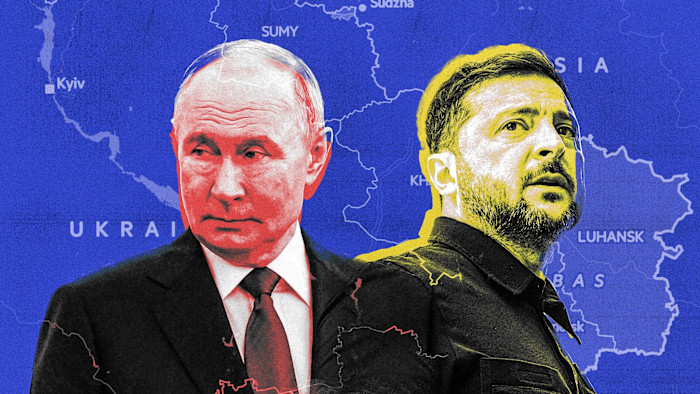
It is in this context that Ukrainian President Volodymyr Zelenskyy’s June 4 open letter to Putin deserves special attention. If drones have changed the way Ukraine fights the war, Zelenskyy’s letter marks a dramatic change in the way that Kyiv is thinking about its end. In it, he asked for direct negotiations between Kyiv and Moscow, and argued that there is good reason to believe that hostilities could cease in the very near future.
We do not know what Putin believes is happening on the battlefield but we do know that Russia is not winning. Its summer offensive has been arrested by Ukraine’s technological advantage, while its losses exceed Moscow’s capacity to mobilise new recruits. Ukraine’s latest strike on Moscow is a clear sign that we are not witnessing a stalemate. The Russian economy is haemorrhaging, and public support for the war is visibly eroding. If Moscow wants to keep pursuing its ambition of taking control over the entire Donbas in the next year or two, Putin would need to resort to mass mobilisation or the use of nuclear weapons. Both options are rife with unpredictable, not to say catastrophic, consequences
If Putin instead opted to stop the fighting, he could not claim total victory — but he could certainly fake success, just as Trump is doing in Iran. US policies towards Europe guarantee that Ukraine will not join Nato at least in the short term. So, Putin can claim that he has achieved one of his objectives. Kyiv will also probably not insist on European peacekeepers; Ukraine simply does not need them and, as the latest European Council on Foreign Relations survey reveals, most Europeans are not enthusiastic about sending them either. So Moscow could claim another demand has been met. Moreover, the Kremlin could hope that a ceasefire would trigger tensions within Ukrainian society and become an instrument of political destabilisation.
Despite their recent military achievements, Ukrainians also have reason to seek an end to the hostilities. Kyiv has won the war in one important sense. The conflict has demonstrated to the world that, contrary to Russian nationalist claims, Ukrainians are not bewitched Russians. Ukraine has lost territory but its sovereignty has been reaffirmed. Its army is one of the strongest in Europe, and its defence sector is the envy of the world. And while the Russian language is still spoken in Ukraine, very few would identify themselves as Russians outside the occupied territories if a referendum were held today. So, after four years of war, there is no one in Ukraine that Moscow can plausibly claim to be defending.
The painful question now facing Zelenskyy is not how to withstand Russia’s aggression but how many more people Ukraine can lose before it loses its future? A long war means not only more citizens killed and wounded but also fewer babies born and fewer Ukrainians returning home from abroad. So, prolongation of the conflict — even if it means liberating some additional territories — is not the optimal long-term strategy, especially with another cruel winter ahead and future vulnerability to unfavourable shifts in European politics.
Right now, there is a real opportunity to freeze the war. The risk is that the window will pass due to Putin’s delusion that he can achieve total victory and because Ukraine’s European allies have failed to grasp that the nature of making peace has changed, along with the nature of waging war. In this dangerous new world, the former is simply the absence of the latter. Direct talks between Russians and Ukrainians may yet be the most realistic way to achieve what passes today for peace.
