
Stay informed with free updates
Simply sign up to the Electric vehicles myFT Digest — delivered directly to your inbox.
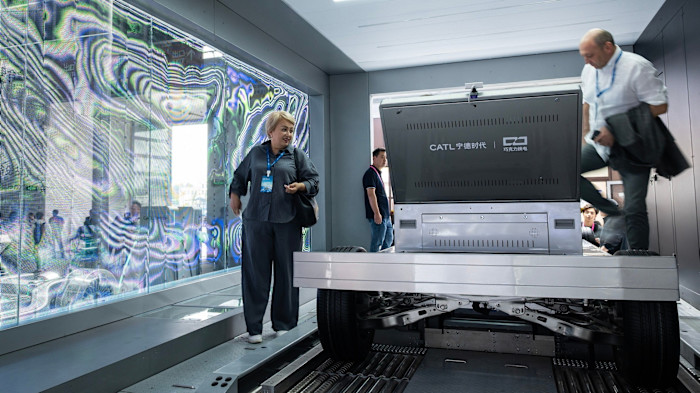
CATL plans to launch more than 30 battery-swapping stations for electric lorries in Europe by 2035 as the world’s largest battery maker bets the technology can cut fleet operators’ costs below those of diesel trucks.
The Chinese group will partner with Octopus Energy, the UK’s largest household energy supplier, to build a network of battery-swapping hubs that the companies said could serve more than 300,000 electric trucks and generate private investment of more than £30bn in the region.
Using battery swapping, electric lorries will be able to replace depleted packs with fully charged ones in minutes, avoiding an almost hour-long process for fast charging. The model can also lower the upfront cost of buying an electric truck because operators do not need to own the battery, while cells can last longer if they are charged more slowly.
“With battery swapping . . . we will be cheaper than diesel is today,” Greg Jackson, founder of Octopus Energy, told the FT. While he acknowledged that diesel costs had been inflated by the war in Iran, he said that even when the price of diesel fell, “we’ll be roughly cost-comparable”, and “unlike diesel, we’ll get cheaper every year”.
The first battery-swapping stations are expected to be rolled out in the UK next year.
Oscar Luo, CATL’s head of overseas investment, said battery-swapping can coexist with ultrafast charging, another technology led by CATL and Chinese electric vehicle and battery maker BYD.
“Our battery swap system can change the whole battery with more than 500 kilowatt-hour power in five minutes. That’s shorter than filling diesel into the tank,” he said at an Octopus event in London where the two companies announced the 50-50 joint venture.
Battery swapping, a technology pioneered by Chinese electric vehicle maker Nio, is becoming widespread in China but has been slower to expand elsewhere because of the high cost of building the required network of sites.
The service stations, which governments are expected to treat as critical infrastructure, will be owned by truck manufacturers and fleet managers rather than CATL or Octopus Energy.
Interest in electric lorries has increased amid the rise in diesel prices caused by the Middle East conflict, which has made the total cost of operating electric versions comparatively much cheaper.
Despite regulatory pressure, the transition has been much slower for heavy goods vehicles than passenger cars, with the share of electric trucks at only 0.9 per cent in the UK and 4.4 per cent in Europe during the first three months of 2026.
In China, CATL plans to install 900 battery-swapping stations for trucks this year, up from about 305 last year. The company has said that 80 per cent of the country’s key logistics trunk roads will be covered by its battery-swapping network by 2030.
The Chinese government is supporting the electrification efforts with plans to have 1.6mn battery-powered trucks on China’s roads by 2030. This will mean a 40 per cent share of new truck sales will be electric, compared with about 25 per cent last year and 37 per cent more recently as a result of the Iran war.
Robin Zeng, CATL’s billionaire founder, expects half of China’s market to be electric-powered by 2028.
