Close Menu

    Subscribe to Updates

    Get the latest creative news from FooBar about art, design and business.

    What's Hot

    Twitch content has trained Amazon AI for years, but users can opt out now

    August 13, 2026

    South Korea Kospi bull market: SK Hynix, Samsung surge

    August 13, 2026

    Have physicists finally discovered glueballs? New evidence points to yes.

    August 13, 2026
    Facebook X (Twitter) Instagram
    Addison Markets
    • Home
    • USA
    • Europe
    • Business
    • Investing
    • Tech
    • Politics
    • Contact Us
    Addison Markets
    Home»Tech»Planet orbits so close to its star that their magnetic fields connect
    Tech

    Planet orbits so close to its star that their magnetic fields connect

    franperez66q@protonmail.comBy franperez66q@protonmail.comJune 26, 2026No Comments2 Mins Read
    Facebook Twitter Pinterest Telegram LinkedIn Tumblr WhatsApp Email
    Share
    Facebook Twitter LinkedIn Pinterest Telegram Email


    The second issue was that in some observations, there were no periodic signals at all. Because we have enough archival observation data, however, the researchers were able to track when the signal appeared and disappeared. And they were able to find a periodicity to that—one that lined up precisely with the star’s cyclic activity. (Think of our Sun’s solar cycle, and apply that to a different star.)

    The researchers suspect that, during high solar activity, the signal from the planet’s magnetic influence is swamped. At low periods in the cycle, the researchers suspect that there simply isn’t enough activity there for the magnetic interactions to enhance. So, they think that we see the enhanced chromosphere emissions only at intermediate levels of stellar activity.

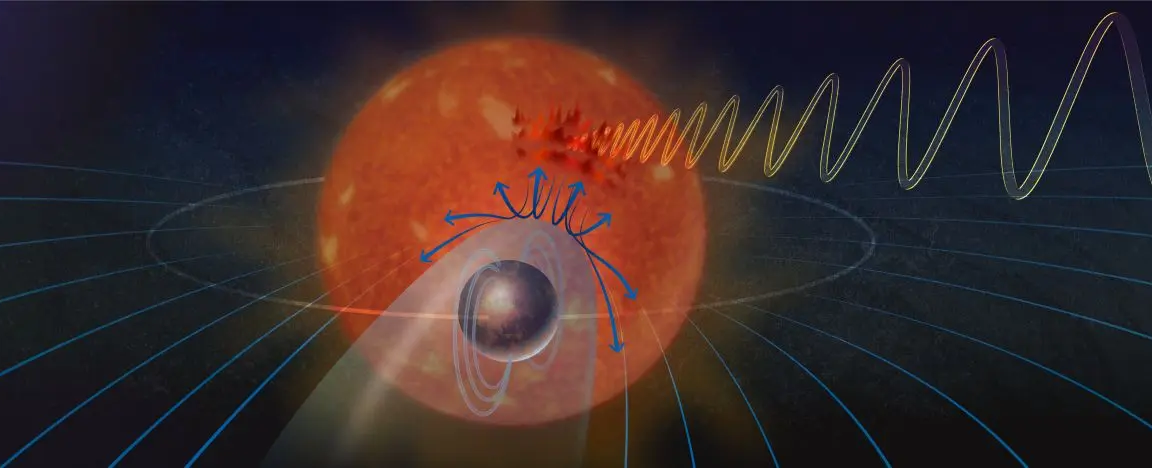
    How is the magnetic influence showing up on the star in the first place? The researchers consider a number of theoretical models, but the only one that produces enough energy at the chromosphere is one where loops of magnetic field connect the fields of the planet and the star. This model allows them to estimate the strength of the planet’s magnetic field, which they put at a minimum of 6 Gauss, over 10 times the strength of Earth’s.

    While that all may seem a bit extreme, it’s not especially unusual, even in our Solar System. The magnetic field strength is similar to that of Jupiter, and Neptune’s magnetosphere extends out to far greater distances than the gap between GJ 436 and its planet.

    As we noted above, this is the most comprehensive look at magnetic-driven flaring in an exosolar system, but it’s not the first. And there are hundreds of additional systems with close-in planets that we can still examine. So, in time, having measurements of exoplanet magnetic fields may become commonplace.

    Science, 2026. DOI: 10.1126/science.adv3075 (About DOIs).


    Source link

    Share. Facebook Twitter Pinterest LinkedIn Tumblr Email
    franperez66q@protonmail.com
    • Website

    Related Posts

    Twitch content has trained Amazon AI for years, but users can opt out now

    August 13, 2026

    South Korea Kospi bull market: SK Hynix, Samsung surge

    August 13, 2026

    Have physicists finally discovered glueballs? New evidence points to yes.

    August 13, 2026

    Cerebras (CBRS) Q2 earnings report 2026

    August 13, 2026

    The web’s newest weapon against AI scrapers is a font

    August 13, 2026

    South Korea Kospi bull market: SK Hynix, Samsung, AI trade

    August 13, 2026
    Leave A Reply Cancel Reply

    Top Reviews
    Editors Picks

    Twitch content has trained Amazon AI for years, but users can opt out now

    August 13, 2026

    South Korea Kospi bull market: SK Hynix, Samsung surge

    August 13, 2026

    Have physicists finally discovered glueballs? New evidence points to yes.

    August 13, 2026

    Cerebras (CBRS) Q2 earnings report 2026

    August 13, 2026
    © 2026 All right reserved
    • Privacy Policy
    • Terms & Conditions

    Type above and press Enter to search. Press Esc to cancel.