
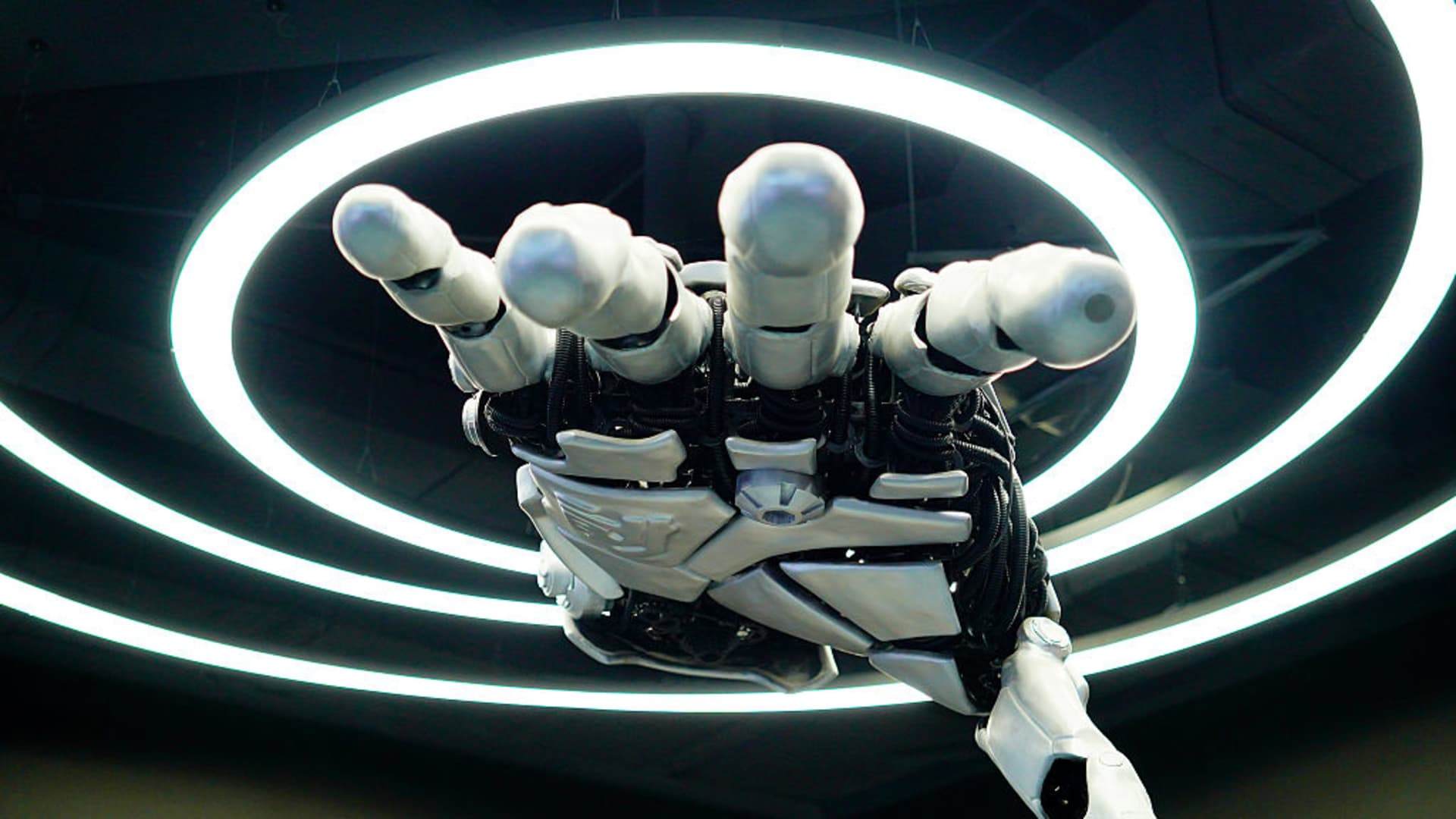
A mechanical hand is on display at the Robot Mall, world’s first embodied intelligent robot 4S store, on August 13, 2025 in Beijing, China.
Vcg | Visual China Group | Getty Images
Companies are rapidly changing their minds that artificial intelligence can “do it all” by rehiring employees to propel their businesses forward, as investors fret over the longevity of the ongoing AI boom happening in the financial markets.
Automaker Ford is one of the latest companies to reverse course. It is reportedly re-employing hundreds of experienced human engineers to work on quality issues automated systems couldn’t address. “Artificial intelligence is a fantastic tool, but it’s only as good as the information you use to train it,” Charles Poon, Ford’s vice president of vehicle hardware engineering, told the media.
Other companies that have walked back their hiring plans to focus more on human capital include Commonwealth Bank of Australia and software giant IBM.
Last year, CBA laid off more than 40 customer service staff and replaced them with an AI voice bot. However, the AI system was unable to cope, which led to an increase in calls, prompting CBA to reverse the job cuts. “Getting CBA to rescind these job cuts is a massive win,” Australia’s finance sector union said in a statement.
According to an ABC report in August last year, CBA admitted it “did not adequately consider all relevant business considerations” when announcing the redundancies and acknowledged “we should have been more thorough in our assessment of the roles required”.
Similarly, IBM replaced its HR functions with AI that handled around 94% of routine requests but was unable to meet the other 6%, which included ethical dilemmas. IBM then announced plans to triple its U.S. entry-level hiring across all business units in 2026.
“If we don’t continue to invest in entry-level hires, what happens in 3–5 years?,” IBM chief human resources officer Nickle LaMoreaux said at a Charter AI Summit in New York. “There’s no pipeline; the well simply dries up,” LaMoreaux added.
These examples echo views presented by analysts that making employees redundant while using more AI may not necessarily offer the best route to business growth.
“Budgeting on ‘tech to replace humans’ without investing in training or upskilling left teams unprepared to leverage AI,” according to a report by Intuition Labs. “Notably, among companies pushing automation, many later ‘regretted’ layoffs, having cut the very people needed to oversee AI,” it added.
According to a report by Orgvue, 39% of business leaders made employees redundant due to AI deployment. However, among that number, 55% admit wrong decisions about those redundancies were made.
“Where AI outputs are inconsistent, inaccurate, or difficult to apply, companies often need to reintroduce human oversight,” said Jessica Zhang, senior vice president of APAC at HR solutions provider ADP. “This can lead to duplicated effort, slower decision-making, and diminished productivity gains,” Zhang added.
Meanwhile, 32% of U.S. hiring managers said they eliminated a role primarily due to AI and later rehired for the same or a similar position, according to data from Robert Half sent to CNBC.
“AI is changing the workplace, but it’s becoming clear that organizations are finding more value in building human-AI collaboration versus replacing human work entirely,” Capitol Technology University noted.
