


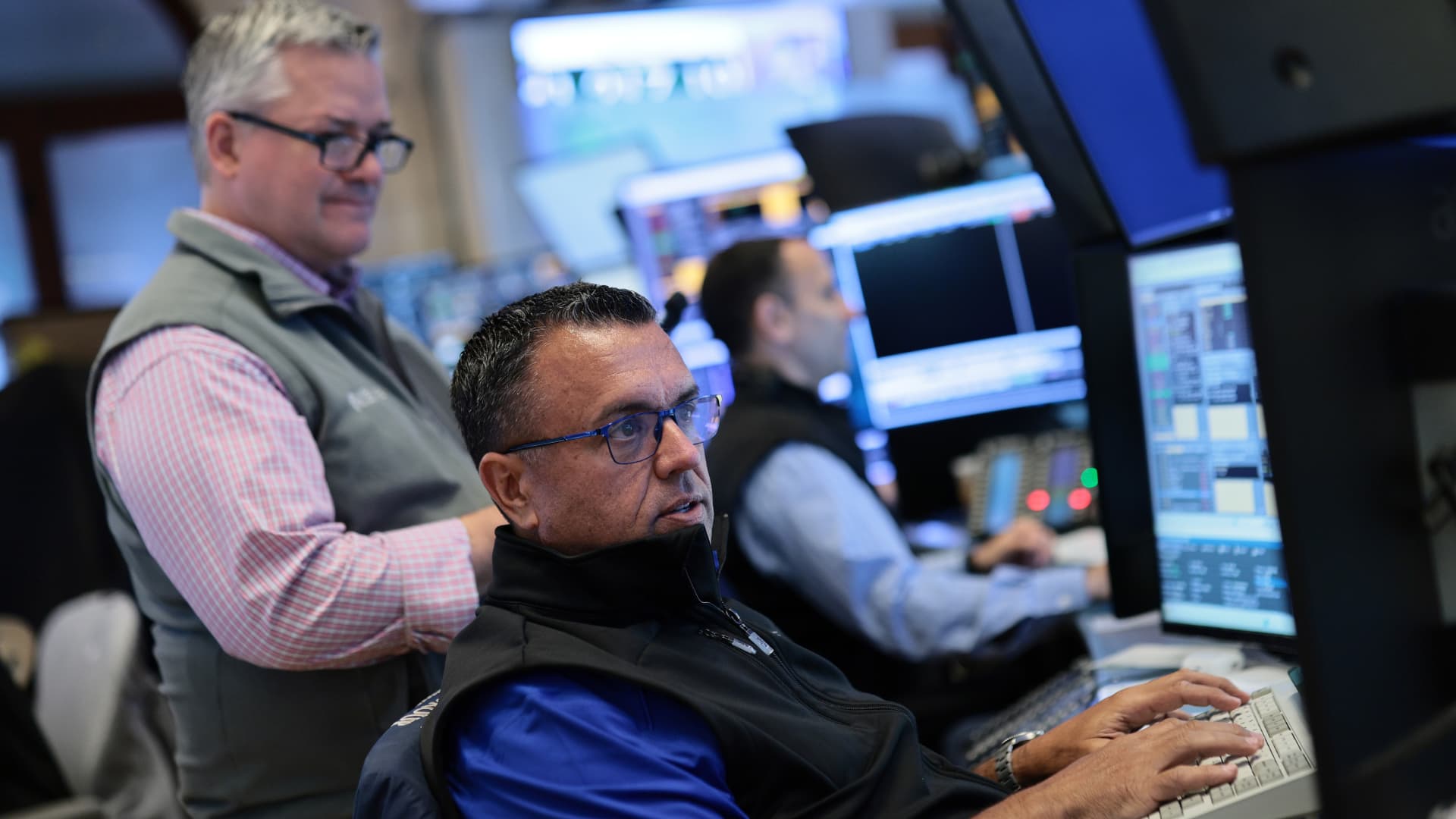
Traders work on the floor of the New York Stock Exchange during morning trading on July 01, 2026 in New York City.
Michael M. Santiago | Getty Images
When you’re in the middle of a hurricane, the price for umbrellas is going to be expensive, no matter which way the wind is blowing. For stocks, the hurricane is the Nasdaq-100 index, and the direction of winds may be changing.
The spread between Nasdaq 100 1-month implied volatility at 28 and the S&P 500 below 16 is near record highs. It’s been widening all year as the stock market’s returns concentrate around Big Tech winners, but the reason for this latest stretch of the gap is different from a few months ago, when Nasdaq options prices were being skewed by extreme demand for calls.
Today, it’s coming from demand for puts, which have gotten more expensive while premiums for far out-of-the-money calls tapers off. The spread between the implied vol of 25-delta puts in the Nasdaq 100 and S&P 500 – bearish contracts with a one-in-four chance of winning – rose from just 3 points in mid-March to 13.6 today, according to Bloomberg data compiled by Nasdaq. In 2020, the spread reached 13.3. Before that, the only time higher was in September 2008.
Nasdaq-100, YTD
“Nobody cared about puts back then, it was all about upside but now that sentiment has shifted,” Kevin Davitt, head of index options content at Nasdaq, said in an interview. “It speaks to potential downside for the high-flying elements of tech.”
The pick-up in demand for puts aligns with slowing momentum in AI stocks that had been consistently rewarding speculators to the upside. The semiconductor ETF (SMH) fell 4.5% Thursday to below $592, a level it first reached in late May.

VanEck Semiconductor ETF, YTD
More than a month of sideways price action in stocks may be piquing interest by bears, but also may not be cause to sound the alarm yet. Call-buying was so intense in the first half of this year that even as the appetite for upside has lessened, it’s still quite high.
Prices for one-standard-deviation out-of-the-money calls on the Nasdaq – contracts with a 16% chance of expiring in-the-money – are currently in the 58th percentile, down from the 99th percentile in May, according to Nations Indexes’ CallDex index.
Another innocuous factor that may be keeping S&P volatility low, adding to the spread: summertime.
“Traders expect the S&P to quiet down, which is normal for the summer,” Scott Nations, president of Nations Indexes, said in a call. “They don’t expect that for the Nasdaq 100, which they think will remain volatile because of the bouncing around in tech.”
