
Unlock the Editor’s Digest for free
Roula Khalaf, Editor of the FT, selects her favourite stories in this weekly newsletter.
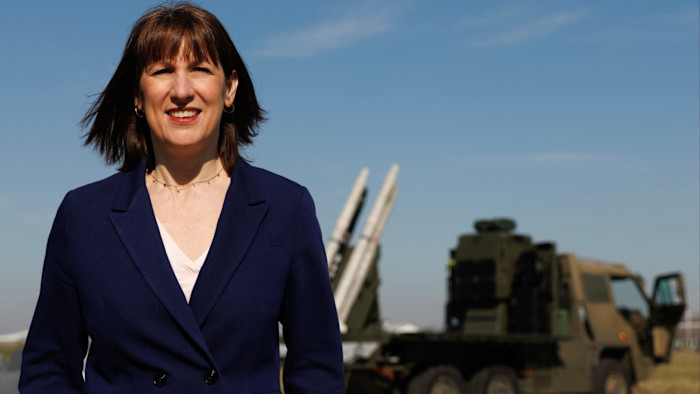
UK Chancellor Rachel Reeves has called for two rival international defence financing schemes to merge, arguing that it makes sense for countries to only fund one institution.
Britain joined the Netherlands and Finland to launch a new lender called the multilateral defence mechanism (MDM), which Poland signed up to this week. The quartet said on Monday that they were making “significant progress” on the project.
A rival initiative to set up a global defence bank formally launched on Tuesday at the Nato summit in Ankara, boasting nine member states. Canada, Turkey, Ukraine, Belgium, Albania, Greece, Latvia, Luxembourg and Romania have signed up to the Defence, Security and Resilience Bank (DSRB).
The DSRB said it would provide “long-term, low-cost financing” for defence initiatives like bolstering supply chains to help governments and small and medium-sized businesses.
Reeves noted on Tuesday that Canada had described the two initiatives as “complementary”. But she said: “I think the next step is to continue to work on bringing them together more formally.”
She defended the UK’s decision to join the MDM, which she said would help Britain with procurement and stockpiling, allowing the UK to achieve “better value for money for taxpayers” while “crucially enabling us to borrow at a low rate to fund defence”. Britain has committed an initial £600mn to the new lender.
She added: “The DSRB also provides important functionality, particularly for countries that have a smaller defence industrial base than what we have in the UK, but we would prefer to have it all part of one mechanism.”
Britain — and likely other countries — would prefer “to only capitalise one institution rather than two”, she said.
Guntram Wolff, a senior fellow at the Bruegel think-tank, said merging the two institutions made sense, adding “now is a good moment to do this” given overlaps in their roles. “Combining a funding arm with a joint purchasing of weapons arm inherently makes a lot of sense.”
He said the MDM was a more ambitious project, because it would create a vehicle that could co-ordinate joint purchases of weapons systems, achieve bigger economies of scale and even hold stockpiles of weapons on its balance sheet.
“It is much more than a bank, it is a mechanism for the joint procurement and possibly joint ownership of key defence assets,” he said.
Canadian Prime Minister Mark Carney, who is shifting Ottawa towards Europe as relations fray with the US, wants the DSRB to be headquartered in Canada.
On Monday Canada announced that German shipbuilder TKMS would build a new fleet of submarines in a multibillion-dollar defence contract that signalled closer ties to Europe.
In December last year Canada became the only country outside Europe with access to the EU’s SAFE initiative that provides up to $244bn in defence loans to its member states.
Reeves wrote to the head of the UK’s Treasury select committee in April saying the MDM was her “preferred approach” and the UK had no plans to join the DSRB.
A Whitehall official told the FT that Prime Minister Sir Keir Starmer wrote to Carney last week making the suggestion to merge the two bodies. Downing Street did not immediately respond to a request for comment.
“Reeves is scrambling as there are many ways to ‘merge’ them but they are also very different bodies,” they said. “The basic problem is the MDM offer is immature, it hasn’t solved fundamental challenges it faces while the DSRB has.”
