
This article is an on-site version of our Europe Express newsletter. Premium subscribers can sign up here to get the newsletter delivered every weekday and fortnightly on Saturday morning. Standard subscribers can upgrade to Premium here, or explore all FT newsletters
Good morning. Nato leaders are meeting in Ankara at a summit designed to please Donald Trump with defence investment pledges — but today’s talks have been overshadowed by his threat to “remove all of our soldiers” from Europe and overnight strikes on Iran.
Follow the summit live with my colleagues and I on the ground.
Here, Ukraine’s president tells our correspondent his pitch to the Nato leaders, and our Rome correspondent reports on a Russian spy scandal.
Nato asset
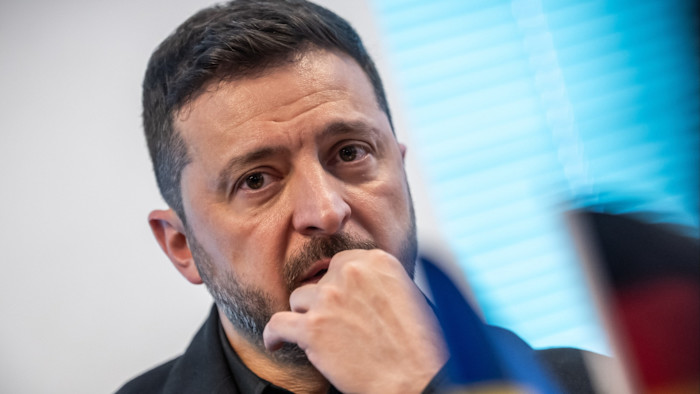
One of the messages Ukraine’s President Volodymyr Zelenskyy is taking to the Nato summit is that the war in Ukraine is not a liability but has, in fact, transformed the country from a security consumer into one of the alliance’s biggest strategic assets, he tells Christopher Miller.
Context: Several European allies have become more vocal about Ukraine’s long-term role in the continent’s security architecture, even as Kyiv’s path to Nato membership remains blocked by the war and a lack of consensus among allies.
“A strong Ukraine together with them in Nato, alongside other Nato countries, means security for everyone on the European continent,” Zelenskyy told the FT.
The Ukrainian leader said European governments increasingly saw Nato membership for Ukraine as strengthening, rather than burdening, the alliance.
He argued that Ukraine’s battle-hardened military, large defence industry and rapidly evolving drone technologies would reinforce Europe’s deterrence against future Russian aggression.
Zelenskyy described Ukraine’s armed forces as a “million-strong army” that would become one of Nato’s most capable militaries alongside the US, making any future Russian attack on an alliance member far riskier for Moscow.
He also framed Ukraine’s burgeoning defence-industrial base as a European asset. Modern security depends not only on weapons stockpiles, but on production capacity, engineering expertise and the ability to adapt technologies every few months, he said, pointing to Ukraine’s hundreds of defence companies and expanding joint projects with European partners.
Ukraine can already contribute those capabilities to Europe’s security without joining Nato, Zelenskyy argued. But partners receive assistance, while allies have mutual defence obligations.
“The greatest deterrent against Russia,” he said, “comes when Ukraine is a full-fledged member of Nato.”
Zelenskyy said Nato may therefore want to bring Ukraine closer sooner rather than later. He said he had warned his western partners that Russian President Vladimir Putin could seek to expand the war beyond Ukraine if he fails to achieve military success.
The Ukrainian president, a second senior Ukrainian official as well as an intelligence assessment shared with the FT, said that Putin could launch an incursion into a Nato country in 2027.
A third person familiar with the intelligence said that Putin had probably calculated that it would be better to strike while US President Donald Trump was in office, given his frustration with Nato allies that did not come to his aid in the war with Iran and general complaints about burden sharing.
Trump has said he would defend Nato allies including the Baltic states if Russia escalated, but not everyone is convinced he would follow through.
“I know he doesn’t want to end the war. Well, more precisely, he doesn’t want to end the war right now, in the form in which it could end today,” Zelenskyy said. “That is, he hasn’t achieved his goals.”
Chart du jour: Europe is warming up
Our Europe correspondents investigate how the continent’s capitals are preparing for more heatwaves.
Spy games
Italian defence minister Guido Crosetto has accused Moscow of conducting “daily hybrid conflict” against Italy after two Italians, including a former senior police official, were arrested on suspicion of spying for Russia, writes Amy Kazmin.
Context: Crosetto has struggled to persuade colleagues in Prime Minister Giorgia Meloni’s government — and the wider Italian public — of the need for higher defence spending despite growing security threats. Most Italians do not see Moscow as an adversary and would like to re-establish normal business ties with Russia.
Prosecutors in Rome said on Tuesday that they had arrested a 59-year-old former member of Italy’s national intelligence branch on suspicion of sharing classified information with “an alleged Russian intelligence agent, covered by diplomatic immunity in Italy”.
The suspect, who was not named, is accused of obtaining sensitive information from six sources, including four military personnel serving in sensitive roles, and sharing it with his Russian contact for a fee, prosecutors said.
Authorities said they had “serious evidence of guilt” against the main suspect, and had “documented several conversations” in which the suspect and his handler discussed information requirements and fees.
In a social media post, Crosetto said the arrests “make it evident to all what Russia’s real attitude towards us is,” adding that Moscow was engaged in a “constant latent war, aimed at weakening our institutions, our alliances and our security”.
He also condemned “internal traitors ready to sell their nation for money, or for power or for personal interest”.
The latest arrest, Crosetto said, was “just the tip of a gigantic iceberg”.
What to watch today
-
Nato summit continues in Ankara.
-
European parliament plenary session continues in Strasbourg.
Now read these
Are you enjoying Europe Express? Sign up here to have it delivered straight to your inbox every workday at 7am CET and on Saturdays at noon CET. Do tell us what you think, we love to hear from you: [email protected]. Keep up with the latest European stories @FT Europe
