


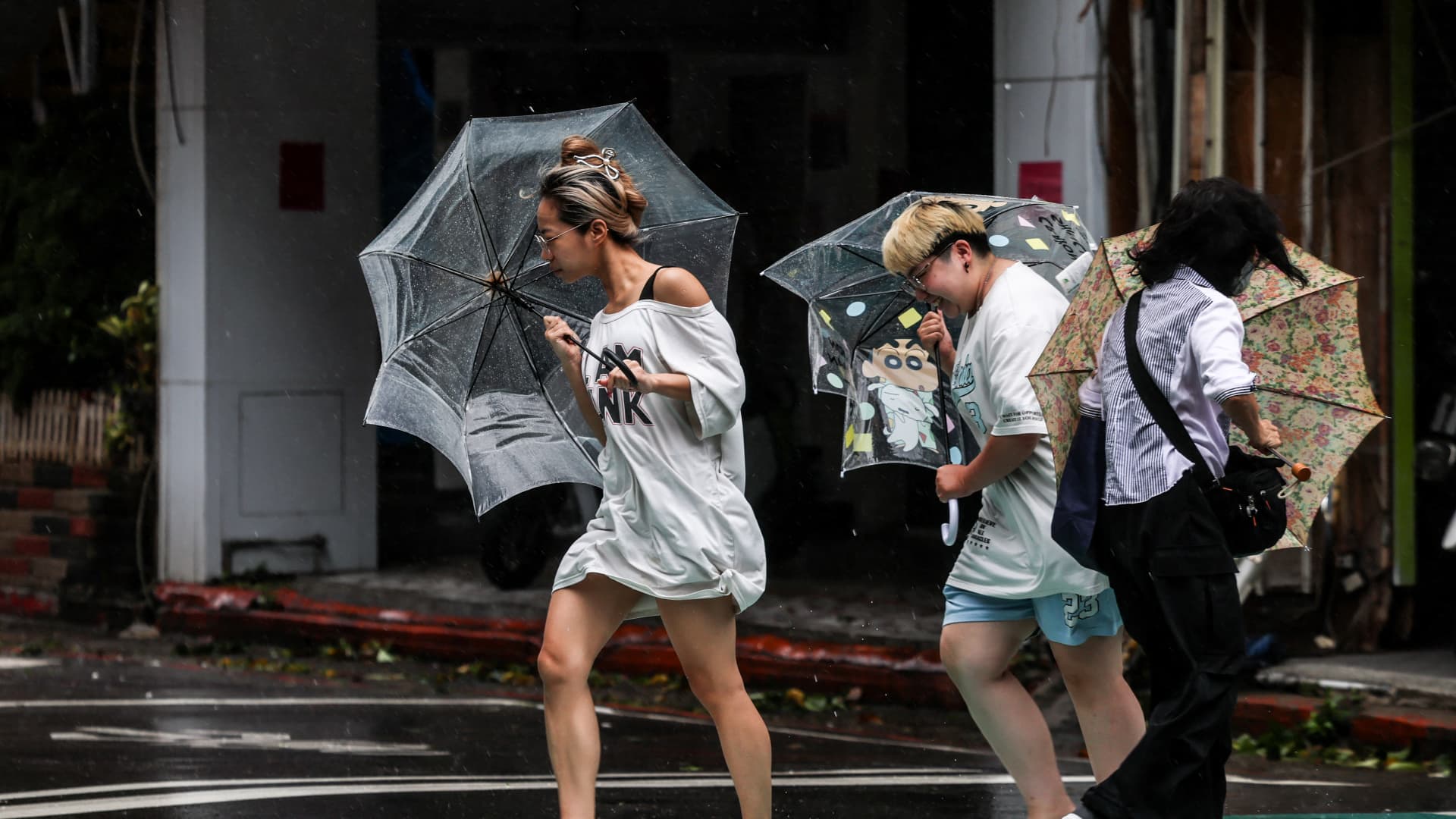
Pedestrians holding umbrellas walk across a road in strong winds and rain as Typhoon Bavi passes off northeastern Taiwan in Keelung on July 11, 2026. (Photo by I-Hwa Cheng / AFP via Getty Images)
I-hwa Cheng | Afp | Getty Images
Typhoon Bavi made landfall late on Saturday in the coastal city of Taizhou in eastern China, where nearly 2 million people were evacuated, after earlier pummeling Japan’s southern Sakishima island chain and brushing past northern Taiwan.
Even as Bavi continues to slow and weaken on its northwesterly path, the typhoon remains a potent risk due to the sheer volume of moisture within its rain bands, which are about the size of France from end to end.
Bavi had maximum sustained winds of about 144 km per hour (90 mph), equivalent to Category 1 on the Saffir-Simpson Hurricane Wind Scale, when it made landfall at around 11:20 p.m. local time (1520 GMT), according to the National Meteorological Center.
State media said more than 1.7 million people had been evacuated across Zhejiang province, where Taizhou is located, along with more than 100,000 each from neighboring Fujian province and Beijing, and some 34,000 from Shanghai.
“I’m a little worried, but I think it’ll be OK. We’ve been through typhoons before. We’ll get through it,” said Wenzhou resident Huang Xinghuan, 50, who was out buying groceries at a traditional wet market before it closed ahead of the typhoon.
Huang said his family had stocked about two to three days’ worth of water. “I think supplies are well guaranteed now. There’s no need to panic or stockpile a lot of food or other supplies,” he added.
While Japan and Taiwan have not so far reported any deaths from the typhoon, 17 people died in the Philippines due to heavy rains brought by an enhanced southwest monsoon, worsened by Bavi’s impact.
TOPSHOT – A person looks on as large waves crash against the coast as Typhoon Bavi passes off northeastern Taiwan, in Keelung on July 11, 2026. (Photo by I-Hwa Cheng / AFP via Getty Images)
I-hwa Cheng | Afp | Getty Images
Taiwan’s fire department said 113 people had been injured, mostly from falls from motorcycles or bicycles, as well as people falling over or being struck by objects.
Taiwan spared worst of Bavi
In Taiwan, the government evacuated more than 14,000 people from mainly mountainous areas as the island shut down for the approach of Bavi to the north.
While Bavi did not make landfall in Taiwan, the government took precautions to prevent loss of life, given forecasts of up to 1 meter (3 feet) of rain in some areas.
Most of those evacuated were in areas in the north and east, with 920 international flights cancelled, effectively closing Taiwan’s main international airport at Taoyuan, outside the capital Taipei, as well as all 282 domestic flights.
Almost all cities and counties across Taiwan declared a typhoon holiday for Saturday, closing any offices and schools that may have been open on the weekend, though in Taipei some restaurants and convenience stores remained open.
The main north-south high-speed rail line also continued to operate, but with reduced service.
In downtown Taipei some people were still out on the street in blustery wind and rain.
“It’s OK, it’s not that serious,” said Yeh Mao-hsiung, 68, out for a morning walk with his dog. “It’s just a little bit more wind.”
But in Taipei’s Beitou neighborhood, in the foothills surrounding the city, gusts of around 100 kph knocked down trees and swelled rivers.
In Wenzhou, Chen Qiuqin, in her 60s, walked through steady rain on her way to her parents’ home to help them prepare for the typhoon but said she was not too concerned, given the government’s preparations.
“I was worried about the flowerpots on my mother’s balcony, so I’m going to help move them inside. My parents are both elderly and they’re home alone, so I wasn’t at ease,” she said.
