


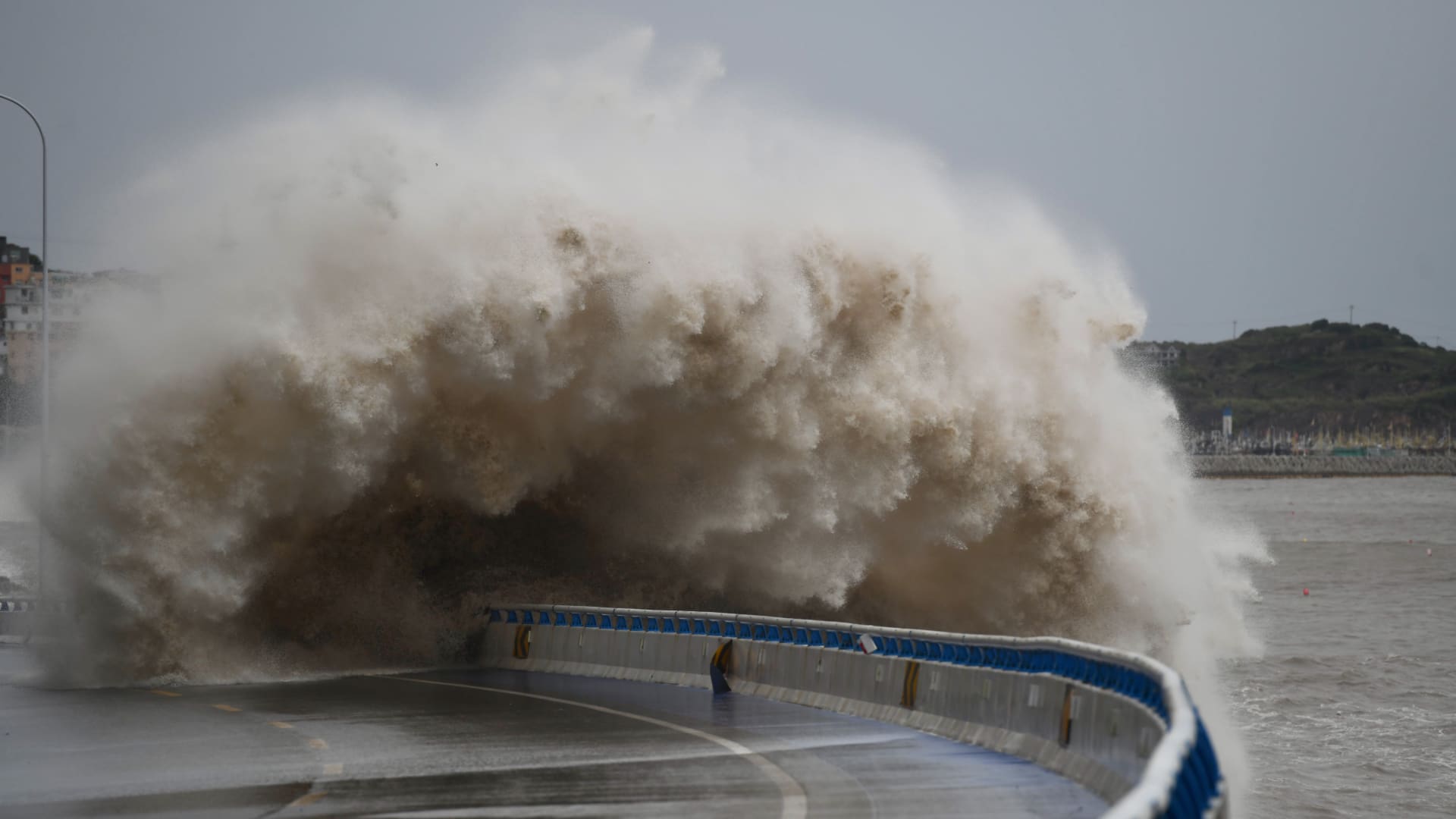
Huge waves crash along the coast as Typhoon Bavi approaches on July 11, 2026, in Ningde, Fujian Province of China. China’s National Meteorological Center continued to issue an orange alert for Typhoon Bavi on July 11, which is forecast to bring torrential rains and strong winds to parts of the country.
China News Service | China News Service | Getty Images
Typhoon Bavi, the most powerful storm to strike mainland China this year, brought heavy rain to the eastern coast on Sunday and lashed densely populated cities with violent winds, testing the country’s ability to cope with extreme weather.
Bavi had weakened by Sunday morning to a tropical storm as it pushed inland, but forecasters warned that the France-sized storm system could unleash prolonged and widespread rain across eastern and northern China in the coming days.
Over 2.8 million people have been evacuated, according to a Reuters tally of figures reported by state media.
Of those, more than 2.2 million were in Zhejiang, an economic and technological powerhouse in the world’s second-largest economy. There have been no official reports of deaths or injuries.
Bavi struck Zhejiang’s coastal city of Yuhuan at around 11:20 p.m. (1520 GMT) on Saturday before making a second landfall in Yueqing, part of Wenzhou, at around midnight.
“The winds were very strong,” Yueqing resident Li Liangxing told Reuters. “We could hear roof tiles and tree branches falling. Of course, we were scared, but we live by the sea, so we’re used to it.”
Gesturing toward a flooded canal beside his residential compound, Li said he had never seen the water so high.
“There used to be a walkway there, but now it’s underwater.”
More than 1,300 trees fell across Yueqing, with more than 700 of them uprooted entirely, state broadcaster CCTV reported. The deepest flooding reached roughly half the height of a vehicle tire.
Emergency crews on Sunday deployed excavators and chainsaws to clear waterlogged streets littered with fallen trees.
In the city’s mountainous north, CCTV footage showed a landslide that sent large boulders tumbling onto a mountain road, while swollen river waters submerged nearby trees.
In Kanmen, a coastal fishing town in Yuhuan, 72-year-old parcel shop owner Lin Yongjin was counting the cost of Bavi.
His shop, which faces the sea, bore the brunt of the storm. Metal frames supporting the entrance canopy had collapsed, and a window in a neighboring building had been blown out. Lin estimated the typhoon had caused more than 6,000 yuan ($885) in damage.
“After it came ashore, there was nothing we could do. Rainwater poured into the house. We spent the whole night dealing with it and didn’t get to sleep until after 5 a.m.,” he said.
Pedestrians holding umbrellas walk across a road in strong winds and rain as Typhoon Bavi passes off northeastern Taiwan in Keelung on July 11, 2026. (Photo by I-Hwa Cheng / AFP via Getty Images)
I-hwa Cheng | Afp | Getty Images
Having lived through many typhoons, Lin said this one stood out. “It was a very powerful typhoon. It made landfall right here in Kanmen. We were right in its path.”
Flights, trains disrupted
Bavi passed northern Taiwan on Saturday, bringing strong winds and driving rain across much of the island. The storm dumped nearly 80 cm (31 inches) of rain in one area in the northern county of Miaoli.
Taiwan’s fire department said on Sunday that 134 people had been injured, mainly due to falling off motorbikes, slipping, or being struck by objects. It reported no deaths. The transport ministry said 137 international flights had been canceled on Sunday, along with 62 domestic trips.
The disruption also extended to China’s transport networks. In Zhejiang’s provincial capital, Hangzhou, two major train stations suspended all services, and 327 flights were canceled at Xiaoshan International Airport.
In neighboring Shanghai, a total of 1,620 train trips and 684 flights were canceled, state-backed The Paper reported.
By Sunday afternoon, Bavi had moved into eastern Anhui province and was forecast to turn northeast before entering the northern Yellow Sea on Tuesday, China’s National Meteorological Center said.
The storm is expected to dump heavy to torrential rain across the provinces of Jilin, Liaoning, Hebei, Shandong, Jiangsu and Anhui from Monday, exacerbating flood risks in areas already soaked by earlier downpours.
In Hebei province’s Qianxi county, where nearly 190 millimeters (7.5 inches) of rain fell from Saturday to Sunday morning. Social media footage verified by Reuters showed rescuers using an inflatable boat to reach people stranded atop a partially submerged car after floodwaters transformed a public square into a muddy lake.
Even as Bavi weakened after landfall, its large circulation can continue to generate destructive weather hundreds of kilometers inland, said Benjamin Horton, the dean of the School of Energy and Environment at the City University of Hong Kong.
Scientists have warned China could face more extreme weather this year with the expected emergence of the El Niño weather pattern, which can drive up temperatures and shift typhoon tracks westward toward the country’s coast.
“Rapid intensification (of typhoons) reduces preparation time for communities and emergency managers, making these events particularly challenging,” Horton said.
