
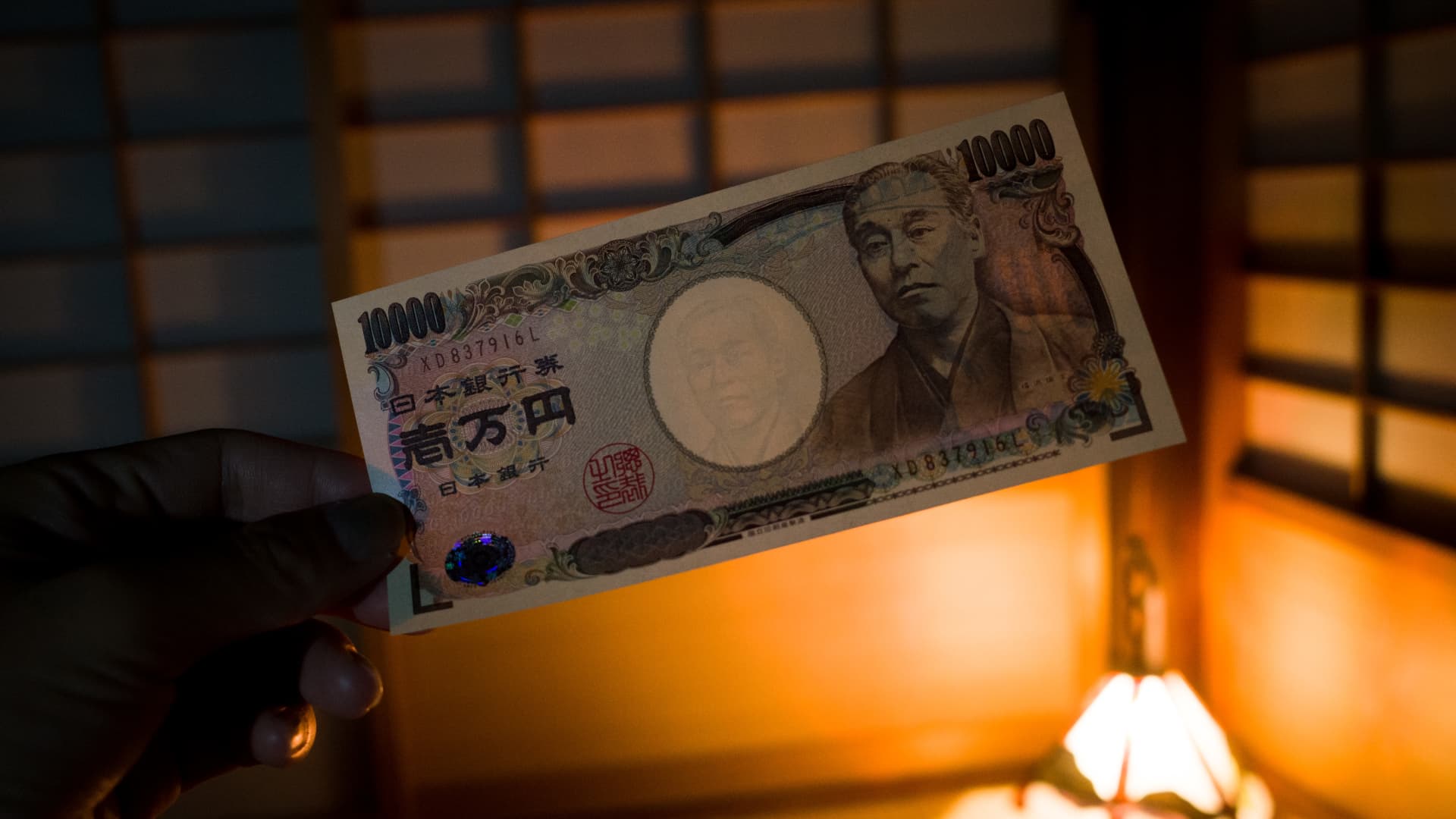
A Japanese 10,000-yen banknote arranged in Kyoto, Japan, on Thursday, Nov. 2, 2023.
Bloomberg | Bloomberg | Getty Images
Japanese government bond yields have been hitting multi-decade highs, with benchmark 10-year reaching levels not seen since 1996 last week.
While Japanese bonds have been selling off amid policy normalization by the Bank of Japan and concerns over Japanese Prime Minister Sanae Takaichi’s spending plans, experts say that the asset class deserves another look from investors.
“JGBs are increasingly moving from “uninvestable” to “investable” for global bond investors,” according to Masahiko Loo, senior fixed income strategist at State Street Investment Management.
Loo said that the multi-decade-high yields mean that investors are “finally” getting paid to own Japanese paper again.
The 10-year JGB yield hit 2.901% last Thursday and is currently trading at 2.781%, over 70 basis points higher since the start of the year. Yield on the 20-year JGBs also hit a high of 3.901% last Thursday.
JGBs were long impacted by the Bank of Japan’s yield curve control program, with the 10-year yield target set at “around zero,” as Japan sought to reflate its economy. The country abandoned YCC in March 2024 as part of its efforts to normalize monetary policy.
Hong Kong-based research firm Gavekal’s co-founder Charles Gave said in research note last week that Japanese government bond yields were higher than where they should be.
“The asset to buy in Japan is one that no one owns: Japanese bonds, especially Japanese long bonds. The Japanese bond market is probably the most attractive bond market in the world today.”
Investors should move toward a “balanced” Japan portfolio if they have no holdings in Japan, with 50% equities and 50% in bonds, other investors should also replace their euro and U.S. bonds, as well as gold, with long-dated Japanese bonds, Gave said.
“Pretty soon, Japanese yields will start falling and the yen will start to go up, especially if oil remains at its current price. Long-duration Japanese bonds should therefore significantly outperform gold in yen terms for the foreseeable future,” he added.
Some analysts, however, differ on the attractiveness of Japanese bonds.
Henning Potstada, global head of multi-asset at Germany-based asset manager DWS said that other bond markets, such as European bonds, were still more attractive due to a higher policy rate. The European Central Bank, Potstada pointed out, has rates at 2.25%, compared to the BOJ’s 1%.
Postada added that debt sustainability was more of a concern for Japan, with Tokyo’s debt-to-GDP ratio of above 200% compared to 81.7% for the EU. “If you have European positions stay or even do more in Europe, because the debt sustainability issues, we think will hold on, and exactly for these investors, Europe offers stability.”
Global impact
Lauren Hyslop, investment manager at Mattioli Woods, said that as Japanese government bond yields continue to rise, investors were “selectively” returning to the market.
“Foreign investors have piled back into the 20- to 30-year segment as yields broke above 3.5%, with a record 9.3 trillion yen flowing into longer dated Japanese debt in 2025 alone,” she said in an email. “The 10-year at around 2.87% is approaching what most major houses consider fair value, broadly in line with Japan’s growth and inflation outlook.”
Ultra-long positions are, however, a “live risk.”
“Life insurers become forced sellers if the 30-year breaches 4.5%, so that level is simultaneously an opportunity and a danger zone,” Hyslop said. “GPIF, the world’s largest pension fund, remains the most consequential potential buyer and any reallocation into domestic bonds from its $1.8 trillion pool would be a powerful stabilizing force.”
Hyslop told CNBC that these shifts had structural implications for the global bond market. “Japan spent two decades as the silent subsidizer of cheap global borrowing. That era is over,” she said.
Last Friday, Japanese Finance Minister Satsuki Katayama reportedly said the Tokyo would seek ways to encourage pension funds, including GPIF, to make “substantially greater investments in Japanese financial assets.”
While the government was exploring ways to boost such investments, there is no immediate revisions to GPIF’s medium-term objectives, according to a Reuters report.
“As domestic yields rise, Japanese investors are repatriating capital, selling $29.6 billion of U.S. debt in the first quarter of 2026 alone and removing a historically reliable buyer from markets already navigating large fiscal deficits.”
John Sidawi, senior portfolio manager for global fixed income at Federated Hermes, told CNBC via email that despite Japanese 10-year bond yields touching multi-decade highs, a “confluence of uncertainties” is still deterring nominal demand.
“Namely, newly founded fiscal pressures and the general position that the Bank of Japan is still behind the curve [on raising rates],” he said. “This dynamic is further exacerbated by Middle East geopolitical tensions which have been exerting upward pressure on global yields in general.”
