
Stay informed with free updates
Simply sign up to the Technology sector myFT Digest — delivered directly to your inbox.
The University of Cambridge will next week unveil a one-of-a-kind testing machine to speed up the development of aerospace and other industrial breakthroughs as part of a bid to bolster Britain’s manufacturing sector.
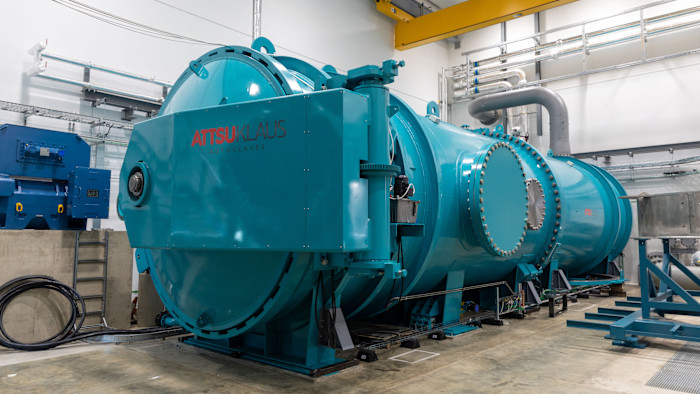
The innovative wind tunnel, housed in a teal-coloured, pressurised container, cost £14mn to develop and is “the only machine of its type in the world”, according to Rob Miller, director of the university’s Whittle Laboratory.
The high-pressure machine is able to test small-scale prototype models in real-life conditions, meaning the designs can be validated at speed.
It is part of an ambitious project by the university to combine physical tests with AI to compress development timelines of new technology from years to months or even weeks, with the ultimate aim of creating UK unicorns focused on aerospace, defence and energy.
The project hopes to help reverse a trend in Britain of pioneering technologies being initially developed here but then moving overseas to commercialise and grow in size because of a lack of funding.
“We are about a hundred times faster than anybody else in the world of testing but the data rates [we can achieve with this machine] are probably a thousand times [faster],” said Miller.
The large amounts of data generated by the machine can be used to train an AI model.
The machine, together with cutting-edge tools to speed up manufacturing, is housed in a new affiliated facility funded by Peter Bennett, the former banker and hedge fund manager turned philanthropist.
Under the project, small teams of researchers will be given ambitious “missions”, each of which is expected to last about two years and require between £1mn and £3mn of funding that is likely to come from a blend of industry, philanthropy and government. The aim is to get to the stage where a new technology has been tested and validated so it can then attract venture capital backing.
The missions will be chosen according to three criteria — the opportunity needs to be significant rather than just an incremental development; it needs to offer the UK the chance to build a sovereign capability using domestic supply chains; and the opportunity needs to be able to be proven to work quickly.

Miller said a test mission, to develop a prototype of a jet engine that burns supercooled liquid hydrogen, showed the concept works.
“We built this machine to give these crack small mission teams a superpower,” said Miller, while adding: “We see this as a sort of unicorn machine.”
Elliott Grant, co-head of the new Bennett Innovation Lab and a former executive at X, Alphabet’s experimental hub, said the aim was to bring “Google X or Bell Labs — those traditional, audacious innovation labs — into Cambridge”.
Grant said AI was no longer confined to large language models but was moving to map real-world conditions to understand design and engineering. “Imagine what a large language model did for language, a world model can do for physics or material science,” he added.
Miller said aerospace companies had traditionally taken six to eight years to move from idea to prototype: “We want to do it in a couple of weeks.”
The team will unveil the project at a summit, dubbed the Frank Whittle Summit, on Monday to coincide with the opening day of the biennial Farnborough Air Show which brings together the world’s largest aerospace and defence companies.
One of the missions to be discussed will be technology breakthroughs in aero-engines to power narrow-body or short-haul aircraft. Rolls-Royce is in talks with the government about securing funding to help develop a new engine for this segment of the market.
Grant, who read engineering at Cambridge, said what had been missing from the UK was a “culture of audacious risk-taking” that was willing to use small amounts of risk capital to take bets on small teams. Success for him, he added, would be for the Whittle to become known for incubating hardware start-ups just as America’s Y Combinator is known for its software start-ups.
“The race is on — this technology is coming online,” he said. “The US obviously is going after it. We should absolutely assume China’s going after it. The UK is in a terrific position to be a key player in this.”
