

Close Menu

    Subscribe to Updates

    Get the latest creative news from FooBar about art, design and business.

    What's Hot

    Bentley launches Torcal as luxury rivals pull back on electric cars

    September 24, 2026

    No Kings But King Dollar

    September 24, 2026

    Ukraine: Russia welcomes U.S. invite for possible Trump-Putin meeting

    September 24, 2026
    Facebook X (Twitter) Instagram
    Addison Markets Addison Markets
    • Home
    • USA
    • Europe
    • Business
    • Investing
    • Tech
    • Politics
    • Contact Us
    Addison Markets Addison Markets
    Home»Tech»We’ve seen helium baked off a rocky exoplanet’s atmosphere
    Tech

    We’ve seen helium baked off a rocky exoplanet’s atmosphere

    franperez66q@protonmail.comBy franperez66q@protonmail.comJuly 16, 2026No Comments2 Mins Read
    Facebook Twitter Pinterest Telegram LinkedIn Tumblr WhatsApp Email
    Share
    Facebook Twitter LinkedIn Pinterest Telegram Email


    Most of the gas in the Universe is a mixture of hydrogen and helium. It’s thought that the initial atmospheres of most planets also start out that way. However, over billions of years, as planets evolve, the composition of their atmospheres may shift. Hydrogen can react with other chemicals, and both it and helium can be lost to space. Venus, Earth, and Mars are thought to have second atmospheres, with their original hydrogen/helium envelopes having been lost and/or transformed.

    The dynamics of loss are complicated. Lighter elements are lost more easily, but hydrogen can be protected by being incorporated into molecules like methane and ammonia. The gravity of the body can help retain some molecules, and a magnetic field can limit radiation’s ability to blast material out of the atmosphere. Proximity to a star will matter too, both because of the radiation it produces and because it can heat the atmosphere and expand it to where gravity’s influence is less substantial.

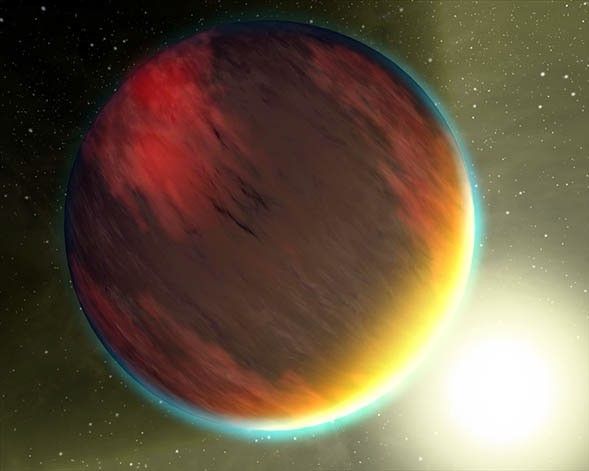
    Given all these complications, it can be difficult to know what to expect to find on exoplanets. But a study in Wednesday’s issue of Nature describes observations of helium being lost from the atmosphere of an exoplanet orbiting the star LHS 1140, about 50 light-years away. Based on the rate at which the helium is being lost, we can infer something about the remaining atmosphere.

    Maybe an atmosphere?

    LHS 1140a is a red dwarf star with two known planets orbiting it. One of them, LHS 1140c, is close to the star, completing an orbit in a bit under four days and receiving about five times more radiation from its host star than the Earth receives from the Sun. Also, a second planet, LHS 1140b, is considerably farther out. It takes nearly 25 days to complete an orbit. That places it significantly closer to its host star than Mercury is to the Sun. Because LHS 1140a is such a dim star, this means it receives less than half as much light from its star as the Earth does.


    Source link

    Share. Facebook Twitter Pinterest LinkedIn Tumblr Email
    franperez66q@protonmail.com
    • Website

    Related Posts

    Ukrainian drones overwhelm Russian tanks’ new active protection system—for now

    August 19, 2026

    Jim Cramer says the market is too negative — and that’s creating buying opportunities

    August 19, 2026

    “Sabotage”: Experts, lawmakers blast RFK Jr. for destroying healthcare research

    August 18, 2026

    OpenAI rolls out ChatGPT for Teens with more safety protections

    August 18, 2026

    Against all odds, SpaceX finally tugs Starship into port after 24 days at sea

    August 18, 2026

    Economists warn AI-driven market rally is due a sharp correction

    August 18, 2026
    Leave A Reply Cancel Reply

    Top Reviews
    Editors Picks

    Bentley launches Torcal as luxury rivals pull back on electric cars

    September 24, 2026

    No Kings But King Dollar

    September 24, 2026

    Ukraine: Russia welcomes U.S. invite for possible Trump-Putin meeting

    September 24, 2026

    Swiss National Bank holds rates at 0% as inflation stays low

    September 24, 2026
    © 2026 All right reserved
    • Privacy Policy
    • Terms & Conditions

    Type above and press Enter to search. Press Esc to cancel.