
This article is an on-site version of our Inside Politics newsletter. Subscribers can sign up here to get the newsletter delivered every weekday. If you’re not a subscriber, you can still receive the newsletter free for 30 days
Good morning. Greetings again from Manchester, where we’ve mainly been complaining about everything smelling like it’s been barbecued, because of the raging moorland fires on our peripheries.
Hopefully that’s not an omen ahead of Monday, when Andy Burnham becomes prime minister. Given the black-box nature of his operation, the strongest signals on his policy direction still lie in the time he has spent here.
So here is one final interpretation of his June 29 speech at the People’s History Museum, the only exposition to date of his blueprint for government, in which he drew together many of the lessons he has drawn from nine years as mayor.
But today I’ve moved my lens from Manchester to South Yorkshire, where there are just as many clues to his thinking.
In that spirit, I have also shifted my painfully contrived music references.
You’re not from New York City, you’re from Rotherham
“Reindustrialisation” will be one of Number 10 North’s key priorities, Burnham said two-and-a-half weeks ago.
What does he mean? To parts of the trade union movement, much of the Labour Party and indeed a certain section of the electorate, it hints at the pre-Thatcher era he references when he talks about ending “40 years of neoliberalism”.
For the same reason, sceptics may read it as rose-tinted and economically illiterate.
But there are more complex realities in the endeavours both he and other mayors have been championing in recent years.
Much has been made of Manchester’s growth story, but here is the productivity gain in one South Yorkshire postcode since 2004:
The Advanced Manufacturing Research Centre in Rotherham, just outside Sheffield, has a very “Manchesterism” vibe.
It was dreamt up in Sheffield university in 2001, as a place the “R” and the “D” in R&D could meet and where their cutting-edge research could help the market, taking the risk out of innovation for companies.
Today its scores of industry partners include Boeing, BAE and MacLaren; it now also has centres in Lancashire and North Wales.
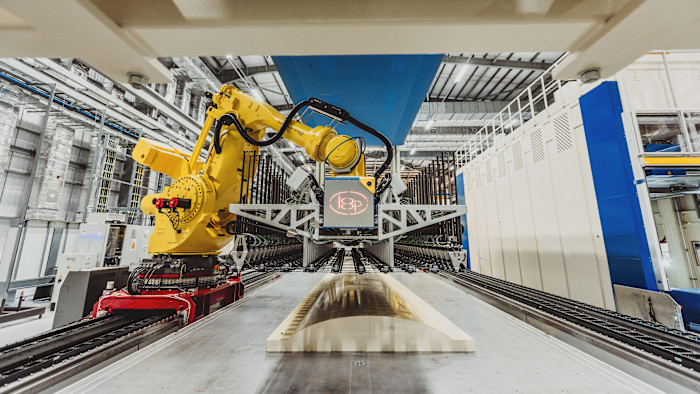
Yesterday the AMRC launched its latest centre, COMPASS (“Composites at Speed and Scale”), a new advanced materials facility that Boeing sees as a route to meeting demand for 44,000 new aircraft over the next two decades.
“We want to make certain that we are using absolutely state of the art technology which makes flying more sustainable for the longer term,” Boeing’s UK and Ireland president Sir Jeremy Quin told me yesterday.
“That means lighter aircraft, it means less fuel usage . . . we’re very proud of the fact that in Sheffield we have here our biggest single R&D project in Europe.”
Far from turning back the clock, for Boeing this is a serious future-looking endeavour, based on academic research propelling modern commercialisation.
Nonetheless the AMRC’s story also appeals to a 20th-century manufacturing memory that lingers in places like South Yorkshire.
South Yorkshire mayor Oliver Coppard argues that the region already has assets such as the AMRC and other such expertise that can be capitalised upon through coherent strategy, infrastructure, financing and partnership.
He cites a conversation he had a few years ago with the economist Ricardo Hausmann.
He said: the problem we have is everywhere wants to be the next Silicon Valley. And you can’t be the next Silicon Valley if you don’t have the assets in place to take that next leap. You have to build on what you’ve got already.
What people do is they throw in their chips, turn their backs on the assets they do have and the strength they do have, and try and build this whole new set of industries based on a model which exists hundreds if not thousands of miles away. It doesn’t work.
The AMRC drew on the economic “muscle memory”, in Coppard’s words, of the area around Sheffield. As in Manchester, the project has been a 25-year bet, underpinned by a smart collaboration between different key players.

It also points to Burnham’s reasons for focusing on the skills agenda, as other mayors do. There are echoes of Alan Milburn’s remarks last week about technical education — that it is seen as being “for other people’s children” — in those of Andy Silcox, chief technology officer at the AMRC, when he spoke to me about engineering.
“People don’t encourage their kids to go into it,” he said. “I don’t think we give it the same respect other countries do.”
To some readers that may sound nostalgic. I would point you towards the graph above, though, and the forward-looking nature of his endeavours. This is not meant to be a Spinning Jenny in every postcode.
“Is this just a doomed nostalgic call for a return to coal mines, steel furnaces and cotton mills? I don’t think so,” wrote materials physicist Richard Jones in his blog about Burnham’s speech.
Jones has not only been influential on Burnham’s local industrial policy in recent years but helped establish the AMRC. Notably he was also cited by Dominic Cummings in the early days of the levelling up agenda, before Covid and related catastrophes put paid to it.
“The key point is to support and grow regional businesses that produce tradeable goods and services,” Jones added.
“This is important in economic terms — these are the activities that bring money into communities. But I suspect that it’s also important in that it gives communities a sense of purpose, a sense that they too are contributing to the nation more widely.”
It is where Burnham hopes politics and economics meet. You could call it Rotherhamism.
What does it mean nationally, though? As I have pointed out previously, the government does already have an industrial policy. I’m not sure it has been seen as a roaring success, though. Perhaps Burnham would look to rewrite, with more of a bottom-up focus on the varied nature of the country’s economic geography.
Perhaps he will countenance more risk appetite among the public financial institutions set up by Rachel Reeves, an approach many local leaders — including Coppard — would like to see.
The model of Jim O’Neill’s Northern Gritstone, which has deployed VC capital into spinouts at northern research universities, may also be worth keeping in mind.
As I wrote last week, Burnham is not anti-university. But I think he will expect the sector to be more intrinsically focused on the relationship between their outputs and their local economies: Sheffield has clearly been doing this for decades.
My guess is those university vice-chancellors who are unused to this need not panic — Burnham studied English at Cambridge, and understands its value — but would still do well to understand what it is he likes about the AMRC, or indeed Manchester university’s nascent partnership with Cambridge.
Nonetheless, the graph above only relates to the one tiny neighbourhood surrounding it. You can also see a second line, which is the Rotherham GVA average.
That Rotherham also experienced the most extreme riot of two summers ago — when a mob tried to burn down an asylum hotel with people inside — will not be lost on Coppard.
That dynamic is in the back of Burnham’s mind, too, when he talks about the Makerfield Test: an attempt to bind his proposals to the economic frustrations raised by his new constituents, 20 miles down the road from where those riots began in Southport.
Such frustrations are now, not a quarter of a century ago.
His promise of “growth in every postcode” therefore implies spreading the AMRC’s productivity success to Wath-upon-Dearne; Manchester city centre’s to Makerfield; and, hardest of all, towards and within places without obvious economic locus.
For all its success, this also implies doing so more quickly than even the AMRC has yet been able to achieve.
It’s not a reason not to try. Burnham and many others would argue that we can’t afford not to — and now, indeed, neither can he.
Top stories today
-
Policy blitz incoming | Whitehall insiders say a “nascent grid” of announcements for Andy Burnham’s first few days in office is taking shape. Without breaking the manifesto pledge to ban new exploration licences in the North Sea, he is expected to suggest other ways the government can allow more drilling to take place in the North Sea, including greater use of “tiebacks” that allow further drilling next to existing fields.
-
Tight rope | The IMF has warned that Andy Burnham cannot afford to boost public spending given the “challenging” UK budgetary outlook, with any support for energy bills needing to be offset by savings elsewhere.
-
ICYMI | Varun Chandra, Keir Starmer’s top business adviser, is to stay in post when Burnham enters Number 10. Matthew McGregor, chief executive of campaign group 38 Degrees, will be Burnham’s director of political strategy.
-
How project ‘ABC’ unfolded | George Parker and Jen take us inside the year-long effort to ensure that by this year’s Labour party gathering in Liverpool at the end of September Burnham would be in charge, a project known as “ABC”, or “Andy by conference”.
-
From the London left to the northern set | The core of Burnham’s critique of Labour’s mistakes in government is cultural, argues Patrick Maguire over on Substack.
