
Stay informed with free updates
Simply sign up to the War in Ukraine myFT Digest — delivered directly to your inbox.
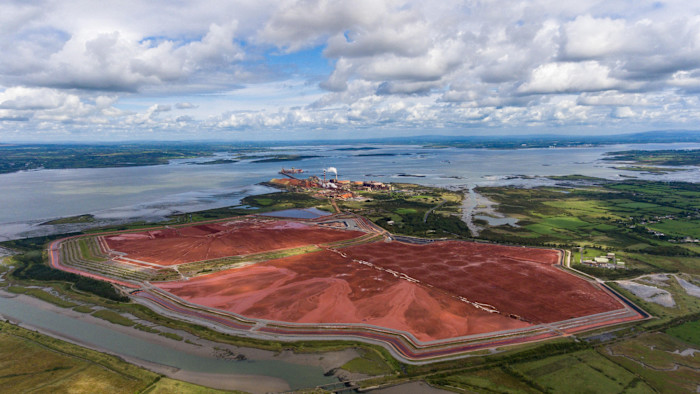
Dublin has urged Brussels to consider the EU’s own need for alumina, the raw material used to make aluminium, as it weighs sanctions that could hit a Russian-owned factory in Ireland accused of fuelling Moscow’s war machine.
Ireland’s deputy prime minister and finance minister, Simon Harris, told the FT that the fate of the Aughinish Alumina plant in the country’s south-west is “as much, if not more, a European issue than an Irish issue”.
Dublin is expected this week to send the European Commission its official investigation into whether exports from the factory are used to make aluminium that ends up in Russian missiles, drones and other weapons used against Ukraine.
Aughinish, Europe’s largest alumina refinery and one of only five in the EU, has become the focus of an international spat after an investigation published this year by the Irish Times suggested that output from the plant was sold to a trading house that supplies a major military-industrial hub in Russia.
Neither alumina nor the Aughinish plant is subject to EU sanctions, but some member states have pushed for it to be included.
Without naming Aughinish directly, Ukrainian President Volodymyr Zelenskyy demanded sanctions against companies based in Europe that “keep supplying the aggressor with essential materials” at the ceremonial EU presidency launch in Dublin this month.
Ireland’s Taoiseach Micheál Martin was in Kyiv on Thursday for talks with Zelenskyy.
Harris declined to comment on whether he thought the factory, which employs almost 900 staff and contractors, should be shielded from sanctions or not, but said: “The European market is going to need alumina.”
“We’re producing alumina in Ireland, which the European market is very dependent on,” he added.
Aughinish has said it supplies 37 per cent of the EU’s smelter-grade alumina, making it central to the EU’s target to process 40 per cent of critical raw materials within the bloc by 2030.
The plant in County Limerick is the majority supplier to Europe’s biggest aluminium smelter, Aluminium Dunkerque, in France, which Aluminium Bahrain (Alba) last month agreed to buy. It is also the sole supplier to the Rusal-owned Kubikenborg plant in Sweden.
The Irish government’s probe is expected to say that it cannot determine conclusively how much of the plant’s production ends up in weapons in Russia.
Aughinish has said only 10 per cent of Rusal’s total alumina needs in Russia come from Ireland. Displacing supply from Aughinish will only ensure that Rusal looks to China or India instead, the company has argued.
Rusal has said it sent 51 per cent of the alumina from Aughinish to Russia in the first half of this year, compared with 45 per cent in 2025.
Dublin will pass its investigation on to Brussels and leave the Commission to weigh potential sanctions. Ireland’s enterprise ministry is expected to publish a summary of the report.
Ireland had “enthusiastically” supported all EU packages for sanctions against Russia, Harris said. “I’ve consistently said we can’t cherry-pick . . . We support Ukraine.”

But Irish officials nevertheless hope the Commission will not adopt any measures that they fear could hurt Europe’s economy more than Russia’s.
There are concerns locally that any sanctions will cause job losses or force the factory’s closure. Harris said he was very conscious of feared lay-offs.
But he noted that “there have been occasions where Europe has had to diversify supply chains. Europe and governments have to be able to do more than one thing at a time. There will be a need for alumina to be produced for the European market, full stop, end of [story],” Harris said.
“There’s an ability to produce alumina in Limerick. It’s not a bad starting point for various conversations,” he added.
He declined to say what might happen if EU sanctions were applied and Rusal cut off imports of the bauxite that is smelted at Aughinish.
Nationalisation of the plant “might not be legally straightforward” but he said: “I think there are still options that can and should be explored.”
Aughinish did not immediately respond to a request for comment.
