
Stay informed with free updates
Simply sign up to the Eurozone economy myFT Digest — delivered directly to your inbox.
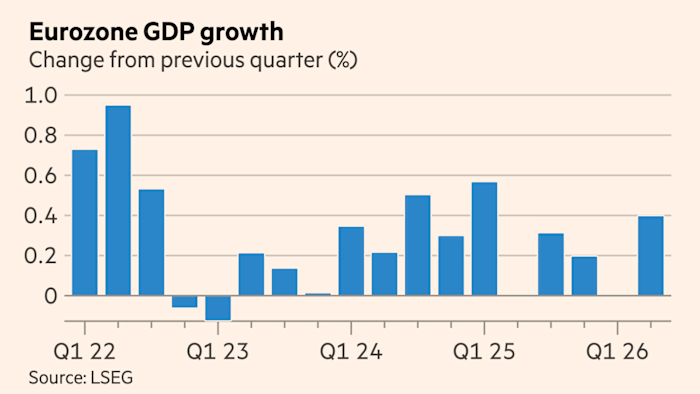
The Eurozone economy grew 0.4 per cent in the second quarter, surpassing expectations, despite continued volatility in energy markets triggered by the US-Iran war.
The figure was above the 0.2 per cent growth projected by economists in a Reuters poll. It marked an improvement on the upwardly revised figure of zero growth in the first three months of the year.
The outcome was “absolutely remarkable” given the geopolitical uncertainty and elevated energy prices, said Karsten Junius, chief economist at Bank J Safra Sarasin.
The US and Iran agreed to extend their ceasefire at the end of the second quarter, pushing the price of Brent crude back to its prewar level. But it has since surged back above $92 a barrel after the truce collapsed.
Carsten Brzeski, chief economist at ING bank, noted that the largest Eurozone economies all grew by at least 0.2 per cent when compared with the previous quarter. The economies of Germany, France and Italy all expanded by 0.2 per cent, while Spain grew by 0.7 per cent.
“Spain is not only world champion in football but also European champion in economic growth,” said Brzeski.
But he added that, given continued high energy prices and improvements in economic sentiment in the 21-country currency area, “it will be hard for the ECB not to hike interest rates at the September meeting”.
Rory Fennessy, senior economist at consultancy Oxford Economics, cautioned against “overinterpreting this upside growth surprise”, adding that he doesn’t “expect growth to accelerate meaningfully from here” following renewed tensions in the Middle East. American forces launched a two-hour “heavy” round of strikes on Iran on Wednesday night.
The European Central Bank last week held interest rates at 2.25 per cent but only after members of its governing council discussed a rise.
Traders are betting on a quarter-point rate increase — the second this year — in September or October as inflation remains above the ECB’s 2 per cent medium-term target. Eurozone inflation data for July will be published by Eurostat on Friday.
The ECB last month cut its GDP growth projections for 2026, forecasting that the Eurozone economy would expand by 0.8 per cent, before improving to 1.2 per cent next year.
The euro was little changed on the Eurozone GDP data release, down 0.1 per cent against the dollar at $1.145.
Separate figures showed the Irish economy, which had contracted sharply in the first three months of the year and dragged on the overall Eurozone performance, returned to growth in the second quarter, expanding by 3.9 per cent.
Ireland’s GDP figures are notoriously volatile as they are distorted by cross-border financial flows stemming from multinational corporations that have their European headquarters in the country.
