

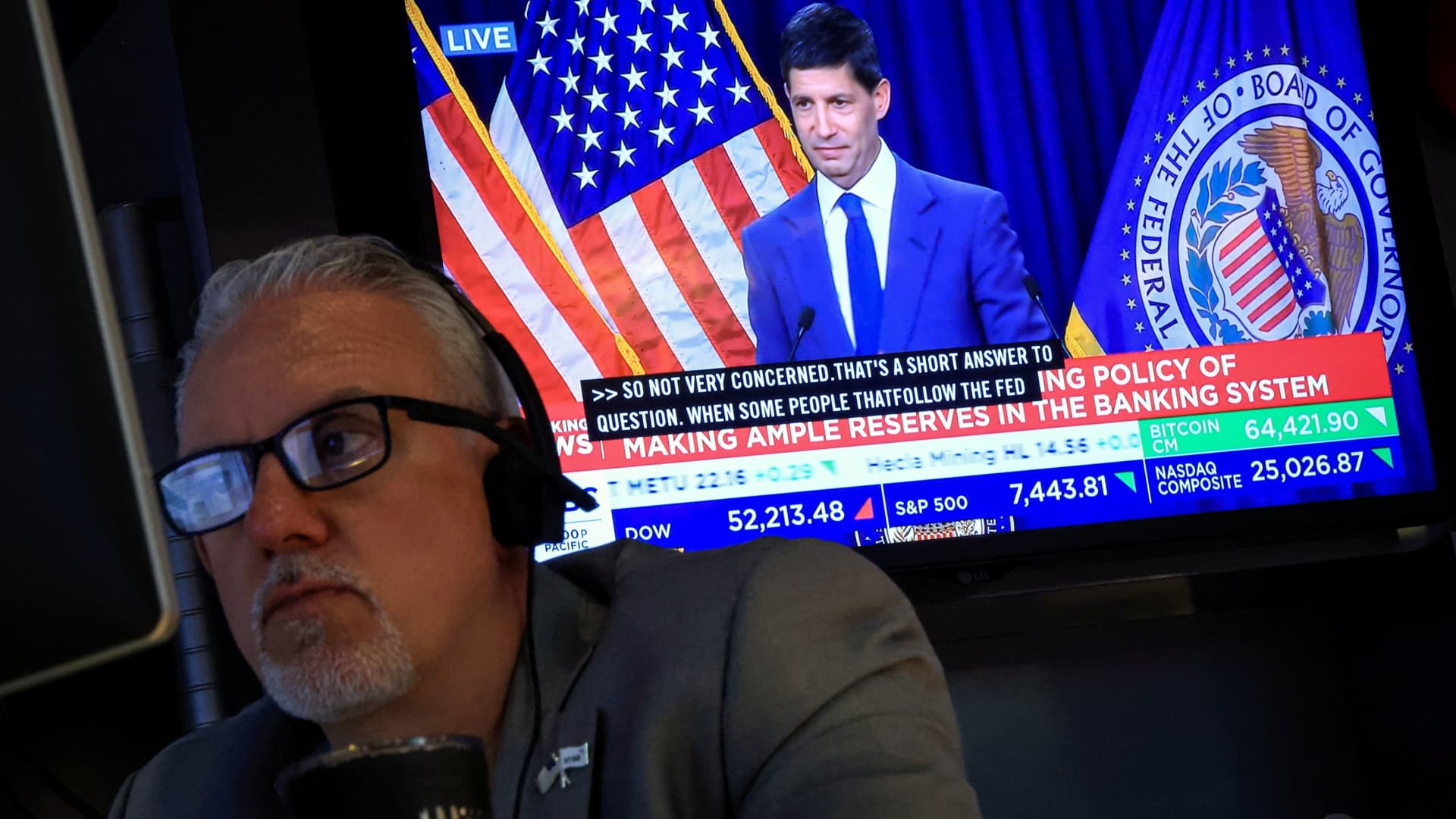
A trader works, as a screen broadcasts a press conference by U.S. Federal Reserve Chair Kevin Warsh following the Fed rate announcement, on the floor of the New York Stock Exchange (NYSE) in New York City, U.S., July 29, 2026.
Brendan McDermid | Reuters
The overwhelming response to Federal Reserve Chairman Kevin Warsh’s comments on Wednesday was that he would go easy on inflation. Investors who drove up bond yields in response should be careful.
Looking closely at what he said, Warsh may not be as dovish as widely believed. If inflation continues to come in above target, then Warsh — judging by his own words — may feel compelled to act soon to restrain the economy. Investors who act on what they thought they heard risk being blindsided if a rate increase is around the corner.
Crucially, Warsh opted not to celebrate a soft inflation print that had come in prior to the meeting. Had he wanted to present a dovish message, he could have seized on that data. Instead, he wrote it off.
Warsh’s muddled performance Wednesday at his second press conference scrambled many investors’ view of the Federal Reserve. Some saw a man who had been long perceived as an inflation hawk appear to talk down worries about inflation. He answered reporters’ questions with vague statements and left many confused.
Some concluded Warsh is in thrall to President Donald Trump, who continues to ask the Fed for lower interest rates, despite the central bank’s statutory independence and pledges from both the president and Warsh that independence remains.
A chorus of market analysts said Warsh performance called his credibility into question. Long-term treasury yields rose, while the dollar fell and gold rose.
But if the market is misreading the Fed chairman as a dove, it could be in for further violent moves when traders are forced to unwind their positions. It helps to look at the prepared statement Warsh read out at the beginning of the press conference that reflected the message he went into the room intending to send — rather than what emerged from the back-and-forth with reporters.
Ahead of the meeting, the consumer price index showed a rare decline, with prices falling by 0.4% in June from the month before.
Warsh was muted on that point. “We understand that the five-plus years of inflation above target cannot be cured in nine weeks — or by a single month of modest price decreases,” he said Wednesday, speaking for the Federal Open Market Committee, which sets the Fed’s benchmark interest rate.
The words of Fed chairs are among the most carefully parsed remarks in the world. Warsh’s performance Wednesday shows he hasn’t yet figured out how to rhetorically separate the short-term and long-term challenges. Nor did his exchanges with reporters bolster his prepared remarks. Instead, he undermined himself and his carefully crafted message.
Investors were hoping to hear a chairman who would strike a hasty blow against fast-rising prices and speak up to a president who continues to bear down on the Fed. Investors didn’t get that on Wednesday. Instead they heard about his plans to tinker with inflation measurements, and panicked.
But that isn’t to say Warsh didn’t try or intend to deliver the message that he was willing to raise rates.
“Where necessary and appropriate, we will not hesitate to act,” Warsh said in his prepared remarks.
It is easy to dismiss that kind of language as empty hand-waving. But in 2012, then-Chairman Ben Bernanke — one of Warsh’s mentors — pledged to “provide additional policy accommodation as needed,” and then proceeded to launch a new round of massive asset purchases. In May 2022, Jerome Powell told reporters that “we will not hesitate” to raise interest rates if necessary. In June, he hiked rates by three-quarters of a point.
Tangled language on inflation
Warsh has often spoken of the tremendous promise of AI to produce growth without inflation. But in his prepared remarks, Warsh was more circumspect. He said it wasn’t clear when the economy’s productive capacity would be able to jump in response to all the spending that’s happening now. As he put it, “the precise timing and magnitude of effects on the supply side remain hard to predict.”
Warsh also spoke more clearly in his opening remarks about a point some analysts seized on in his later responses to reporters. The Fed’s formal commitment on prices is to achieve 2% annual inflation over the long run as measured by the personal consumption expenditures index.
Asked about PCE, Warsh gave some observers the impression that he might change the 2% target. We are sticking with PCE for now, Warsh said. But, “who knows, come after next January, what we might say about strategy.”
But Warsh showed no ambiguity in his prepared remarks. “There is no soft inflation target, there is no soft implicit target — not on this Committee’s watch. There is only a target, and it is 2 percent.”
So what is the Fed chairman prepared to do about it? There, too, his opening remarks dropped hints. The FOMC didn’t just discuss interest rates, Warsh said. “We discussed monetary policy tools and strategies for achieving stable prices.” The committee, Warsh explained, asked, “how much accommodation are we getting from the balance sheet?”
In other words, Warsh has already begun the task of moving the FOMC toward his long-stated goal of shrinking the Fed’s balance sheet. As he has said elsewhere, that would effectively tighten financial conditions, similar to the effects of raising interest rates.
The issue of the balance sheet speaks to Warsh’s challenge: He doesn’t have the power to quickly push through the changes he wants. Warsh came into the Fed with an agenda for “regime change,” as he described it. But the mechanism to achieve that change is a set of slow-moving task forces that he believes will sooner or later nudge the Fed into his preferred reforms. He wants to reduce the balance sheet, find alternate ways to measure inflation and get ready for an economy reshaped by AI.
But the task forces won’t report back before the end of the year at the earliest. The committee clearly isn’t ready to take action on the balance sheet. Warsh’s explicit discussion of the Fed’s “tools” is a strong indication he will take the earliest possible opportunity to use the balance sheet to tighten monetary policy, in addition to anything he might do on interest rates.
Meanwhile Warsh has to deal with an economy battered by tariffs and high energy prices that he can’t influence directly, and by an AI boom whose potential fruits are still over the horizon.
Warsh has spent decades studying the leaders of the Fed and their failures. Credibility is paramount to him. His words suggest he may be further down the path to a rate hike than investors interpreted following Wednesday’s meeting — and might just be waiting for the two inflation reports that come before the FOMC gathers next in September.
Given the beating he took in the aftermath of this meeting, it likely won’t take him much to pull the trigger on a rate increase at the next one.
