
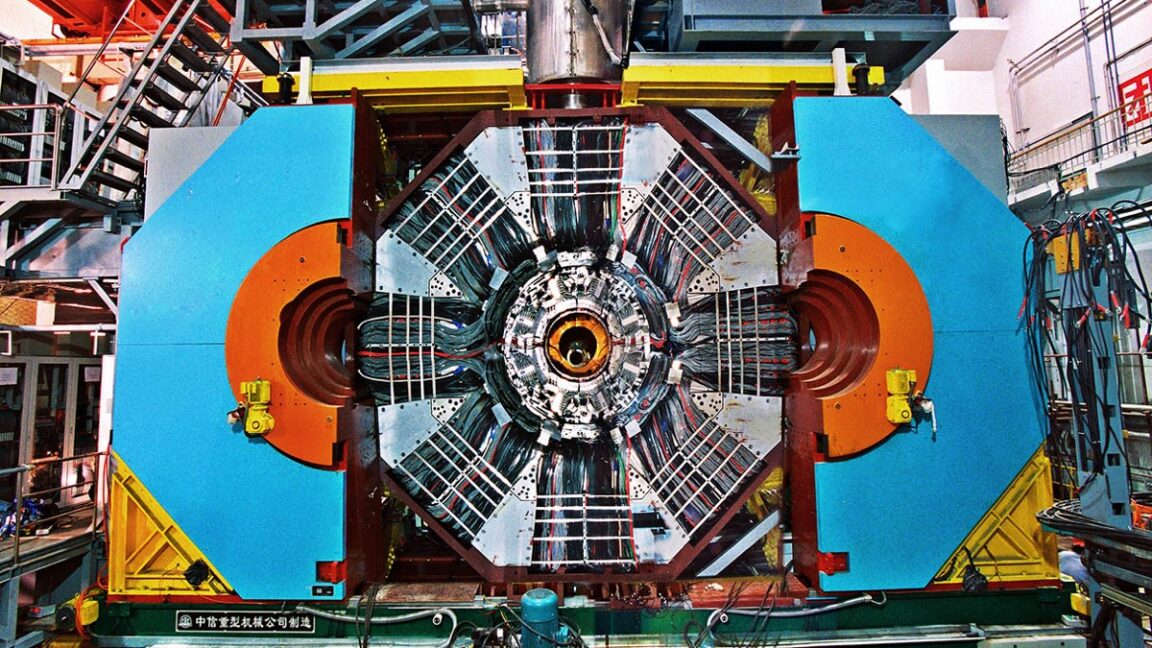
Physicists with the Beijing Spectrometer III (BES III) experiment have uncovered convincing new evidence of the existence of so-called glueballs, an elusive composite particle made entirely of gluons predicted by quantum theory. The results appeared in a preprint posted to arXiv last month and were also presented last week at the International Conference on High Energy Physics (ICHEP).
All the stuff we see around us is made up of quarks held together by gluons (carriers of the nuclear strong force) to form protons and neutrons, which comprise the core of every single atom. The Higgs boson, discovered in 2012 after decades of searching, was widely touted as the final missing piece of the Standard Model of Particle Physics. But there are still plenty of unanswered questions, including whether or not glueballs really exist. They should, if the Standard Model is correct; they’re a direct prediction of quantum chromodynamics, i.e., the theory of the strong nuclear force. There should even be several kinds of glueballs.
As Matthew Francis wrote for Ars in 2015:
Just like the Higgs boson, glueballs are part of the reason that matter has mass. The Higgs boson is a manifestation of the “Higgs field,” which is present throughout the Universe. Quarks, electrons, and other fundamental particles would be mass-free in a Higgsless cosmos, but when they interact with that field, they pick up mass. In contrast, most of the mass of protons and neutrons doesn’t come from quarks; it comes from the “glue” holding them together.
Gluons are the reason for that glue (they are named “glue-ons,” after all). Though they don’t have mass, the energy involved in binding everything together inside a proton is huge, and a lot of that energy takes the form of mass thanks to E=mc2. Without gluons, protons wouldn’t exist, much less be as massive as they are. But there’s another side effect: gluons stick to each other, not just to quarks. That means it could be possible to build a particle out of just gluons, with no quarks needed—that’s the glueball.
There is a dizzying array of subatomic particles in the particle zoo. Of particular relevance to the hunt for glueballs is the so-called J/ψ particle discovered in 1974, a meson consisting of one charm quark and one charm antiquark. When those particles decay, they produce a lot of gluons and composite particles known as hadrons in the process, so physicists have long thought that this was the best experimental regime in which to search for glueball signatures. According to astrophysicist Ethan Siegel, for a particle to be considered a possible glueball, it must have zero spin, no electric charge, and odd parity, among other properties.
