
Stay informed with free updates
Simply sign up to the Russian politics myFT Digest — delivered directly to your inbox.
Russian President Vladimir Putin’s visit to a disputed Pacific island chain has drawn a strong rebuke from Japan’s Prime Minister Sanae Takaichi, who warned that the move risked damaging relations.
Putin reignited the more than 80-year dispute over the Kuril Islands, which the Soviet Union seized from Japan at the end of the second world war, with a visit on Thursday to Iturup, known as Etorofu in Japan.
The trip was the Russian president’s first to the Kurils in his 26-year rule, though he was not the first Russian head of state to visit the islands. In the run-up to the trip, Putin attended military drills, criticised Japan’s government and donned naval garb to meet senior officers to discuss protecting Russia’s eastern borders.
Japan “repeatedly urged the Russian side not to proceed with such a visit”, Takaichi told reporters on Thursday.
“Despite this, President Putin visited Etorofu island today, and we strongly protest the visit,” she said. “This visit has further worsened sentiment towards Russia in Japan and made it more difficult to restore relations over the medium- to long-term.”
Japan’s foreign ministry also summoned the Russian ambassador to protest against the “extremely regrettable” visit.
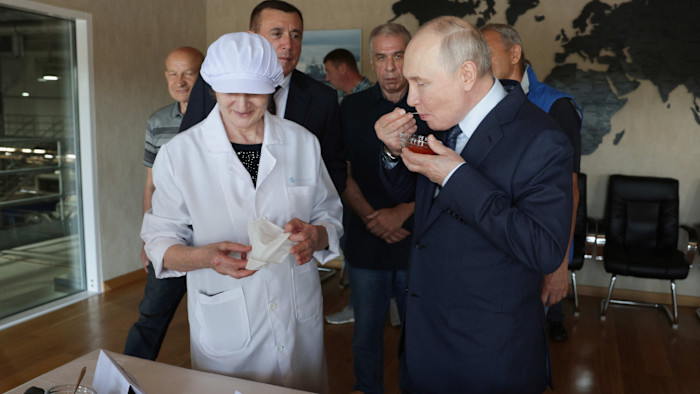
The Kremlin released footage of Putin visiting a fish-processing plant, a school and a hospital as well as meeting the region’s governor, who told him that Russians were working to support the invasion of Ukraine “even in the most remote areas”.
Putin replied: “These are our people. The genetic code of the conqueror.”
The Kuril Islands have been a repeated source of tension. Japan never signed a peace treaty with the Soviet Union at the conclusion of the second world war because of Moscow’s claim over the four southernmost islands in the chain, which Tokyo calls the Northern Territories.
Covering about 5,000 sq km, the islands, which are now controlled by Russia, host a population of about 20,000 and rich fishing grounds. The Japanese population was expelled after the war.
In a speech on Wednesday, Putin accused Tokyo of “abandoning” a joint declaration under which the Soviet Union pledged to transfer two smaller islands — Habomai and Shikotan — to Japan in 1956.
Putin said Russia and Japan had made progress on resolving the issue in the 2010s under then prime minister Shinzo Abe, but said Tokyo had made “changes to its position without provocation by us”.
James Brown, a political scientist at Temple University, Japan Campus and an author of a book on the territorial dispute, called Putin’s visit “a significant change”, adding that it was likely intended as “a warning to Japan about its support for Ukraine and growing co-operation with Nato”.
Takaichi’s response risked escalating the dispute further, Brown said. Japan’s prime minister had shown some signs of willingness to re-engage with Russia, he said, but her statement could be an indication of moving in a more “hawkish direction”.
Dmitry Medvedev, who visited the islands four times as Russian president and prime minister in the 2010s, said that anyone “who does not understand that the Kurils belong to Russia for eternity, like Japanese Prime Minister Takaichi, will face terrible consequences”, according to Tass.
Alexander Gabuev, director of the Carnegie Russia Eurasia Center in Berlin, said Putin was also attempting to project strength ahead of parliamentary elections set for September.
After having been isolated in the Kremlin and his northern residence for most of this year, Putin has stepped up public appearances in the past month. Most of those appearances have been east of the Urals — out of reach of the Ukrainian drones that have struck refineries and ecommerce warehouses in European Russia this summer.
“He needs to show that he’s active, he’s in charge of the situation, and he’s doing something, and isn’t scared to travel,” Gabuev said.
Putin also criticised Japan for joining western-led sanctions and identifying Moscow among the “sources of primary threats” in its military doctrine.
The Russian president appeared to be referring to Japan’s annual summary of its defence outlook, released earlier this month, which referred to Russia’s “continuing active military activities in the Northern Territories, which are inherent territories of Japan under illegal occupation”.
The white paper also underlined Tokyo’s concerns about growing Russian military co-operation with China in the vicinity of Japan, including joint air and naval operations.
“Such repeated joint activities are obviously intended as demonstration activities against Japan and pose a grave concern for Japan’s security,” it said.
