
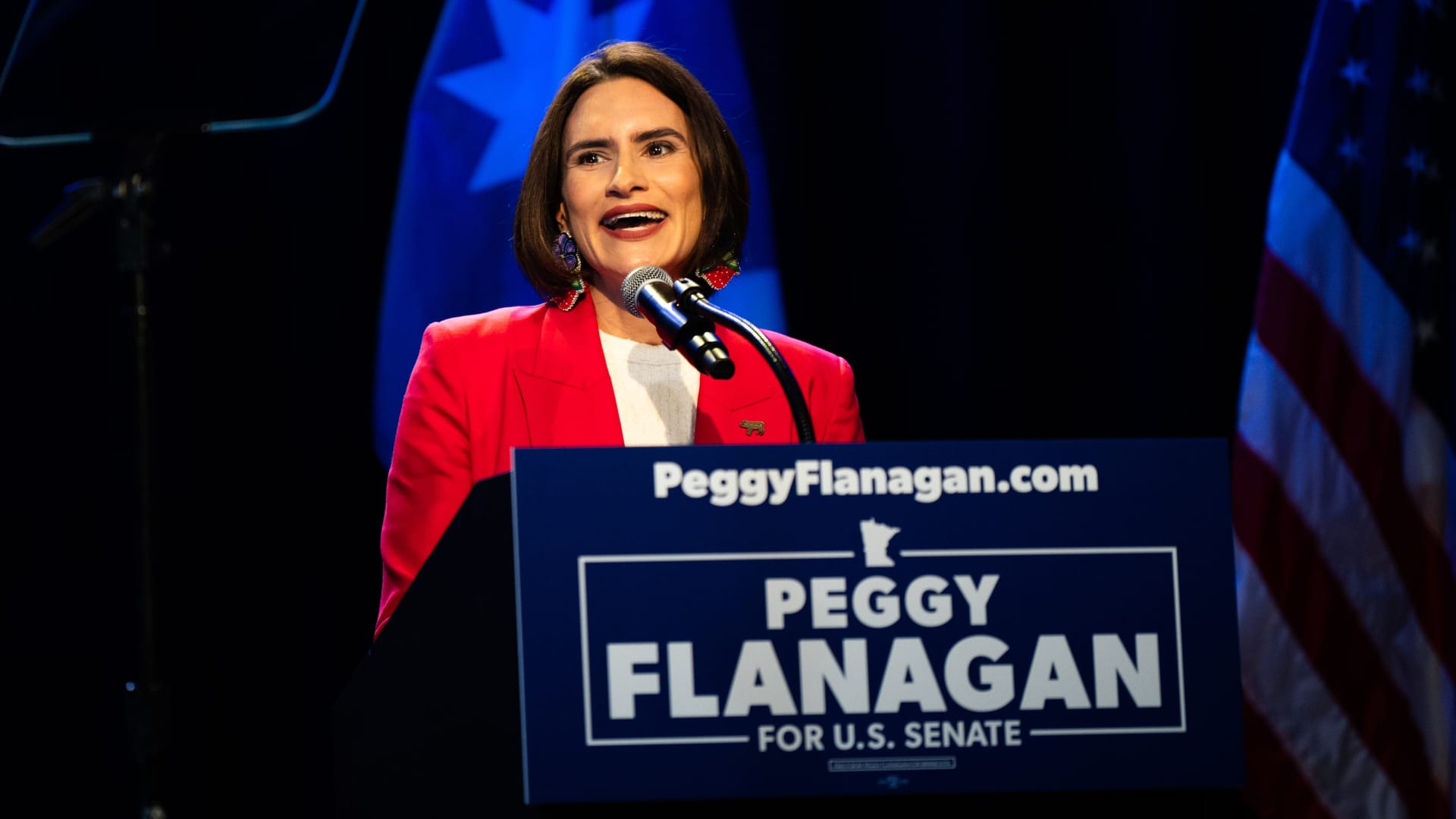
Democratic candidate for U.S. Senate, Minnesota Lt. Gov. Peggy Flanagan, speaks during a primary election night party at First Avenue on August 11, 2026 in Minneapolis, Minnesota.
Stephen Maturen | Getty Images
State Rep. Francesca Hong was supposed to win Tuesday’s Wisconsin Democratic gubernatorial primary by around 20 percentage points, according to the latest public polling. Instead, the Democratic socialist lost by less than 1 percentage point.
Hong’s stunning loss to the more moderate Milwaukee County Executive David Crowley is the latest in a string of massive polling misses in primary contests for the 2026 midterm elections. The misses come as more money than ever is flowing into the electoral process, underscored by the emergence of prediction markets opening up widespread betting on elections.
In Minnesota on Tuesday night, Lt. Gov. Peggy Flanagan defeated Rep. Angie Craig, D-Minn., by nearly 20 percentage points despite some recent polls of the Democratic Senate race showing a tight contest. Last week in Michigan, Democratic Senate candidate Abdul El-Sayed won his primary by only 1 percentage point after polls had him up double digits on Rep. Haley Stevens, D-Mich.
The polling errors are coming as progressives in the Democratic Party surge in primary elections across the country, potentially upending how one of the major U.S. political parties approaches the economy. Hong, a democratic socialist, was pushing a far-left agenda that included government-run grocery stores, higher taxes on the rich and taxpayer-subsidized childcare.
Kyle Kondik, the managing editor of Sabato’s Crystal Ball at the University of Virginia’s Center for Politics, said that a set of potential factors may have skewed the polls in Wisconsin. That includes the chance that white progressives, who are the power center of left-wing candidates, are responding to polls at a greater clip than other Democrats. Wisconsin also does not have registration by party, meaning its primaries are open, which can make it harder to figure out who is actually voting.
“This also was, frankly, a crazy race, and there likely was a lot of change in the closing days. It may have even been the case that progressive Abdul El-Sayed’s (D) victory in the Michigan Senate primary, and subsequent Democratic handwringing about his electability, contributed to a shift toward Crowley in Wisconsin,” Kondik said.
“Hong also expanded her national profile down the stretch of the campaign, and her media appearances did little to dispel the notion that she would have been a very risky nominee for Democrats,” he said.
Wisconsin Democratic gubernatorial candidate Francesca Hong speaks to supporters during an election-night party on August 11, 2026 in Madison, Wisconsin.
Scott Olson | Getty Images
A big miss for prediction markets
Prediction markets in Wisconsin had a bad night, too. Just like polls, they portrayed a race that looked much more secure for Hong than in reality once the votes started rolling in.
On Kalshi, Hong had a 95% chance of winning as of Monday night, while Crowley just had a less than 5% chance. In a now deleted post on X on Tuesday afternoon, before polls closed, Polymarket said that Hong was a “near-lock” to win the nomination, noting she had 96% odds to do so.
A Polymarket spokesperson told CNBC that the post was flagged internally for its language to describe the race and thus was deleted.
Meanwhile in Michigan last week, prediction markets showed El-Sayed with greater than 90% odds to win the Democratic nomination for Senate before polls closed, despite his very narrow victory.
Lakshya Jain, co-founder of the electoral data website SplitTicket and director of political data at the publication The Argument, said he was frustrated by what was happening on the related contracts on prediction markets once polls closed in Wisconsin on Tuesday night.
“The biggest concern for me was that the movement that I was seeing,” Jain said. He was frustrated that odds for Hong were shooting higher or tumbling lower as results from across the state came in, all while he didn’t think individual vote drops were altering the outlook for her actual chances to win that much. “There was absolutely no reason for the markets to move toward her if they were actually being efficient.”
Still, Jain said there is usefulness to prediction markets when it comes to elections, particularly their ability to price in factors often external to polls.
Kalshi co-founder and CEO Tarek Mansour took to X to defend the platforms’ outcomes.
“Before the ‘prediction markets got it wrong’ headlines roll in: a 5% probability doesn’t mean it won’t happen,” he wrote. “It means it should happen 1 in 20 times. If 5% candidates never won, the markets would be broken.”
Meanwhile, voters in Minnesota delivered a surprise. Prediction markets gave Flanagan about a 70% chance to win the nomination in the state’s U.S. senate race Tuesday night, showcasing a better result for traders on those platforms.
Flip Pidot, chief strategy officer at PredictIt and member of the board of directors at the Coalition for Political Forecasting, said reliance on polls is often a problem for prediction market contracts, like those in Michigan and Wisconsin.
“People just still look at that poll barometer as the North Star,” he said. “Everyone was surprised that the polls were so wrong on both these races, and the markets are what they are. They’re just a reflection of what the general populace thinks.” But the good thing about markets is there’s an incentive for more traders to participate and make them more accurate, due to their potential financial rewards.
A mixed bag for Democrats
How the results differed from polls and prediction markets present a mixed bag for Democrats amid a progressive surge throughout the country.
Hong’s shortfall compared with public polling could temper the belief that progressives have hijacked the Democratic Party.
“More broadly, the Democratic ‘establishment’ isn’t as strong as it once was but party leaders are not without power,” Kondik said.
Meanwhile, after the last public poll in the Minnesota Senate race showed Craig in the lead, Flanagan’s win in Minnesota gives progressives hope that their momentum remains despite Hong’s loss. Flanagan ran a progressive campaign, calling for universal healthcare known as “Medicare for All” and halting military aid to Israel in the wake of the war in Gaza.
“Voters want bold change but with a patriotic spirit and fervor,” said Rep. Ro Khanna, D-Calif., who had endorsed both Hong and Flanagan, when asked by CNBC what Democrats can learn from Tuesday’s results.
Hong, who was notably endorsed by the Democratic Socialists of America’s Milwaukee chapter, may have been hampered by past comments where she called for the cancellation of Thanksgiving and abolishing the police.
“We must be for transformational change. Medicare for all, tax billionaire wealth, and no foreign wars,” Khanna said. “But we must explain this as economic patriotism. This is America’s next New Deal, and a path to success for our nation.”
Disclosure: CNBC and Kalshi have a commercial relationship that includes customer acquisition and a minority investment.
