
Unlock the Editor’s Digest for free
Roula Khalaf, Editor of the FT, selects her favourite stories in this weekly newsletter.
Engineers undertook a safety inspection around the area where a train derailed on Thursday afternoon in East Sussex less than 24 hours before the incident, according to the company operating the affected train.
In a post on X at 5.46pm on Wednesday, Southern Railway said: “A safety inspection of the track is taking place between Lewes and Haywards Heath.” It warned of potential delays through the 11-mile section of track.
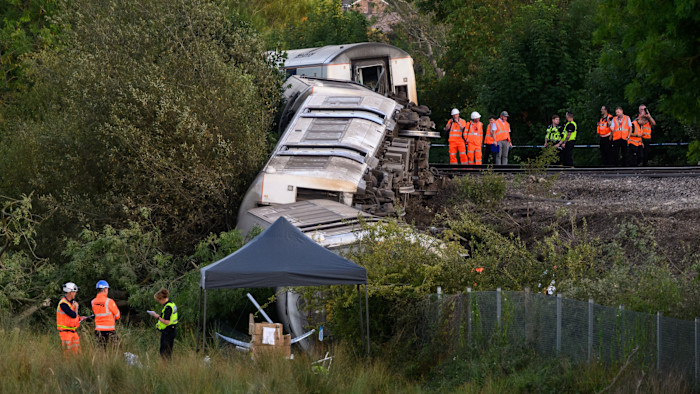
Just before 4pm on Thursday afternoon, the last three carriages of a Southern Railway service from London Victoria to Eastbourne derailed and overturned just before reaching Lewes station from Haywards Heath.
British Transport Police said two people were seriously injured and another 18 suffered less serious injuries in the crash.
Inspections that disrupt services are undertaken only when there is reason to believe a fault might represent a safety risk.
The safety inspection would have been undertaken by staff from Network Rail, the rail infrastructure owner. It declined to comment on Friday about Wednesday’s inspection, the state of track in the area or whether it was revising its safety protocols in light of Thursday’s incident, which took place amid extremely hot weather in south-east England.
While inspectors from the Rail Accident Investigation Branch have been at the crash site, there has been no official statement about the cause of the crash. The organisation said on Friday that it would provide an update on its investigation next week. Train services through the affected area are halted until further notice.
Pictures from the scene showed significant buckling of the track in the area, although it was not clear whether that caused the derailment or was a result of it.
Thursday was the hottest day so far of this summer’s heatwave in the UK and temperatures in the area of the crash were well over 35C. Track temperatures can reach around 20C higher than the air temperature in direct sunlight.
In very hot conditions such as these, welded rail track can buckle and cause derailments. Track that appears in good condition can deform suddenly under the weight of a train.
Network Rail had issued warnings before Thursday that conditions were hot enough to cause damage to track and that journeys might be disrupted as a result.
At least two other safety inspections were undertaken on track on the UK rail network on Friday morning. Chiltern Railways announced around 8.30am that engineers were undertaking a safety inspection of track between Leamington Spa and Banbury. TransPennine Express announced at 9.45am that safety inspections were being undertaken between York and Scarborough. Both lines subsequently reopened.
The UK rail network generally copes with the threat of rail buckling by imposing speed restrictions to reduce stress on affected track, by closing affected sections and mitigation measures such as painting track white to make it reflect heat.
A passenger train derailed in June 2009 near Cummersdale in Cumbria after hitting a section of buckled track. No one was injured in that incident, which an investigation attributed to maintenance and communication errors.
