


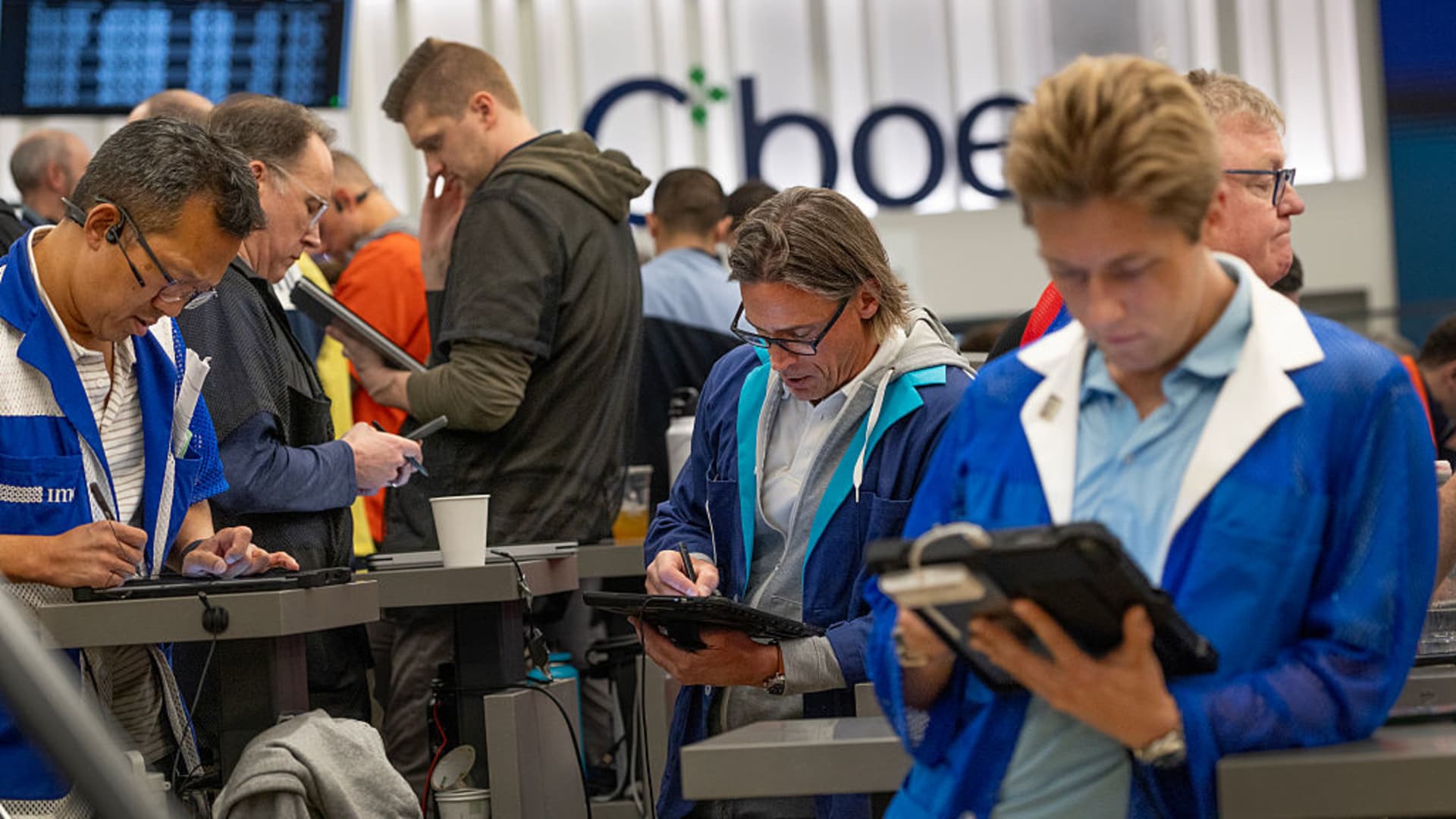
Wall Street’s so-called “fear gauge” has fallen to its lowest level of 2026 so far, reflecting relative market tranquility in a year marked by geopolitical turbulence — but the calm appears unlikely to last.
Strategists warn that rock-bottom volatility, fresh stock market all-time highs and unresolved geopolitical risks are converging just as markets enter the historically stormy mid-August-to-mid-October stretch.
The Chicago Board Options Exchange (CBOE)’s Volatility Index, or VIX, measures expected market volatility over the next 30 days using S&P 500 option prices. A key tracker of stock market volatility, the index moves lower the calmer markets appear.
With the S&P up some 16% year-to-date, and other equity benchmarks also touching record highs, the VIX dipped to 14.2 on Friday, its lowest level so far in 2026.
CBOE Volatility Index.
Jonathan Krinsky, managing director and chief market technician at BTIG, said the VIX’s retreat points to growing complacency heading into the mid-August to mid-October period — historically a choppier time for markets, particularly during mid-term election years.
“We are in a window that historically sees downside volatility, and we are entering it with the market at all-time highs and VIX at YTD lows,” Krinsky said in a note Sunday. “Unfortunately, history says don’t get too comfortable as we enter the worst part of the calendar during mid-term election years.”
He noted that in every mid-term election year since 1990, the equal-weight S&P has registered a pull-back of at least 7% from its Aug. 18 average peak through mid-October.
Krinsky said 2026 has proved an “anomaly” for stock markets, with no 80% downside volume day since last October; typically the average year sees 21 such days, and there has never been a year with fewer than five, he explained. Separately, even with recent dovish inflation-related data including job data, CPI and PPI, long-end Treasury yields are near cycle highs.

S&P 500.
“We think this a very attractive time to pare down risk, or look at hedging broad-based equity exposure as we enter a very difficult part of the calendar, historically speaking,” he added.
‘Risks beneath the surface’
Global quant trading firm Susquehanna described the volatility reset as “substantial,” even though cross-asset and geopolitical risks remain active, with two-month implied volatility edging back towards pre-Iran-war levels, at 13.5%.
Axel Rudolph, chief technical analyst at investing and trading platform IG, said the VIX slide, coupled with a 12-week consecutive run of equity fund inflows, comes despite little sign of a resolution in the Middle East and a sustained squeeze around the Strait of Hormuz.
In a market commentary, Rudolph said that July’s surprise 0.6% fall in retail sales indicates U.S. consumers are now beginning to feel the strain.
“Markets are starting to look a little too comfortable given the risks still lurking beneath the surface,” Rudolph said in a commentary, adding that the long-term Treasury yields point to a” very different picture” from the one implied by the recent equity rally.
“Three straight weeks of gains is impressive, but with volatility so low and risks still building, investors may be underestimating just how vulnerable this rally is to a fresh bout of bad news.”
