


Unlock the Editor’s Digest for free
Roula Khalaf, Editor of the FT, selects her favourite stories in this weekly newsletter.
Spanish Prime Minister Pedro Sánchez has blamed Russia and Israel for stoking discord about a migrant crisis in one of its north African exclaves as he comes under domestic pressure over an influx of tens of thousands of people that remains unresolved.
In his most expansive comments on the crisis to date, Sánchez called the unprecedented episode that began in Ceuta in late July a “hybrid attack” and blamed Israeli and Russian social media actors for spreading “misinformation”.
“It’s clear that if Russia gets involved in spreading misinformation on this issue, or if Israel also spreads misinformation on this issue while criticising the Spanish government, then it is not because they are concerned about migration in Spain or Europe, but rather because of the political positions we are taking,” Sánchez said on Cadena SER radio.
While Sánchez has consistently echoed EU criticism of Russia’s war with Ukraine, he has gone further than other European leaders with early and strident condemnation of Israel’s devastating military campaign in Gaza — triggering a breakdown in relations.
Sánchez did not provide evidence for his claims about Ceuta, but they come as the leftwing prime minister seeks to deflect blame and contain the fallout from the influx, which has sparked condemnation of his government from Ceuta residents and opposition politicians.
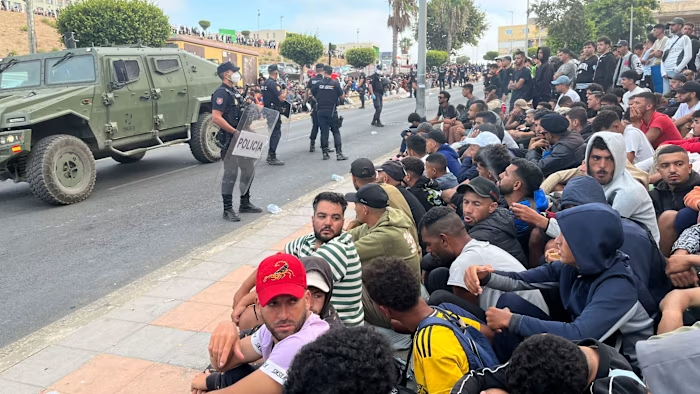
About 5,000 migrants are still in the exclave, violence has flared on its streets in recent days and Spanish residents claim Madrid has abandoned them.
More than 70,000 people swam or scaled border fences to enter Ceuta from Morocco in a single day last month in the most dramatic episode of illegal immigration into the EU in recent years. The Spanish authorities have confirmed that at least 82 people died.
Sánchez attributed the Ceuta crisis to “fake news” propagated in part by human traffickers about a Spanish Supreme Court ruling in early July, which spread the idea that anyone who swam to Ceuta could not be immediately sent back to Morocco.
Once the large-scale influx had begun on July 30, Sánchez said Israeli and Russian social media accounts started to amplify the erroneous messages.
Sánchez said he did not “see any information” to suggest Morocco played a role in orchestrating the influx. The north African kingdom borders Ceuta and disputes Spain’s sovereignty over the territory.
EU disinformation analyses detected Russian actors promoting Ceuta-related misinformation after the initial migration crisis began to exacerbate differences between Spain and other EU member states, according to two officials briefed on the report.
The EU report did not detect any Russian misinformation to encourage the movement of people, the officials said, adding that they did not have any concrete information regarding Israeli actors.
Israeli foreign minister Gideon Sa’ar said on Monday that Sánchez’s comments were a “brazen lie”, adding on social media platform X that “continuing to spread defamatory lies will not distract from Sánchez’s disgraceful failure to manage his country’s affairs”.
The Kremlin’s spokesperson Dmitry Peskov told the FT that “we reject these accusations”.
Russia’s main TV channels, which are all state-owned or state-controlled, run regular reports on Ceuta, and have severely exaggerated the extent of the crisis. This included reports about “thousands” of people storming Ceuta on August 16, of a “massive outbreak of cholera and tuberculosis”, and that the enclave “ran out of food”.

The unprecedented surge of people has reopened the EU’s deepest divisions over immigration. It has pitched Sánchez, one of the few EU leaders who espouse a liberal immigration policy, against Italy’s rightwing Prime Minister Giorgia Meloni, who has made curbing unauthorised immigration a priority.
Meloni responded by reintroducing sporadic border checks on travellers arriving in Italy from Spain, and Sánchez’s government reacted by imposing random checks on arrivals from Italy.
The Spanish leader called the situation “absurd”. But Rome on Monday announced it was extending the additional checks — which were initially imposed for a month — for another 15 days, as Meloni seeks to deflect criticism from a far-right challenger of being too soft on immigration. In response, Spain said it would extend its own checks for another 15 days.
Sánchez, who called the Ceuta crisis an attack on the EU as a whole, said: “Europe must show solidarity.”
He added that “it has to show solidarity in Lampedusa”, an Italian island that has been an entry point for unauthorised migrants from north Africa, “in Greenland and in Ceuta”.
Additional reporting by Carmen Muela in Madrid, Neri Zilber in Tel Aviv and Anastasia Stognei in Berlin
