

Unlock the Editor’s Digest for free
Roula Khalaf, Editor of the FT, selects her favourite stories in this weekly newsletter.
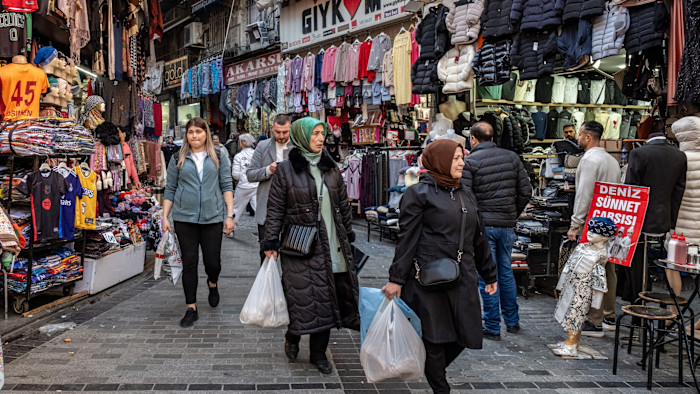
Turkey is on the frontline of the Iran war: it shares a 530km border with the Islamic republic. The same could be said of the country’s finances. Many investors expect Turkey’s central bank to raise interest rates on Wednesday to fight the inflationary and currency pressures unleashed by the conflict.
A lot is at stake. Over the past two years, Turkey has clawed back its lost reputation for sound economic management, allowing the country’s central bank to cut its policy rate from 50 per cent to 37 per cent. So next week’s meeting is widely seen as a litmus test of its credibility.
JPMorgan expects the central bank to raise the policy rate to 40 per cent. Goldman Sachs also says policy should tighten, arguing this is needed “to prevent a further deterioration in the core trade balance and inflation”. But how it will act is unclear.
Officials maintain that the war’s economic shock is “manageable”. The current policy rate is 7 percentage points above the rate of inflation — a spread that has so far deterred Turkish savers from switching into dollars. The central bank has spent more than $50bn propping up the currency since the war began, Fitch calculates. But gross reserves, which include currency swaps, remain high at $170bn. The current account deficit remains modest, for now.
But this may not last. Inflation is sticky and Turkey, which imports most of its energy needs, had forecast an average oil price of $65 a barrel for this year. Brent, however, has recently been hovering around $95 a barrel.
Adding to the uncertainty, the most hawkish member of the bank’s Monetary Policy Committee, deputy governor Osman Cevdet Akçay, will retire just before the rates decision. John Paul Rathbone
How is sentiment holding up in the Eurozone’s biggest economy?
Investors in the Eurozone will have a close eye on numerous survey data from German investors and businesses next week, for signs of how soaring energy prices are feeding through into the region’s biggest economy.
S&P Global will release its April purchasing managers’ indices for Germany’s manufacturing and services sectors, a closely watched gauge of business conditions, on Thursday.
Added to those, the Ifo business climate index on Tuesday and the investor-focused ZEW indicator of economic sentiment on Friday will offer an important sense of how the energy shock is denting Germany’s economic momentum.
“The coming week will be instructive for gauging how quickly sentiment is deteriorating across the euro area, particularly in Germany,” said Modupe Adegbembo, an economist at Jefferies.
Adegbembo said she expects Germany’s composite PMI to weaken to 50.3 points in April, down from 51.9 in March, “as higher energy prices, supply uncertainty and weaker confidence begin to weigh on new orders and business expectations”. She also expects softer readings for the ZEW and Ifo surveys.
Signs of weaker activity would be a significant focus for policymakers at the European Central Bank.
While traders are still pricing in interest rate rises this year, ECB president Christine Lagarde stressed this week that it was too early to draw conclusions about rates, and that market pricing of higher rates could soon change with any sign that weak growth — rather than rising inflation — is the greater risk.
“A softer run of PMIs, Ifo and ZEW would reinforce the message that the energy shock is feeding through primarily via weaker sentiment and activity,” Adegbembo said. This would “support our view that growth risks are rising faster than medium-term inflation risks”. Emily Herbert
How is the UK faring amid the fallout from the war?
Investors will look at a handful of data next week for signs of how the war in the Middle East is affecting the UK economy.
The focus will be on March inflation, due on Wednesday. Economists polled by Reuters expect a leap in petrol prices to have pushed the annual headline rate to 3.3 per cent, up from 3 per cent in February.
The war and its anticipated inflationary fallout initially prompted traders in swaps markets to price in four quarter-point rate rises from the Bank of England this year. This has fallen back to barely one, as a ceasefire and lower energy prices have eased inflation concerns.
However, any disappointing news on inflation could prompt a revision of that outlook ahead of the BoE’s next policy decision on 30 April.
“We judged that the collective mood of the Monetary Policy Committee will be ‘alert and wary’ over medium-term price pressures, although our baseline view remains that it will avoid raising rates this year,” said Philip Shaw, an economist at Investec.
Data on producer input costs, also due on Wednesday, will show how energy costs are piling up for UK businesses. Retail sales figures on Friday will provide an insight into how consumers responded to war-related uncertainty and the jump in petrol prices.
Unofficial surveys — S&P Global’s purchasing managers’ indices on Thursday and the GfK consumer confidence index on Friday — are expected to point to weaker business and consumer sentiment in April relative to March. Valentina Romei
