

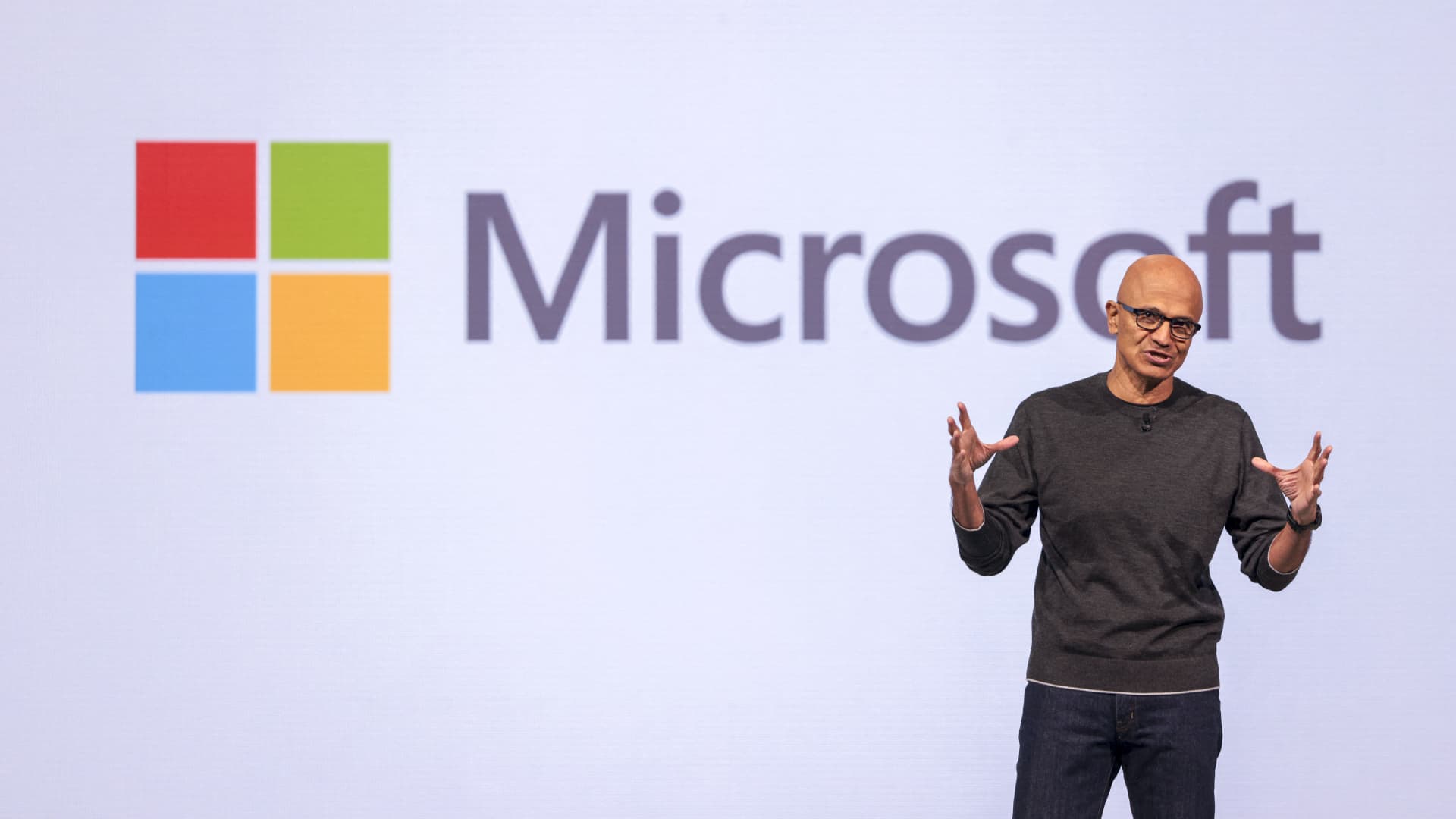
Microsoft on Wednesday reported better-than-expected quarterly results and issued a strong forecast for its all-important Azure cloud unit. But key debates hanging over the stock weren’t put to bed, resulting in a muted reaction in extended trading. Here’s a look at some of the key metrics in Microsoft’s fiscal 2026 third quarter versus the Wall Street consensus: Revenue in the three months ended in March rose 18% year over year to $82.89 billion, beating the LSEG consensus estimate of $81.39 billion. Earnings per share (EPS) totaled $4.27, up 23.4% from a year earlier, topping the $4.06 consensus, according to LSEG. Azure cloud revenue growth on a constant currency basis came in at 39%, versus the FactSet consensus of 38%. On a reported basis, Azure cloud revenue was up 40%, ahead of the FactSet consensus of 39%. MSFT 1Y mountain Microsoft’s stock performance over the past 12 months. Bottom line Let’s call it a step in the right direction. There were some positives, led by the Azure growth guidance for the current quarter. But there were also some reminders about why Microsoft had become such a battleground stock in the first place — in particular, concerns about the viability of highly profitable seat-based software business models. With all these puts and takes, it’s not surprising to see the stock oscillating between modest gains and losses in after-hours trading on Wednesday night. Microsoft was beloved in the early days of the generative AI boom, thanks to its close ties to ChatGPT creator OpenAI. But the shine has faded, rendering Microsoft the worst-performing stock in the “Magnificent Seven” over the past six months. It’s tested our patience and that of plenty of other longtime shareholders, too. Among the reasons for the stock’s poor performance: Microsoft’s reliance on OpenAI for Azure growth came to be viewed as a weakness rather than a weapon. At the same time, the market wondered whether Microsoft was leaving Azure growth on the table as it ran into capacity constraints. Skepticism also mounted about the quality of Microsoft’s Copilot AI assistant as rivals like startup Anthropic were showered with praise for their tools. Additionally, concerns about “AI eating software” have been a major overhang on Microsoft and its industry peers. These debates were not solved on Wednesday night, even if some clarity was gained. The positives: Microsoft expects Azure growth for the three months ended in June to be between 39% and 40%, compared to the FactSet consensus of roughly 37%. Microsoft also signaled that it’s ramping up its capital expenditures to bring more AI computing capacity online. That should help the company meet demand from external customers while also allocating resources to internal AI model research to lessen its reliance on OpenAI’s intellectual property over time. Microsoft and OpenAI’s relationship continues to evolve , with a growing distance between them. On the earnings call, Microsoft CFO Amy Hood said the company expects to spend about $190 billion in capex in calendar 2026, implying almost $120 billion in the April-to-December timeframe. That compares with roughly $118 billion for all of calendar 2025, representing roughly 61% year-over-year growth. Another modest positive is that paid Copilot seats now exceed 20 million, up from 15 million disclosed in January, and Hood said the company expects a sequential increase again in the current quarter, driving continued average revenue per user growth. This isn’t to say Microsoft doesn’t still have work to do to make Copilot better, but adoption is at least trending upward. So, what about the bad? Well, Microsoft cannot escape the fact that it’s still a software company that has thrived on selling seat-based licenses to customers. And in the age of AI, where companies may be lowering their headcount and the remaining employees are using gobs of expensive AI compute, the old way of charging customers may need to evolve. Indeed, a considerable amount of time on Wednesday night’s conference call Q & A was spent discussing the seat-based versus consumption models. CEO Satya Nadella essentially made the case for a hybrid solution — and while time will tell whether he’s right, the very nature of the conversation reinforced some of the existential concerns investors have about software providers right now. For now, we’re reiterating our hold-equivalent 2 rating and price target of $500. Guidance Here’s the guidance that Microsoft offered for its fiscal 2026 fourth quarter: Azure revenue growth (constant currency) between 39% and 40%, comfortably ahead of the FactSet consensus of 36.9%. Total revenue in the range of $86.7 billion to $87.8 billion, implying growth between 13% and 15%. The midpoint of the guidance is slightly below the FactSet consensus of $87.56 billion. Operating expenses of $19.3 billion to $19.4 billion, implying 7% year over year growth. The implied FactSet consensus was $19.78 billion. Capital expenditures over $40 billion as more compute capacity comes online. Here’s the Q4 revenue expectations by reporting segment: Productivity and Business Processes: $37 billion to $37.3 billion. That is above the FactSet consensus of $36.64 billion. Intelligent Cloud: $37.95 to $38.25 billion. That compares with the FactSet consensus of $37.65 billion. More Personal Computing: $11.75 billion to $12.25 billion, below the FactSet consensus of $13.31 billion. (Jim Cramer’s Charitable Trust is long MSFT. See here for a full list of the stocks.) As a subscriber to the CNBC Investing Club with Jim Cramer, you will receive a trade alert before Jim makes a trade. Jim waits 45 minutes after sending a trade alert before buying or selling a stock in his charitable trust’s portfolio. If Jim has talked about a stock on CNBC TV, he waits 72 hours after issuing the trade alert before executing the trade. THE ABOVE INVESTING CLUB INFORMATION IS SUBJECT TO OUR TERMS AND CONDITIONS AND PRIVACY POLICY , TOGETHER WITH OUR DISCLAIMER . NO FIDUCIARY OBLIGATION OR DUTY EXISTS, OR IS CREATED, BY VIRTUE OF YOUR RECEIPT OF ANY INFORMATION PROVIDED IN CONNECTION WITH THE INVESTING CLUB. NO SPECIFIC OUTCOME OR PROFIT IS GUARANTEED.
