


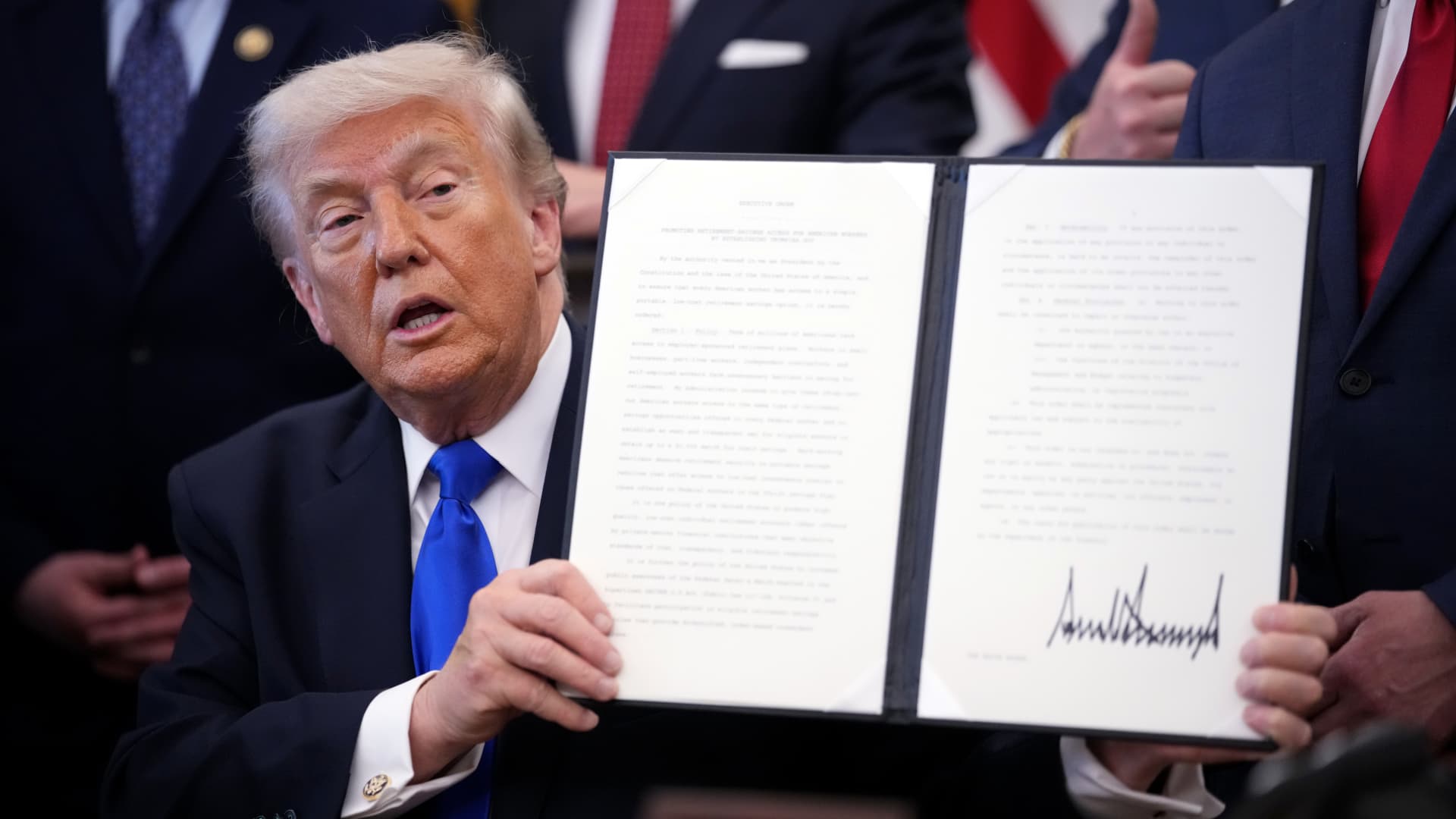
U.S. President Donald Trump holds up an executive order during an event in the Oval Office of the White House on April 30, 2026 in Washington, DC.
Andrew Harnik | Getty Images
President Donald Trump signed an executive order Thursday to create a new way to save for retirement for workers who don’t currently have access to a 401(k) or another workplace plan.
Trump ordered the launch of a new website next year, TrumpIRA.gov, where workers could research, compare and enroll in private-sector IRA accounts through which, if eligible, they could collect a matching contribution from the federal government.
“You’ll then be able to access the same type of retirement accounts that federal employees enjoy through the Thrift Savings Plans, which are incredible, as part of the federal Saver’s Match program,” Trump said at a White House press conference. “Low-income Americans will be eligible to receive up to $1,000 per year in matching funds deposited directly into their accounts.”
The president initially floated the idea of expanding access to retirement accounts for employees without workplace plans during his State of the Union address in February.
Roughly 56 million Americans lack access to an employer-sponsored retirement plan at work, according to 2025 research from the Pew Charitable Trusts, an independent public policy nonprofit.
Trump’s order will be integrated with the Saver’s Match, a provision from 2022 legislation known as Secure 2.0. The Saver’s Match goes into effect in tax year 2027.
Under those rules, single taxpayers with a modified adjusted gross income of up to $20,500 or joint filers making up to $41,000 qualify for a government match worth 50% of up to a $2,000 contribution to a qualified retirement account, for a maximum match of $1,000 a year. Single filers with annual incomes of between $20,500 and $35,500 qualify for reduced matching contributions. Joint filers making up to $71,000 can qualify for a reduced match.
In 2025, the Morningstar model of retirement outcomes projected that Americans eligible for the match would receive a 12% boost to their wealth in retirement.
About 26 million full- and part-time workers who qualify for a full or partial version of the Saver’s Match don’t have access to a plan where they can collect the benefit, according to the Economic Innovation Group, a bipartisan public policy organization.
“Establishing a universal retirement system to companion with Social Security was always needed, and its time has come,” said Teresa Ghilarducci, a professor at The New School who co-authored 2021 research with National Economic Council Director Kevin Hassett on providing low-income workers with retirement savings similar to the Thrift Savings Plan.
Legislation ‘critical as part of the conversation’
The executive order instructs the White House to work with Congress to propose legislation that will make both the coverage and the savings credit larger. “To take it to the next level, we need congressional approval, which should be very easy to get. It should be bipartisan,” Trump said during the signing.
While the currently proposed match applied to individuals with incomes below $35,000, Hassett said during the press conference that the administration is seeking legislation to expand the plan to even more Americans.
Legislation would “make this effort stickier, because it’ll be a congressional action, not just from a president,” Ghilarducci said.
The call for Congress to build on the newly announced program is likely to be “really important and well received,” said Shai Akabas, vice president of economic policy at the Bipartisan Policy Center, a Washington, D.C.-based think tank.
The Saver’s Match is a step in the right direction to getting more low- to moderate-income people who don’t have access to employer-sponsored plans to save, Akabas said. The initiative could give people more information and easier channels to set up an account, he said.
“We know that the significant majority of people are unlikely to take these proactive steps on their own,” Akabas said. “That’s why the call for legislative action is also really critical as part of the conversation here.”
Congress has already put forward proposals to address this issue. The Retirement Savings for Americans Act, a bicameral bill, calls for the creation of portable, tax-advantaged retirement savings accounts. The Automatic IRA Act, a bill proposed in the House, would require employers with more than 10 employees to enroll their employees in automatic IRAs or other automatic retirement contribution plans.
In addition, 17 states have passed legislation to establish automatic enrollment individual retirement accounts, or auto-IRAs, that provide access to state-facilitated retirement plans for workers whose employers do not provide their own plans.
As the federal push to encourage retirement savings moves forward, policymakers will have to think about the costs to both the federal government and employers, as well as the details for how the plans may be set up, Akabas said.
Correction: This article has been updated to reflect that under the Saver’s Match rules, single taxpayers with a modified adjusted gross income of up to $20,500 or joint filers making up to $41,000 qualify for a government match worth 50% of up to a $2,000 contribution to a qualified retirement account, for a maximum match of $1,000 a year. Single filers with annual incomes of between $20,500 and $35,500 qualify for reduced matching contributions, and joint filers making up to $71,000 can qualify for a reduced match. A previous version misstated the income figures.
