


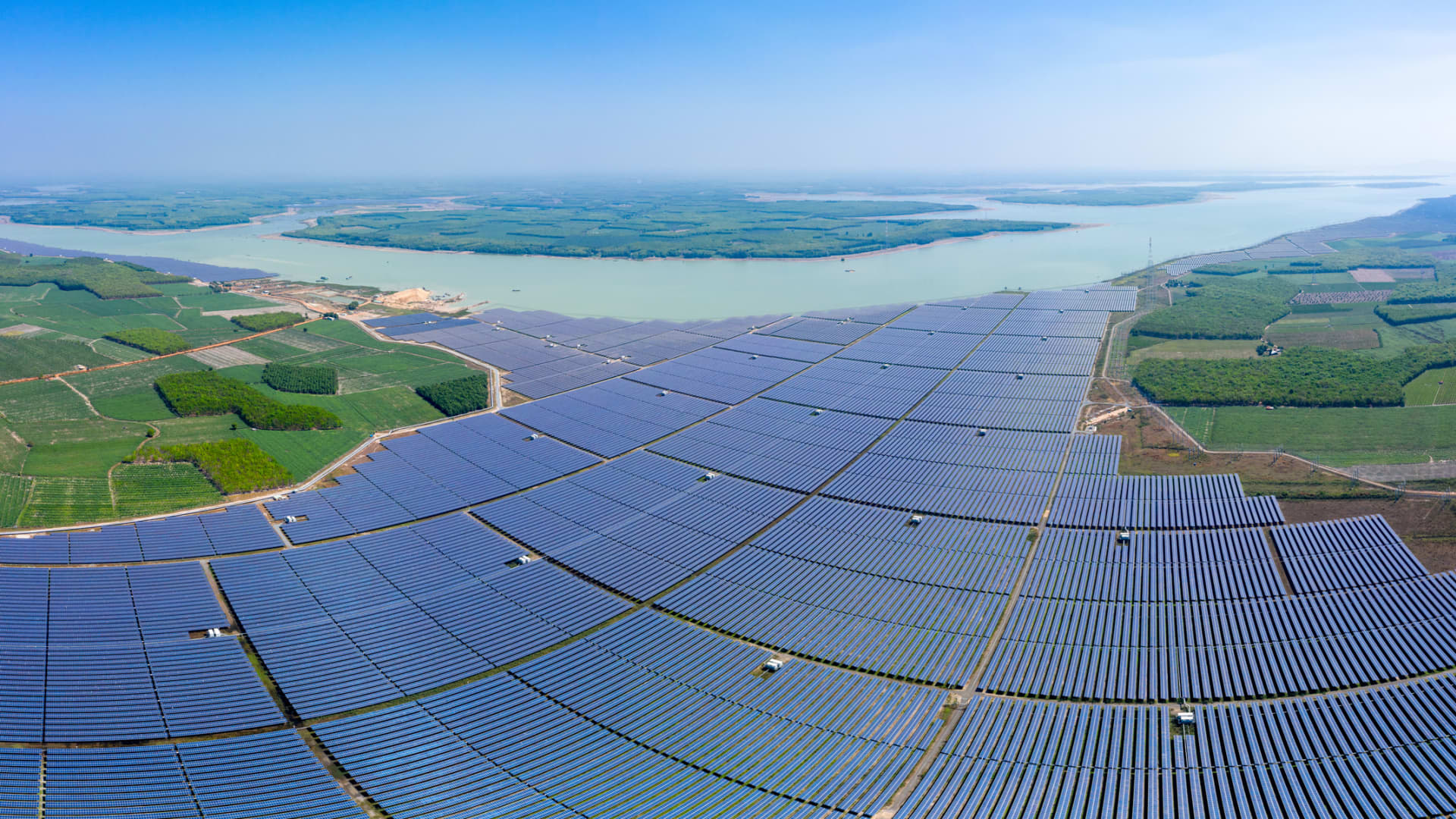
A solar power plant in Vietnam’s Tay Ninh Province. Singapore’s central bank is backing bio-energy and solar projects in Southeast Asia via its Green Investments Partnership.
Tan Dao Duy | Moment | Getty Images
The Asian Development Bank $70 billion plan, backing new energy and digital infrastructure in the region, is set to boost Southeast Asia the most.
The program includes a pan-Asia power grid initiative, connecting national and subregional power systems, and an Asia-Pacific digital highway to close the infrastructure gap in the region, according to ADB that has set 2035 as the deadline for funding projects.
“Energy and digital access will define the region’s future,” said ADB President Masato Kanda said in a statement on Sunday.
That connectivity will build the systems Asia and the Pacific need to grow, compete, and connect, Kanda said. “By linking power grids and digital networks across borders, we can lower costs, expand opportunity, and bring reliable power and digital access to hundreds of millions of people.”
While the funds are for the entire Asia-Pacific region, experts say that Southeast Asia is expected to be the major beneficiary of ADB’s connectivity push.
The bank typically leans toward developing member countries based on growth needs, project readiness and mandate, beyond sheer market size, said Greg Statton, vice president and chief technology officer for Asia Pacific and Japan at AI-powered data security firm Cohesity.
Statton noted that unlike Southeast Asia, China has largely moved away from ADB financing with its own finance institutions and policies in place. India has strong access to capital markets and runs many domestically financed projects, even though it still receives a fair amount of funding from ADB, while Japan itself is a major funder of ADB.
“Larger economies such as China, India, and Japan already have more established domestic capital markets, deeper infrastructure financing channels, and greater fiscal capacity to fund large scale projects internally,” said Chasen Nevett, managing partner of principal investments at GMA Capital Partners, adding that Southeast Asia remains structurally underbuilt in both energy interconnection and digital infrastructure.
“That combination creates a more efficient deployment environment for capital, where each dollar can unlock broader private sector participation and accelerate regional integration, Nevett said.
Power play
Indonesia, Vietnam, and the Philippines are expected to be the largest beneficiaries within Southeast Asia.
Those countries are expected to receive a larger share of the $70 billion funding due to their population size, infrastructure needs and active project pipelines, based on ADB”s historical lending patterns and current priorities, according to Statton.
While Malaysia and Thailand could also benefit given they are regional hubs for energy and data infrastructure, the relative marginal impact of capital may be somewhat lower due to their more developed base in Southeast Asia, said Nevett.
Malaysia has the biggest data center project pipeline in Southeast Asia, which accounts for about 60% of all proposed projects in the region and, along with Thailand, it is expected to lead data-center load demand in Southeast Asia by 2035, according to Wood Mackenzie.
ADB funding also provides an opportunity to build interoperable transmission systems that allow clean power to flow across borders, improving reliability and lowering costs, said Scott Dunn, strategy and growth lead for Asia at infrastructure consulting firm AECOM.
Markets such as Laos, Thailand, Vietnam and Cambodia have abundant hydropower and fast-expanding solar and wind, but they lack cross-border capacity to move clean power to the biggest demand centers, Dunn said, adding that ADB’s plans are “effectively designed for these conditions.”
ADB aims to integrate nearly 20 gigawatts of renewable energy across borders and link 22,000 circuit-kilometers of transmission lines by 2035.
