
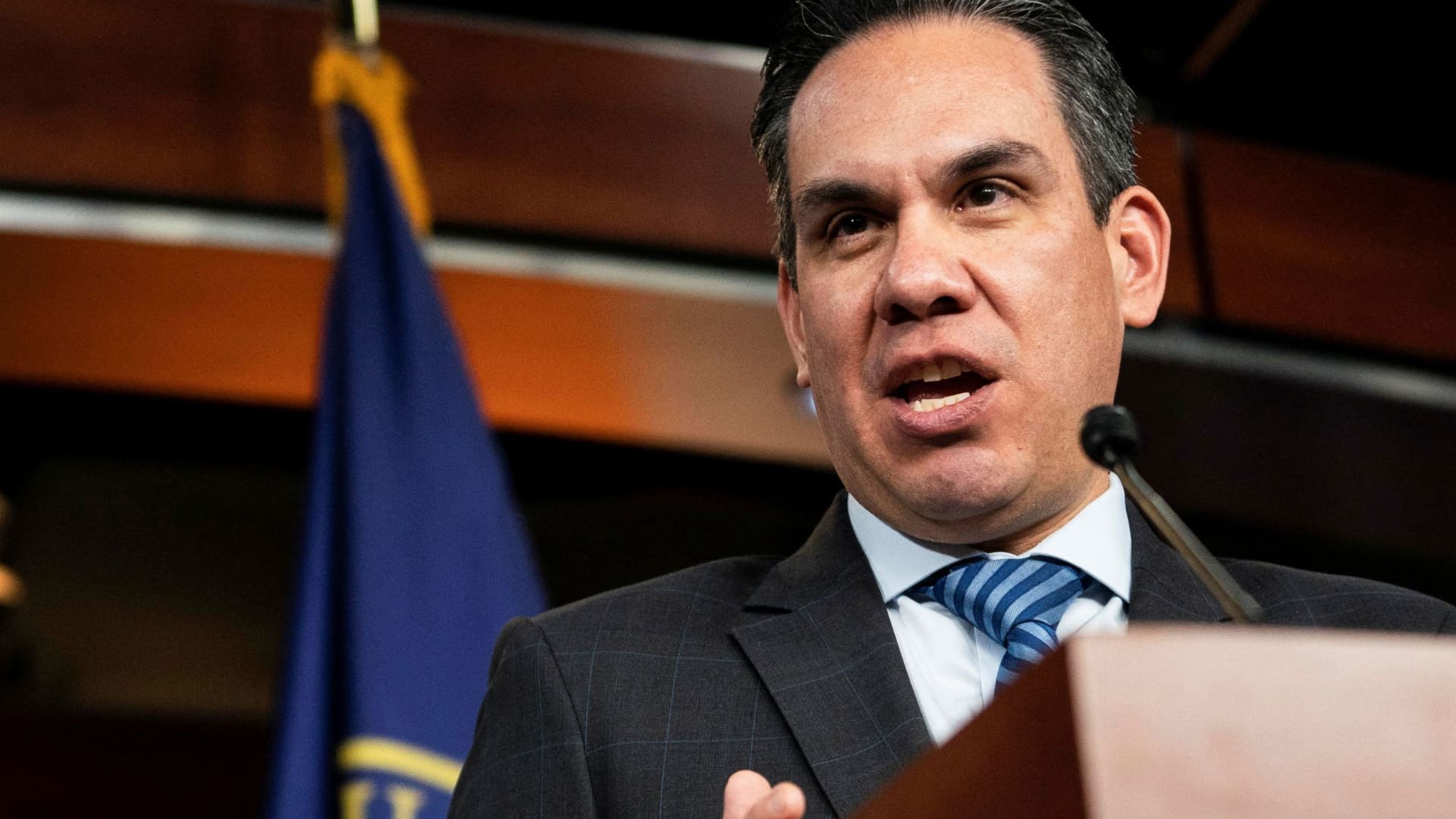
Democratic Caucus Chairman Rep. Pete Aguilar, D-Calif., speaks during a news conference with House Democratic leadership at the U.S. Capitol in Washington, Jan. 10, 2023.
Sarah Silbiger | Reuters
The U.S. House on Tuesday is poised to vote on a $70 billion funding package despite Democrats’ vows to fight back. The vote is a major test for House Speaker Mike Johnson as he tries to cement one of President Donald Trump’s top domestic priorities.
Passage would likely end a monthslong stalemate over immigration enforcement that has shut down parts of the Department of Homeland Security.
Rep. Pete Aguilar, D-Calif., chair of the House Democratic Caucus, called the package a “$70 billion blank check for ICE and border patrol, with no strings attached.”
“This comes after Republicans already cut healthcare, food assistance, and they’ve a already give ICE $140 billion in their Big Ugly Bill,” Aguilar said at a press conference on Tuesday, referring to Republicans’ 2025 tax and spending package more commonly known as the One Big Beautiful Bill. “On top of that, this doesn’t do a single thing to help Americans with their daily costs of living.”
The package, which has broad support among Republican congressional leadership, would fund Immigration and Customs Enforcement and Customs and Border Protection, both of which are Department of Homeland Security subagencies that were left out of an earlier spending bill amid Democratic opposition. The $70 billion would extend through the end of Trump’s presidency. And it could bring to an end a drawn-out debate over immigration enforcement policy that began in January – after federal law enforcement agents killed two U.S. citizens in Minneapolis as part of an immigration crackdown — and led to a government shutdown.
Trump had called for the bill to reach his desk by June 1. The package advanced out of the Senate last Friday, on a 52-47 vote with no Democratic support.
The House took an initial procedural vote early in the afternoon, with all Republicans voting in favor to narrowly approve it. The chamber will take a final vote on the package later Tuesday.
But its fate is far from certain even though it only needs a simple-majority vote to be approved. Johnson has struggled to get the Republican Party aligned as lawmakers on the right have said the measure doesn’t go far enough and some centrists with tough elections ahead in November express concerns about immigration enforcement practices.
Republican Rep. Chip Roy, a Texas hardliner, told House leadership that he was undecided, according to Politico. And Rep. Kevin Kiley, who switched his party affiliation from Republican to independent in March but still caucuses with the GOP, has said he opposes the package without changes to immigration enforcement.
“I thought we had a golden opportunity to come together as a Congress to implement those reforms and to rebuild trust and to focus immigration enforcement where most people think it should be, on those who posed the risk to public safety,” Kiley said outside the House chamber on Tuesday. “Instead, we’re doing exactly the opposite.”
Republicans have a narrow majority in the House and can afford to lose a handful of votes if Democrats are united in opposition.
Passage of the immigration funding package would be an important hurdle for Johnson to clear, as he struggles to get other Trump priorities over the finish line with a dwindling number of days Congress will be in session before the 2026 midterm elections.
Johnson huddled with Trump on Tuesday about ICE and CBP funding, as well as an attempt to extend a section of the Foreign Intelligence Surveillance Act of 1978 that allows the government to collect the communications of people outside the U.S., including when they are interacting with Americans.
Section 702 of the act is due to expire June 12 unless Congress extends it. Privacy hawks on both sides of the aisle have called to amend the policy to protect U.S. citizens from government overreach, meaning Johnson will need to rely on some Democratic support to get any extension over the finish line. FISA Section 702 has traditionally had both supporters and foes in each political party.
Democrats, meanwhile, are threatening to withhold support after Trump named Federal Housing Finance Agency Director Bill Pulte as director of national intelligence. Pulte has no known prior intelligence experience and has shown a willingness to use his position to go after Trump’s foes.
“The negotiations prior to Trump’s announcement with respect to Bill Pulte were already in a very sensitive place,” House Minority Leader Hakeem Jeffries, D-N.Y., said at a press conference on Monday. “And then Donald Trump, as he often does, tosses a hand grenade into those sensitive negotiations by elevating Bill Pulte as the director of national intelligence.”
Asked if he’d let FISA expire, Jeffries said conversations were ongoing “but clearly to get to good faith negotiations, the effort to elevate Bill Pulte as the acting director of national intelligence should be reversed immediately. And then let’s see where we wind up at the end of the week.”
Some Republicans have also called on Trump to drop Pulte as acting director of national intelligence.
“FISA gives us over 50% of our most sensitive intelligence and has enabled the U.S. to stop multiple terrorist attacks,” Rep. Don Bacon, R-Neb., a moderate who is retiring at the end of this Congress, posted to X on Monday. “Letting FISA lapse would reflect a nation paralyzed by hyper-partisanship and dysfunction. POTUS can help by canceling plans to put Bill Pulte as Acting DNI.”
—Garrett Downs contributed to this story.
