


Unlock the Editor’s Digest for free
Roula Khalaf, Editor of the FT, selects her favourite stories in this weekly newsletter.
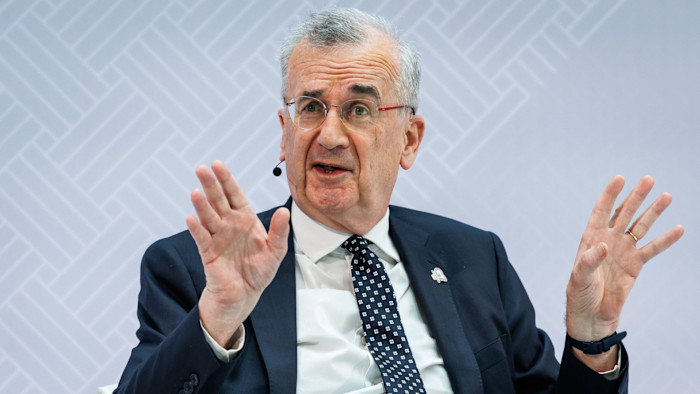
The European Central Bank should keep its options open for its next interest rates decision in June, the departing governor of the Banque de France, François Villeroy de Galhau, said in his farewell speech on Thursday.
“I have read a great deal of speculation and several statements about the timing of our next interest rate hike at the ECB,” he said, adding that this “strikes me as looking a bit too much like disguised forward guidance. What should guide us is not a date, but the data.”
Villeroy de Galhau is one of Europe’s longest-serving and most influential central bankers and will step down next month before the ECB sets rates on June 11.
French President Emmanuel Macron has nominated his former chief of staff, Emmanuel Moulin, to replace Villeroy de Galhau, who spent more than a decade at the helm of the Banque de France.
At its most recent monetary policy meeting last week, the ECB held rates at 2 per cent but left the door open to a June rise.
ECB president Christine Lagarde said policymakers had discussed an interest rate increase in April “at length and in depth” before unanimously deciding to hold off.
Villeroy de Galhau said policymakers must focus their attention on “second-round effects” of the energy shock driven by the Middle East conflict.
He cited three indicators they should watch carefully: core inflation “both current and projected”, households’ and businesses’ medium-term inflation expectations and “developments in wages”.
Villeroy de Galhau also used his swansong speech to warn future policymakers to treat negative interest rates with “greater caution” than bond-buying programmes and other forms of unconventional monetary policy.
The Eurozone had negative interest rates for eight years up to 2022. But in one of the clearest acknowledgments yet by a senior European central banker of the political backlash caused by the policy, Villeroy de Galhau said that “negative nominal interest rates are poorly understood and potentially destructive of social cohesion”.
He also delivered a broader defence of the ECB’s unconventional policies after the global financial crisis and the pandemic, arguing that some tools had proved more effective and less politically damaging than others.
Villeroy de Galhau rejected claims that the ECB’s bond-buying and other forms of quantitative easing helped fuel the inflation surge of 2022 and 2023, saying such arguments were “simply false”.
Inflation was caused by the Covid-19 pandemic and Russia’s full-scale invasion of Ukraine, which were both “totally unpredictable”, he said.
Villeroy de Galhau also warned against forgetting why unconventional policies became necessary in the first place. After the global financial crisis and during the European debt turmoil, weak growth, persistently low inflation and near-zero rates left central banks struggling to stimulate economies through their traditional policy tools.
Moulin’s nomination to succeed Villeroy de Galhau will need to be approved by a divided French parliament in which Macron’s coalition government has no majority.
