


Unlock the Editor’s Digest for free
Roula Khalaf, Editor of the FT, selects her favourite stories in this weekly newsletter.
Turkey has arrested the founder of an investment brokerage at the centre of an $18bn alleged Ponzi scheme that has torched the savings of hundreds of thousands of investors and raised questions about why regulators did not act earlier to stop it.
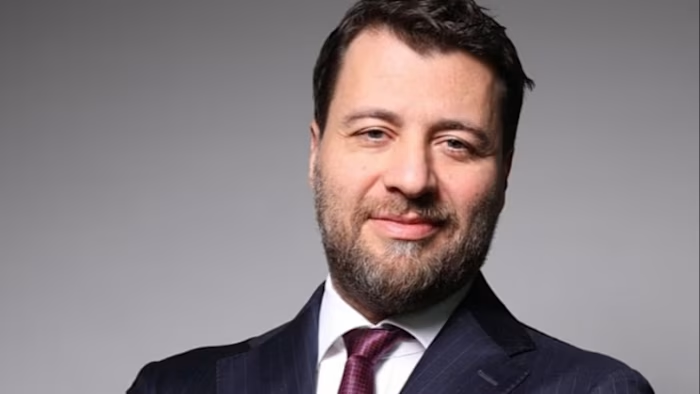
Emre Tezmen, chair of Tera Yatırım, was arrested early on Wednesday alongside Tera board members Kerem Alkin and Emre Alkin, local media reported.
Kerem Alkin served as Turkey’s ambassador to the OECD from 2021 to 2024 and previously sat on the boards of state-controlled Halkbank and Turkey’s sovereign wealth fund. His brother Emre Alkin, a prominent economist, is a frequent television commentator as well as rector of Istanbul’s Topkapı University.
Two other executives were also jailed pending trial, as part of the investigation into aggravated fraud and membership of a criminal organisation.
The scale of the scandal was laid bare on Wednesday when Turkey’s Capital Markets Board, or SPK, said it had affected more than 455,000 investors who held stakes in 131 funds with a total of about $18bn in assets. The funds are now being liquidated.
“God willing, the necessary steps will be taken in a short time to address grievances,” said justice minister Akın Gürlek, adding that President Recep Tayyip Erdoğan was “closely following the investigation”.
Prosecutors have frozen the assets of executives at financial firms linked to the scandal and restricted transactions by their spouses and close relatives, state-run news agency Anadolu reported.
Amid multiple news reports of figures who have been linked to the scandal wiring millions of dollars to Swiss bank accounts, prosecutors have also requested data on money and crypto transfers sent abroad since 2024.
The episode has come at an awkward time for finance minister Mehmet Şimşek, who has worked to restore confidence in Turkish economic management. So far there are few signs it could develop into a broader financial crisis.
The benchmark Bist 100 share index appears to have steadied after it fell 8 per cent last week. There is also little evidence that panicked local investors have rushed to buy hard currency or gold. Instead, lira deposits rose by $12bn in the week to September 15, Goldman Sachs estimated.
Attention is now increasingly turning to why regulators did not intervene earlier to forestall the crisis, which erupted last week after some funds struggled to meet investor redemptions. Many funds had concentrated their portfolios in illiquid shares whose prices rose sharply when the funds bought them.
Those higher share prices then boosted reported fund returns, attracting further investor money that was used to purchase the same or related stocks — a self-reinforcing pattern that Gürlek has compared to a Ponzi scheme.
A letter sent by the Istanbul chief prosecutor to the SPK in February 2025, which surfaced this week, shows that prosecutors asked it to investigate unusual share trading by Muhammed Yarız, the 28-year-old chair of Pusula Portföy — one of the funds now implicated in the scandal.
Ramazan Başak, a former deputy head of Turkey’s financial crimes agency Masak, has also said he repeatedly warned authorities about suspicious transactions but that his warnings went unheeded.
Başak was detained in April for disseminating misleading information in two social media posts, one of which questioned the plausibility of a fund’s reported 10,128 per cent return.
“We warned so many times, but no precautions were taken,” Başak said in an online interview this week. “Without political and bureaucratic support from above, carrying out these organised operations is simply not possible,” he alleged.
