


Unlock the Editor’s Digest for free
Roula Khalaf, Editor of the FT, selects her favourite stories in this weekly newsletter.
Its products might be a mainstay of high-end home kitchens, but Sub-Zero & Wolf was not founded as the sleek stainless-steel gourmet appliance company that it is known as today. In 1943, Westye F Bakke needed a solution for storing his diabetic son’s insulin at home — and so the Sub-Zero refrigeration technology was born. Coming full circle, this medical niche is becoming a talking point thanks to the rise of the “wellness fridge”.
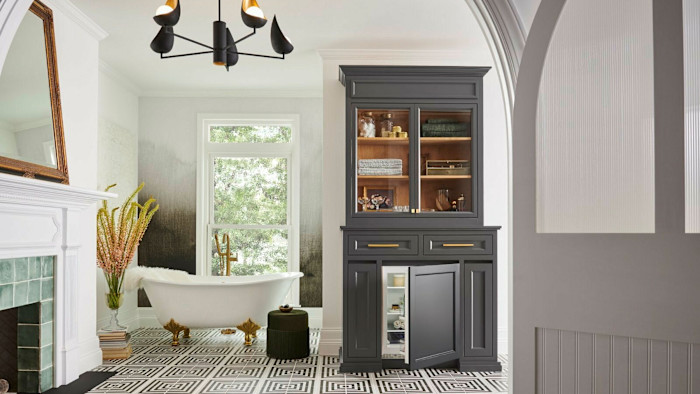
“In the past two years we’ve seen a 10-fold increase in demand for undercounter fridges,” says UK sales manager Greg Hughes. He’s not just referring to the kitchen counter. These are fridges that are also being fitted into the bathroom, bedroom or dressing room, and used for supplements, skincare, scent, ginger shots as well as medicines, face towels and herb-infused water.
Safety and discretion mean you might not want injectables or other medications rattling around when friends — or children — open the kitchen fridge. But whether this is a smart hack, or another symptom of bonkers wellness hype, divides the experts.
It builds on the “trend of having refreshments to hand”, says Hughes. Clients say beauty products not only feel better on the skin, but believe they perform better at lower temperatures. Some supplements, including probiotics, are best taken on an empty stomach, so homeowners want to have them handy when they wake up. One of Sub-Zero & Wolf’s recent clients had 16 fridges installed in one home.
“Most well-formulated skincare products are designed to be stable at room temperature,” says Joanne Evans, facialist and founder of clinic Skin Matters in Holland Park, west London. She takes a balanced approach, but sees the uptick in demand as part of a shift towards more considered self care. “Skincare is no longer just cosmetic — it’s part of a wider health and wellness mindset,” she says.

Many injectables, such as GLP-1s (Ozempic, Wegovy, Mounjaro — unopened) and peptides, need to be refrigerated to maintain stability and efficacy; it’s “non-negotiable”, says Evans. Skincare is more selective. “Some active formulas, including vitamin C and retinoids, can benefit from being kept cool to slow degradation,” she continues. But she also recommends keeping mists, eye gels and aloe vera in the fridge to help soothe puffiness. “Even tools are great cold — cryo globes, gua sha and rollers.”
“Bathrooms are increasingly being designed as private wellness spaces,” adds Steve Clinch, head architect at London-based design studio Echlin. At a recent project in Fitzrovia, the master bedrooms feature en-suite bathrooms with a concealed fridge “to support skincare routines without compromising the calm, architectural language of the space”. In south-west London, interior designer Murude Katipoglu recently disguised a fridge in a bespoke sideboard for a client’s home gym.
Bathroom company CP Hart recently fitted a fridge for supplements; it was a first for them, says director of design Yousef Mansuri, but, he adds, “we are expecting demand to rise”.

Although these fixtures can be costly — a Sub-Zero & Wolf fridge costs from £4,500 — any integrated model has the potential to disappear seamlessly behind a cupboard door. But they don’t have to be hidden: Smeg’s FAB5 series of mini fridges come in a range of colours — and they don’t emit the same low hum as full-size models, so they can work in bedrooms.
Indeed, keeping them on show can be a slick option. Milan-based SKS Appliances partnered with Spanish designer Patricia Urquiola to create Mantle, a range of chunky, sculptural cabinets that can be used to disguise the company’s drawer refrigerators. Clad in glossy Cimento tiles, in colours from blue to burgundy, it turns the beauty fridge into a thing of beauty.
Find out about our latest stories first — follow @ft_houseandhome on Instagram
