


Stay informed with free updates
Simply sign up to the Aerospace & Defence myFT Digest — delivered directly to your inbox.
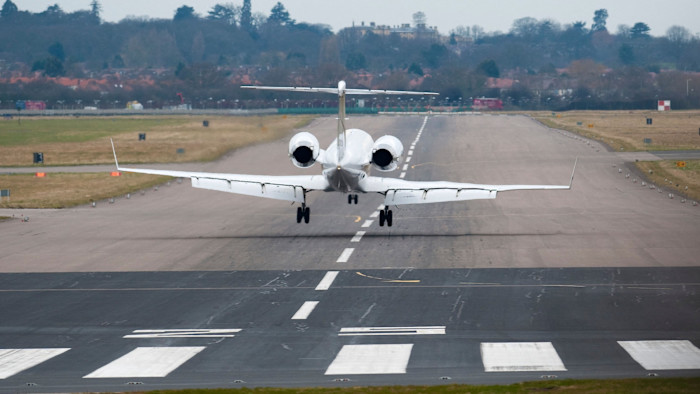
Private jets can keep flying into an RAF base in the south-east of England, after a court declined to allow a legal challenge by three rival airports over safety concerns.
Oxford, Farnborough and Biggin Hill brought the case against the UK aviation regulator to force it to suspend or restrict commercial operations from RAF Northolt in west London.
But a High Court judge on Wednesday dismissed their claim, allowing the military base to remain open for the elites and executives who value its location within striking distance of central London.
Northolt’s use for business aviation has been a source of controversy since the air force refurbished the base in the mid-1990s to provide an extra terminal and other facilities suited to the handling of civilian flights.
Most recently, files released by the US Department of Justice have shown that private jets linked to the convicted sex offender Jeffrey Epstein regularly used the air base until shortly before his arrest over further sexual offences in 2019. Epstein was found dead in a New York jail cell while awaiting trial later that year.
The operators of the private airports, which compete with Northolt, argued there was an “unfair disparity” in safety standards between them and the military facility.
Potential hazards listed in a safety assessment included a wartime officers’ mess, security fences, large trees and lampposts along the A40 road.
The operators wrote to the Civil Aviation Authority (CAA) in 2024, saying they were “more concerned than ever about civil aviation safety at RAF Northolt”. They brought a judicial review after the regulator refused to impose restrictions on flights.
The private operators said it was unfair that they were bound by the CAA’s commercial safety policy while the military facility was not.
But the CAA defended its actions, saying it had undertaken a six-month investigation to address the operators’ concerns.
In his judgment, Mr Justice Mould agreed that the CAA had conducted a rational and lawful safety assessment. He also ruled that government aerodromes were not legally bound to comply with the same requirements as private facilities.
The UK Civil Aviation Authority welcomed the ruling “endorsing our approach to the safety regulation” at Northolt.
“We will continue to work with all parties on maintaining high standards of safety across the UK’s aerodrome network,” it added.
Oxford and Biggin Hill condemned the decision in a joint statement as “a backwards step for flight and passenger safety”.
“It appears to provide for the CAA to allow ‘London’s VIP Airport’ to operate to a different set of safety considerations to those applied to other civil airports,” the two operators said, adding they were considering an appeal.
Northolt is the oldest RAF base, which opened in 1915 before the service was formed through a merger of the Royal Flying Corps and Royal Naval Air Service in 1918.

Like many London-area bases, Northolt played an important role in the Battle of Britain during 1940.
Its role as a hub for private jets grew out of the base’s use as a “VIP Airport”, handling much of the air travel of members of the royal family and senior government ministers.
Flights in and out of Northolt do not feature in data collected by the CAA as the base is a military facility.
However, in response to a question, London Mayor Sadiq Khan in 2017 said the base handled 12,000 movements annually by business jets — more than rivals Farnborough in Hampshire and Biggin Hill.
Now-defunct budget airline Flybe in 2015 lobbied for the base to be made available for commercial scheduled flights, although permission for that was never given.
