


Unlock the Editor’s Digest for free
Roula Khalaf, Editor of the FT, selects her favourite stories in this weekly newsletter.
The closest Vladimir Putin and I have ever been was on May 9, 2005 — Victory Day in Russia.
Me, an aspiring 12-year-old dancer, performing in a musical showcasing the entire Great Patriotic War — the part of the second world war involving the Soviet Union — staged on Moscow’s Red Square, a great honour for my provincial dance group.
Him, elected to his second term as Russian president, sitting in the stands nearby, just a couple of dozen metres away, surrounded by war veterans. At one point, the dancers climbed up to present them all with red flowers.
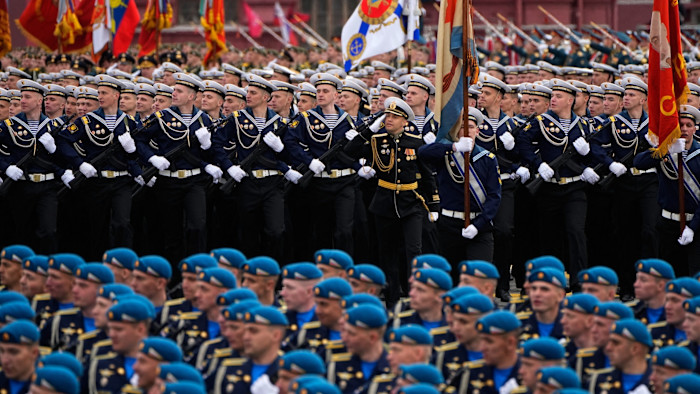
Such colourful celebrations now seem surreal. I left the country in 2022. Amid heightened fears of Ukrainian attacks, the Victory Day display this year involved few guests and lasted just 45 minutes. Moscow was under tight security, with internet services shut down across the city. Putin spoke of the war in the present as well as the past. “Victory has always been and will be ours,” he said at the diminished parade on Red Square.
It was a stark difference to the Victory Days of my childhood. The first I can remember was when I was four. The minute of silence commemorating those who fell in battle was about to begin and I was running around our flat in the grey panel-block apartment building shushing people. Then it began: the radio broadcasting the metronome for 60 seconds. My family was silent, clearly amused by my eagerness.
This was the early 1990s and Russia was in disarray. The Soviet Union had collapsed and so had its ideology. Religion barely existed. On other public holidays my family would simply sit around a table or play games. But Victory Day offered structure, ritual and meaning. In my hometown of Voronezh, everyone came together, the whole place feeling alive and smelling of lilac.
This was partly because almost every family — whether dissidents, national minorities or the Soviet nomenklatura — had someone who fought in the war. My own great-grandfather, Grigory, served as an infantryman, marching from Siberia to Norway. For Russia, where so many historical narratives have been rewritten, it offered a rare sense of continuity.
It was also one of the few collective memories that felt unquestionable (especially since the Molotov-Ribbentrop pact and what Soviet soldiers did in Germany after the victory were not discussed). For me, the lore of Victory Day was everything good prevailing over everything evil despite overwhelming odds. As children, we learned about the girls our age who refused to bend under Nazi torture and the boys who protected their comrades by throwing themselves on to machine guns. We would ask ourselves: would we have held up under such pressure? Would we break if captured?

When did memory start turning into martyrdom? For a long time, the official aspects of Victory Day celebrations were anchored in the past, a residual Soviet formality. But by my final years at school, the annual celebrations had already taken on a harsher, more compulsory tone. New emblems appeared, including the black and orange St George ribbon. Originally associated with military honours in Imperial Russia, it became a symbol of Russian nationalism, support for the Kremlin and the war in Ukraine.
By the early 2010s, when I was at university, the idea of war was being presented not as Russia’s past but as its future. The slogan “Never again” had morphed into the chilling “We can do it again”. The opposition referred to this obsession as pobedobesiye, or victory mania.
When Putin, announcing the full-scale invasion of Ukraine in 2022, connected it to the Great Patriotic War and cast Ukrainians as Nazis, few Russians were surprised. One of the few emotional bonds in Russian society was being used to lend moral legitimacy to a new war.
Now, Russians can face criminal prosecution for “offending veterans” or “denying genocide of the Soviet people”. Modern war memorials resemble temples to militarism. Victory Day is no longer simply a day of remembrance. Some in the country support this, others are shocked. For Russians, it has become one more point of division.
[email protected]
