


Stay informed with free updates
Simply sign up to the Russian politics myFT Digest — delivered directly to your inbox.
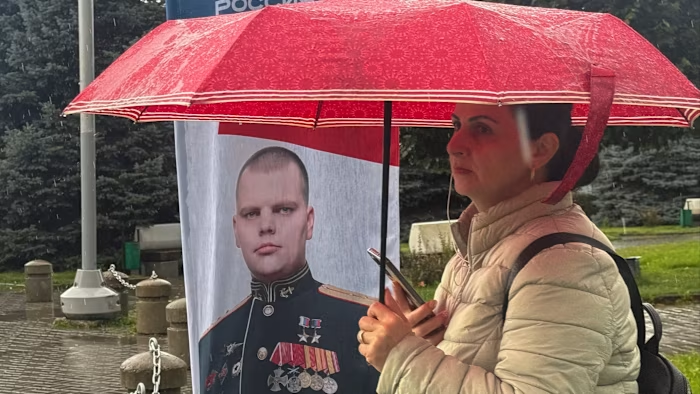
Nearly 50 veterans of Vladimir Putin’s full-scale invasion of Ukraine will enter Russia’s parliament after the Kremlin’s leading party secured its best-ever result in last week’s elections.
United Russia, which is backed by the Russian president and was set to capture about 58 per cent of the vote, will field 49 Ukraine war veterans in the Duma, the lower house of parliament, according to the party’s general secretary Vladimir Yakushev.
The heavy presence of veterans, who previously served in units that Ukraine has accused of war crimes, is part of the Kremlin’s attempt to rally public support for the invasion more than four and a half years since Putin ordered it in 2022. Last week’s parliamentary elections were the first since the start of the war.
More than 100 veterans have graduated from Time of Heroes, a Kremlin-run programme modelled on western-style public policy schools, where former soldiers are given crash courses in matters of state before being awarded mid-ranking positions in ministries, state companies and regional governments.
But the Kremlin has taken care to stage-manage their emergence as a political force amid broader worries about how to reintegrate the hundreds of thousands of men currently serving in Ukraine into society once the war finally ends.
By promoting the veterans as what Putin has called the “new elite”, analysts say Russia wants to strengthen the war’s legitimacy while retaining control over the political process.
Doing so has become an even higher priority for the Kremlin as support for the war has slipped in recent months. Ukraine’s intensifying drone strikes, a struggling economy and widespread internet blackouts have brought the war’s consequences home to more Russians in major cities.
The Kremlin responded by tying Putin more directly to United Russia, a step it had previously eschewed to avoid saddling him with its poor approval ratings.
Russia’s Supreme Court struck Yabloko — the only party expressing so much as mild opposition to the war — from the ballot, leaving Russians to pick between puppet parties that all support the war and have fielded military candidates.
“We know where decisions are made and whose job it is to rubber-stamp them. Who cares who rubber-stamps them,” said Andrei Kolesnikov, a Moscow-based political scientist.
The veterans may be better represented in parliament than Russia’s Communist Party, which came second in the vote and is set to have about 40 seats.
It remains unclear how many veterans of the approximately 200 who stood will actually enter parliament. Yakushev initially said United Russia would seat 86 war veterans before the party issued a correction and said on Monday only 49 would take their seats.
Mikhail Komin, a political scientist and fellow at the Center for European Policy Analysis, said experience from lower-level elections suggests voters are not particularly eager to back veteran candidates. Former soldiers enjoyed an electoral boost over other candidates only in places where United Russia was able to exert pressure on voters, he suggested.
“The state probably sees how the public is reacting, and they are on the lists not because they improve the party’s electoral prospects, but because this is a way of delivering on Putin’s call to turn war veterans into a new elite,” Komin said.
The full number of veterans in parliament will be clear later this week after the parties decide which people on their party lists will actually take up their seats, Komin added.
United Russia’s list was headed up by foreign minister Sergei Lavrov and Moscow’s mayor Sergei Sobyanin, whose far more senior posts gave the party a boost through name recognition. Candidates like them are likely to give way, potentially increasing the number of veterans in parliament, Komin said.
Russia’s existing elite, however, has shown that it may not be eager to surrender control to a new generation of war veterans. While the veterans elected do include former soldiers awarded the Hero of Russia, the country’s highest state honour, some existing lawmakers have also positioned themselves as combatants without much evidence.
Vitaly Milonov, a longtime United Russia lawmaker from St Petersburg, has said he volunteered for an army artillery unit in September 2022, killed several Ukrainians, and was promoted to lieutenant. During that time, Milonov regularly gave interviews in the Russian media and participated in parliamentary debates, leading some commentators to accuse him of treating army service as a public relations stunt.
The stream of veterans earmarked for roles in other government posts through the Time of Heroes programme has also stalled. Almost 90 per cent of the regions participating in the programme have not taken on new participants for a year or more, according to independent news site Agentstvo.
“These contradictions could start to show themselves more fully after the war, when those who return from the front start jockeying for position with civilian officials,” Kolesnikov said. “Who’ll win? It’ll be a hard-fought draw.”
