

Close Menu

    Subscribe to Updates

    Get the latest creative news from FooBar about art, design and business.

    What's Hot

    Trump signals he could send details of Iran deal to Congress

    June 16, 2026

    France’s spy agency replaces Palantir with local rival

    June 16, 2026

    How Carvana’s expansion to new vehicles could reshape the U.S. market

    June 16, 2026
    Facebook X (Twitter) Instagram
    Addison Markets
    • Home
    • USA
    • Europe
    • Business
    • Investing
    • Tech
    • Politics
    • Contact Us
    Addison Markets
    Home»Tech»The US space enterprise is desperately waiting for Starship—will it finally deliver?
    Tech

    The US space enterprise is desperately waiting for Starship—will it finally deliver?

    franperez66q@protonmail.comBy franperez66q@protonmail.comMay 18, 2026No Comments2 Mins Read
    Facebook Twitter Pinterest Telegram LinkedIn Tumblr WhatsApp Email
    Share
    Facebook Twitter LinkedIn Pinterest Telegram Email


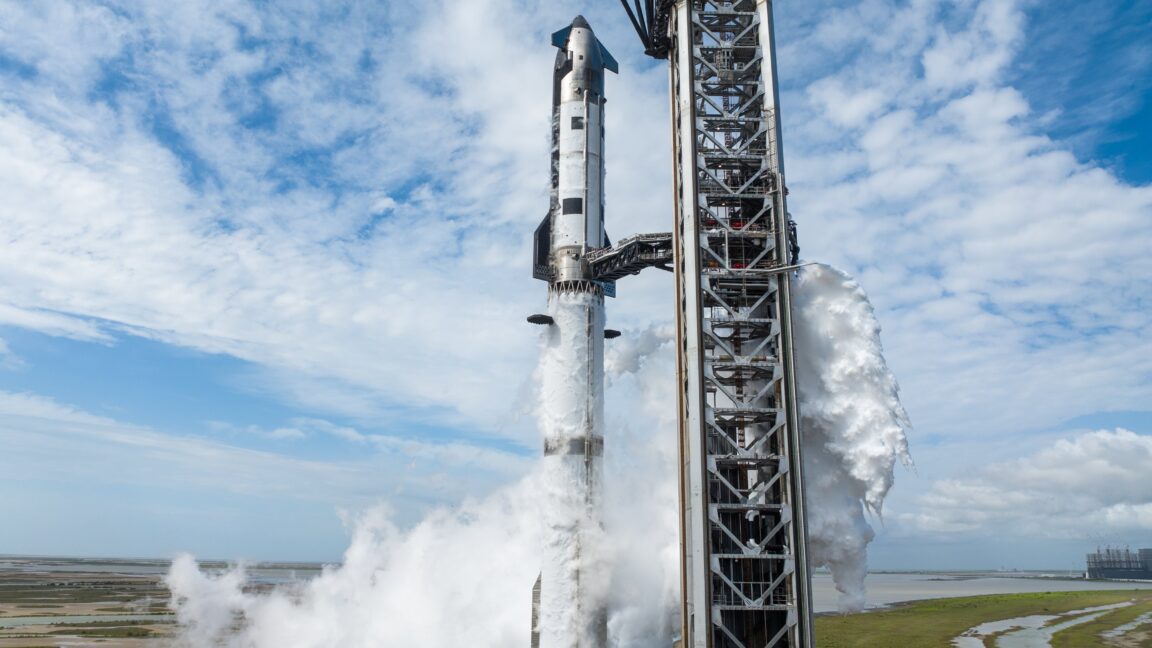
    In early February, the next V3 booster successfully passed pressure testing. After it was moved to the launch pad, SpaceX planned to ignite 10 engines up to full power. But just after ignition, due to an automatic abort from the ground systems, a hard shutdown was commanded. This ended up damaging half of the Raptors.

    Then, in mid-April, the company moved this booster with a full complement of 33 engines to the launch pad for another static fire test. This time, a ground-side sensor reported an issue with pressure in the manifolds, which distribute propellant to the vehicle. This may have been a spurious reading, but it ended the test early, just 1.88 seconds after ignition.

    The company finally completed a successful, full-duration static fire test in early May.

    “This is such a wild ride,” said Jenna Lowe, senior manager of Starship operations, in the new video. “The highs are high. The lows are low.”

    The new rocket

    In many ways, this is a brand new rocket. It incorporates hundreds of lessons learned from V1 and V2 of the vehicle and seeks to improve overall performance, reliability, and robustness. This is the vehicle that should hopefully allow SpaceX to start deploying large Starlink satellites into orbit and demonstrate in-space refueling that is critical for NASA’s Artemis Moon goals.

    For the booster stage, the changes begin at the bottom and continue all the way to the top.

    SpaceX says that for this third version of the Raptor rocket engine, it has reduced the mass to 1,525 kg from 1,630 kg and that overall vehicle-level mass savings are nearly 1 ton per engine through simplification of the engine itself, vehicle-side commodities, and supporting hardware. The entire fuel transfer system has been redesigned. This should be more reliable and will allow simultaneous startup of all Raptors.


    Source link

    Share. Facebook Twitter Pinterest LinkedIn Tumblr Email
    franperez66q@protonmail.com
    • Website

    Related Posts

    SpaceX to acquire the AI coding startup Cursor for $60 billion

    June 16, 2026

    Critical Copilot vulnerability allowed hackers to seal 2FA code from users

    June 16, 2026

    Commodore’s newest gadget is a flip phone that blocks social media and browsers

    June 16, 2026

    Who is Gwynne Shotwell, Elon Musk’s second-in-command at SpaceX?

    June 16, 2026

    SpaceX gains 9% in premarket trading as momentum builds

    June 16, 2026

    Qualcomm working on 40 new AI device designs

    June 16, 2026
    Leave A Reply Cancel Reply

    Top Reviews
    Editors Picks

    Trump signals he could send details of Iran deal to Congress

    June 16, 2026

    France’s spy agency replaces Palantir with local rival

    June 16, 2026

    How Carvana’s expansion to new vehicles could reshape the U.S. market

    June 16, 2026

    Laser Photonics stock surges on data center equipment order

    June 16, 2026
    © 2026 All right reserved
    • Privacy Policy
    • Terms & Conditions

    Type above and press Enter to search. Press Esc to cancel.