
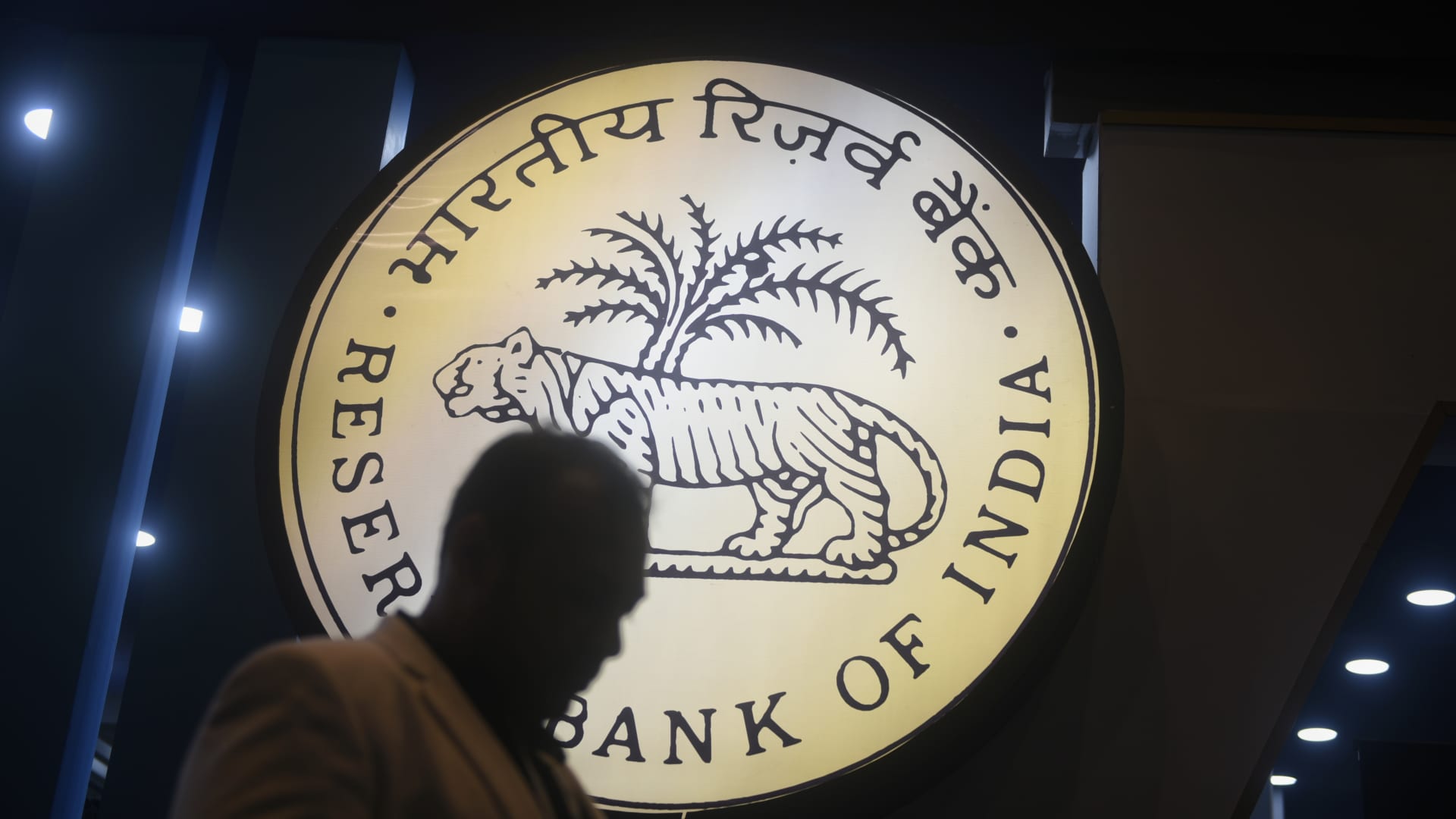
People walk past Reserve Bank of India signage in front of an installation stall at Global Fintech Fest in Mumbai, India, on Aug. 28, 2024.
Indranil Aditya | Nurphoto | Getty Images
India’s central bank may defy expectations that it will leave its benchmark interest rate unchanged during its monetary policy decision meeting on Friday.
The majority of economists polled by CNBC expect the Reserve Bank of India to keep rates unchanged at 5.25% while signaling a rate hike may only occur towards the end of the year.
A minority expect policymakers to act at this week’s meeting in a bid to anchor the rupee, which has depreciated to record lows against the dollar.
CNBC conducted a poll of nine economists over the past week, in the run-up to the RBI policy decision.
But it is “more logical,” for India’s central bank to chart a different course and raise interest rates, said Venugopal Garre, managing director and head of India research at Bernstein, speaking on CNBC’s Inside India on Tuesday.
A rate hike will align India with “how global rates have moved in the more recent weeks,” and could contain outflows at a time when “currency depreciation has been the biggest pain point for policy makers,” he added.
India’s regional peers have acted — some going beyond expectations — to get ahead of the inflation curve.
Like India, Indonesia has been wrestling with a falling currency, and on May 20, the country’s central bank raised its policy interest rates by a larger-than-expected 50 basis points. Sri Lanka’s central bank on May 26 raised its policy rate by 100 bps, the biggest hike in four years.
The Indian currency has been under pressure from its rising import bill and sustained capital outflows, even prompting Prime Minister Narendra Modi to appeal to citizens to help conserve foreign exchange.
Policymakers have also taken action to defend the embattled rupee, including selling dollars through state-run banks to stem its slide, according to a Reuters report. The government has also raised duties to curb demand for gold, a move aimed at conserving foreign exchange.
The rupee continues to be among the most fragile currencies in Asia, even though it has climbed off record lows and come close to the psychologically important 100 against the dollar.
US Dollar/Indian Rupee FX Spot Rate
Referring to the exchange rate volatility, the Governor of the RBI Sanjay Malhotra said the central bank will do “whatever is required to ensure orderly price discovery in the forex market,” in an interview on news website Mint on May 25.
Though Malhotra didn’t explicitly say a rate hike was under consideration, his remarks suggested he was preparing currency and bond markets for bolder action with all options on the table.
Inflation concerns
Another factor that could push the RBI in favour of a rate cut is the risk of higher inflation.
Although India’s inflation rate remains below the RBI’s mandated 4%, some economists believe combined inflation pressures from higher energy costs, the weaker currency, and weather-related crop shortages could force the RBI to take pre-emptive action.
There are emerging risks to the inflation trajectory ahead due to the “pass-through of higher energy costs to retail consumers” and “any weather-related disruptions due to El Nino this year,” said Sakshi Gupta, Principal Economist at HDFC Bank.
In April, despite the government keeping prices at the pump steady, India’s consumer price inflation had risen for the sixth straight month to 3.48%.
But over the past fortnight, the government has undertaken several fuel price hikes, which could lead to a sharper rise in inflation.
The cumulative fuel price hikes of 7.5 rupees per liter ($0.08) exceeded Citi’s base assumptions of 5 rupees, leading the brokerage to raise its average inflation forecast for the financial year ending March 2027 to 4.9% from 4.6% earlier.
“We still expect the June MPC to keep rates on hold,” the brokerage said in a report on Saturday, referring to the central bank’s Monetary Policy Committee, but added that it anticipates two hikes of 25 basis points each in August and October.
Fuel, fertilizer, food
Unfavorable El Niño forecasts could compel the RBI to raise inflation projections and hike the interest rate sooner rather than later. El Niño refers to the warming of the sea surface temperature, which occurs naturally every few years. At its April meeting, the Reserve Bank of India warned that El Niño could be a threat to inflation.
Those forecasts are now looking starker.
“El Niño is arriving on our doorstep in the coming months with 90% certainty,” António Guterres, secretary-general of the United Nations, said in a statement Tuesday. He added that the world needs to treat this as an “urgent climate warning,” and warned that the “impacts will hit harder.”
Meteorologists have lowered expectations for this year’s Indian monsoon, projecting rainfall at 90% of the long-period average, as per multiple local media reports.
That’s weaker than the 92% estimate issued in April and would mark the poorest monsoon performance in 11 years. India is already in the grip of a severe heatwave, and nearly 60% of its farming relies on rainfall.
Food inflation, a key constituent of India’s consumer price index, was up 4.2% in April from 3.87% in March.
Adding to its food production woes, the U.N.’s Food and Agriculture Organization Chief Economist Maximo Torero said India faces fertilizer shortages ahead of the critical Kharif sowing season in India.
“If the crisis (Gulf conflicts and below normal monsoon) persists, India faces higher import costs, reduced domestic fertilizer availability, and pressure on food inflation, particularly for wheat, rice, and vegetables,” he said in a report published on the news agency website ANI on April 22.
