
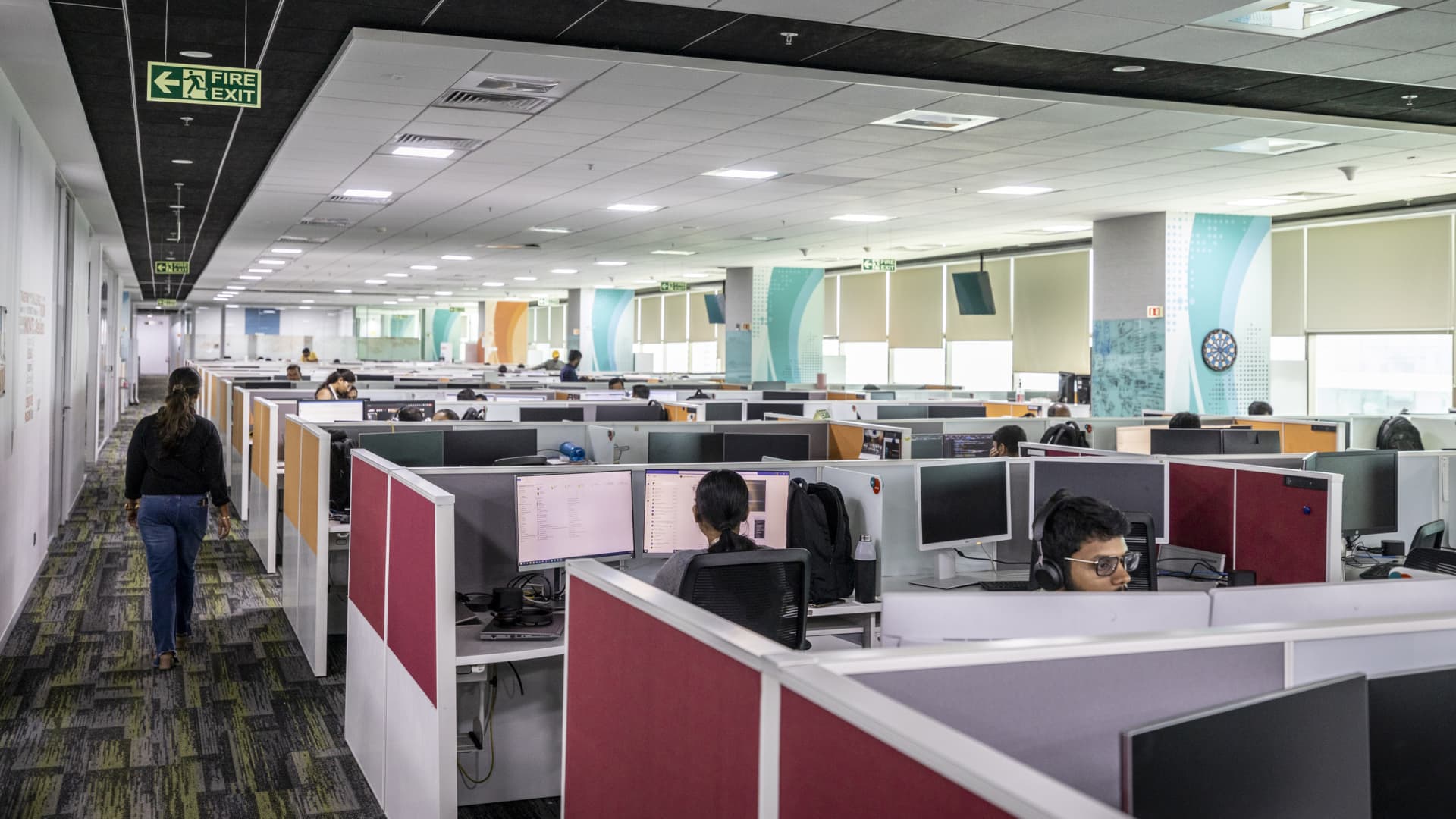
Workers at the Siemens Healthineers AG global capability center (GCC) in Bengaluru, India, on Thursday, on April 27, 2023. Global capability centers have evolved far beyond tech support, but their growth presents challenges for multinationals and Indian cities alike. Photographer: Aparna Jayakumar/Bloomberg via Getty Images
Bloomberg | Bloomberg | Getty Images
Workers around the world are using artificial intelligence, and commonly putting in unpaid time. But many still feel uneasy about their jobs and are not engaged in the workplace.
These are just some of the findings from the People at Work 2026 report by payroll and human resources services provider ADP — which surveyed more than 39,000 adult workers across 36 markets in 2025.
Workers feel job-insecure
Even with global unemployment at historically low levels, workers don’t think their jobs are safe.
Only 22% of workers globally strongly agreed that their job was safe from being eliminated, ADP found.
No market in the survey had a majority of workers who felt confident their jobs were safe, either. Nigeria had the highest share of workers who felt secure, at 38%, while Japan had the lowest at 5%.
In the U.S., just 28% felt safe, while in the U.K. only 25% shared the same sentiment.
Unpaid work is common
Most workers also say they are giving employers time they are not paid for.
ADP found that 62% of workers worldwide said they work up to five unpaid hours each week. Another 26% reported six to 15 unpaid hours, while 12% said they work 16 or more unpaid hours per week.
Unpaid work was especially common among managers and senior leaders. Half of upper managers and C-suite executives said they put in at least six unpaid hours a week, and 20% said they worked 16 or more unpaid hours, the data showed.
That extra effort may look like commitment, but ADP warns it can come with trade-offs.
Workers putting in the most unpaid hours were often highly engaged and likely to find meaning in their jobs.
On the other hand, they were also more likely to report feeling less productive, less likely to be thriving and more likely to be looking for another job.
Workers who use AI are less stressed, but feel less productive
Since 2022, AI tools such as ChatGPT have found their way into the workplace, promising increased productivity to workers. However, ADP’s survey found daily users of AI were four times more likely than nonusers to say they were less productive than they could be.
“It’s possible that the more people use AI to get their work done, the more it feels like they’ve accomplished less than they might have,” ADP wrote.
But it’s not all negative for these users of AI. Workers who reported using AI frequently showed higher engagement, less stress and were more positive about their teammates, the survey showed.
“What matters even more is feeling that you are on the best team. The more people use AI, the more likely they were to report being on the best team,” ADP said.
Among people who use AI tools every day, 30% were fully engaged at work. But for workers who never use AI, engagement was only 14%.
Engagement a major challenge
Employee engagement has improved since the pandemic, but it remains low. Only 19% of workers worldwide were fully engaged in 2025, ADP found. Though engagement varied widely by market. Brazil had the highest rate at 29%, while China had the lowest at 11%.
By region, engagement was highest in the Middle East and Africa at 25%, and lowest in Asia-Pacific, at 15%.
ADP said employers can move the needle by investing in skills, building trust, helping workers find purpose and reducing stress.
The skills connection was especially strong: Among workers who strongly agreed their employer was investing in them, 53% were fully engaged. Where that support was lacking, only 12% were fully engaged.
“Workers who find meaning in their jobs are 12.5 times more likely to be fully engaged than workers who don’t. This could be as simple as asking people where they find purpose and giving them opportunities that align,” ADP also added.
