


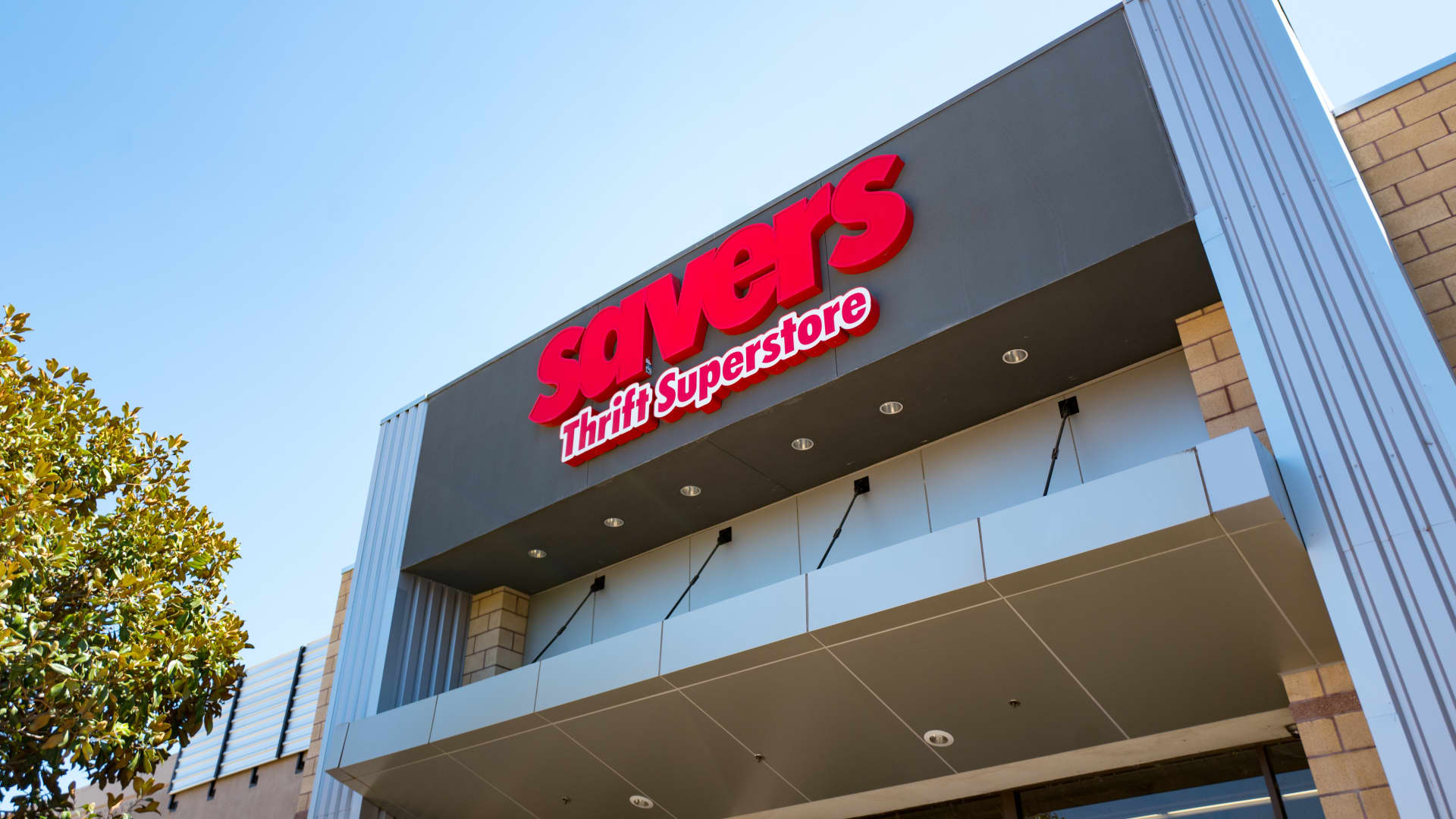
Savers Value Village is launching a new platform leveraging artificial intelligence to help optimize product pricing, the company told CNBC exclusively, as the tricky-to-price thrift segment gains traction around the world.
The new platform, called ThriftIQ, uses AI to reduce the work needed to price items across the men’s and women’s apparel assortment and bring more consistency.
“We’re getting clear sell-throughs, larger baskets, it’s helping our new stores ramp more favorably, and obviously there is the profitability improvements,” CEO Mark Walsh told CNBC.
The tool has already been deployed in 58 pilot stores, according to the company, pricing more than 25 million items. That number is expected to double by the end of the year, Walsh added.
Savers, which had 375 stores at the end of the second quarter, said it processes more than 1 billion pounds of reusable goods every year. ThriftIQ was developed in partnership with data science and technology consulting firm Kaizen Analytix using Savers’ proprietary data sets, which the company has been developing for nearly two years.
“It’s not dynamic pricing, and once those garments are priced and tagged, that tag doesn’t change,” Walsh said.
The company’s goal with the new AI tool is to bring more predictable pricing for customers while also keeping average prices the same or lower, remaining between roughly 40% and 70% below traditional retail prices.
Savers said ThriftIQ marks the latest step in the company’s broader strategy to modernize and enhance its business operations. It will deploy the platform across more of its U.S. and Canadian locations through early 2028.
Walsh said the tool is not meant to get rid of manual labor in stores, but rather make workers more productive.
“Savers is transforming thrift through innovation, and I couldn’t be more excited about the trajectory of the business,” he said.
The tool comes at a time when secondhand retail and thrift are seeing a surge, especially with the macroeconomic backdrop of higher inflation, lower consumer confidence and more price-conscious buyers.
“We are benefiting from some very powerful secular momentum in this space. Thrift has gone, and is continuing to go, mainstream in retail, and so we see that in the younger customers, in the more affluent customers, for example, that are adopting thrift,” Chief Financial Officer Michael Maher told CNBC. “But I think in addition to that, we are bringing investment, technology, innovation and execution to that.”
Savers also reported its second-quarter earnings on Thursday, seeing a 7.4% increase in total net sales, which came in at $448.2 million. Comparable store sales increased 4.4%.
Savers reported net income of $21.6 million, or 14 cents per share, for the quarter, versus $18.9 million, or 12 cents per share, in the prior-year period.
Maher also said the company saw its third consecutive quarter of year-over-year growth in earnings before interest, taxes, depreciation and amortization.
The company incorporated the impact of ThriftIQ into its updated 2026 guidance, saying that it expects to return to a “high-teens adjusted EBITDA margin within the next three years.”
“This is just the latest chapter of transformative innovation,” Maher told CNBC. “It is a core plank of our long-term strategic plan, and yes, we’re constantly looking at innovation.”
