

Close Menu

    Subscribe to Updates

    Get the latest creative news from FooBar about art, design and business.

    What's Hot

    Trump-Zelenskyy meeting: U.S. says Russia lost control of diesel oil

    September 22, 2026

    Putin’s ‘war heroes’ form new political elite in Russian parliament

    September 22, 2026

    Novo CEO signals M&A opportunities to strengthen drug pipeline

    September 22, 2026
    Facebook X (Twitter) Instagram
    Addison Markets Addison Markets
    • Home
    • USA
    • Europe
    • Business
    • Investing
    • Tech
    • Politics
    • Contact Us
    Addison Markets Addison Markets
    Home»Tech»Theban tomb reveals how Egyptian burial trends evolved in time
    Tech

    Theban tomb reveals how Egyptian burial trends evolved in time

    franperez66q@protonmail.comBy franperez66q@protonmail.comAugust 18, 2026No Comments2 Mins Read
    Facebook Twitter Pinterest Telegram LinkedIn Tumblr WhatsApp Email
    Share
    Facebook Twitter LinkedIn Pinterest Telegram Email


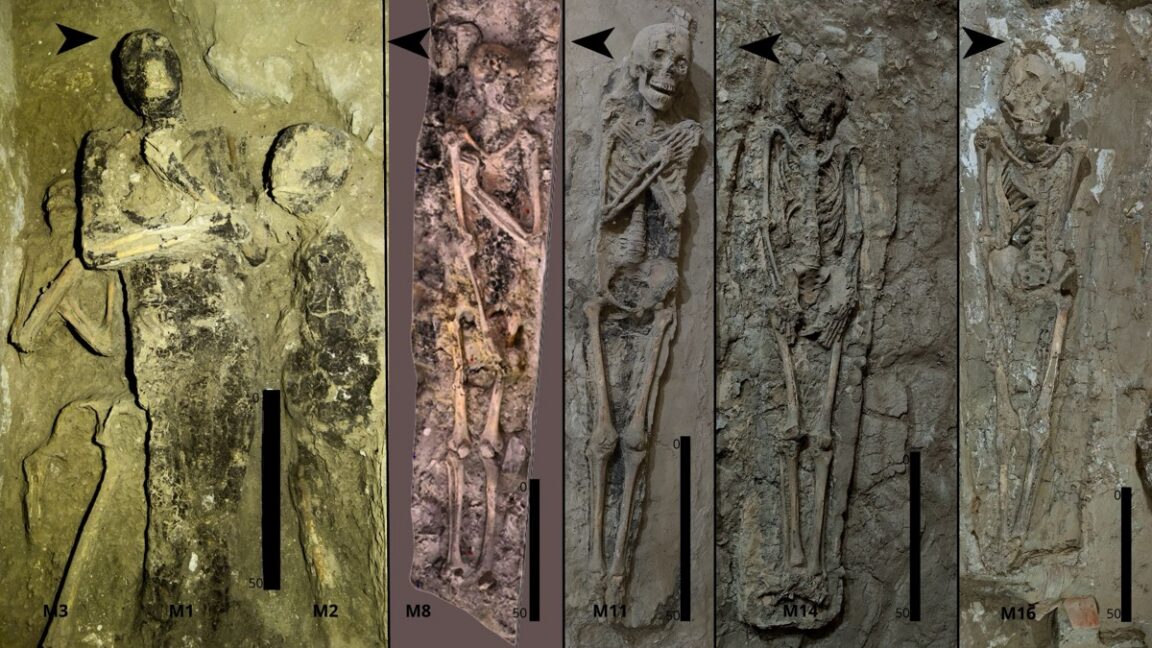
    “The earliest individuals buried here appear to have been of high social standing, as they were interred in coffins, with funerary nets and amulets, and with an assemblage containing costly items, such as the contents held in Phoenician amphorae, a large number of which were found alongside them,” said co-author Miguel Ángel Molinero Polo, also from the University of La Laguna. “The bodies buried in vertical superposition did not have coffins but were carefully mummified. They also can be associated with upright jars that point to a specific ritual not found in the earlier phases of the tomb’s use.”

    There was also evidence in some chambers of substantial reworking in the form of accumulated silts, sands, gravels, limestone blocks, plaster, ceramics, and other displaced materials—some due to human intervention, some possibly due to flooding. And one chamber—the one with the fragmented remains of four people—may have experienced a fire, since the remains had clearly been damaged by excessive heat (as high as 550° Celsius, or 1,022° F), particularly the crania and lower limbs.

    “Overall, [this site] can be understood as a funerary space with an accumulative biography, in which reuse did not simply involve the addition of burials, but the progressive transformation of the organization, materiality, and meaning of the space itself,” the authors concluded. “Rather than acting as a passive container, the chamber can be interpreted as a dynamic mortuary environment where bodies, objects, sediments, and architectural constraints shaped the material construction of funerary continuity over time.”

    Frontiers in Environmental Archaeology, 2026. DOI: 10.3389/fearc.2026.1888379  (About DOIs).


    Source link

    Share. Facebook Twitter Pinterest LinkedIn Tumblr Email
    franperez66q@protonmail.com
    • Website

    Related Posts

    Ukrainian drones overwhelm Russian tanks’ new active protection system—for now

    August 19, 2026

    Jim Cramer says the market is too negative — and that’s creating buying opportunities

    August 19, 2026

    “Sabotage”: Experts, lawmakers blast RFK Jr. for destroying healthcare research

    August 18, 2026

    OpenAI rolls out ChatGPT for Teens with more safety protections

    August 18, 2026

    Against all odds, SpaceX finally tugs Starship into port after 24 days at sea

    August 18, 2026

    Economists warn AI-driven market rally is due a sharp correction

    August 18, 2026
    Leave A Reply Cancel Reply

    Top Reviews
    Editors Picks

    Trump-Zelenskyy meeting: U.S. says Russia lost control of diesel oil

    September 22, 2026

    Putin’s ‘war heroes’ form new political elite in Russian parliament

    September 22, 2026

    Novo CEO signals M&A opportunities to strengthen drug pipeline

    September 22, 2026

    London’s schools are running out of children

    September 22, 2026
    © 2026 All right reserved
    • Privacy Policy
    • Terms & Conditions

    Type above and press Enter to search. Press Esc to cancel.